
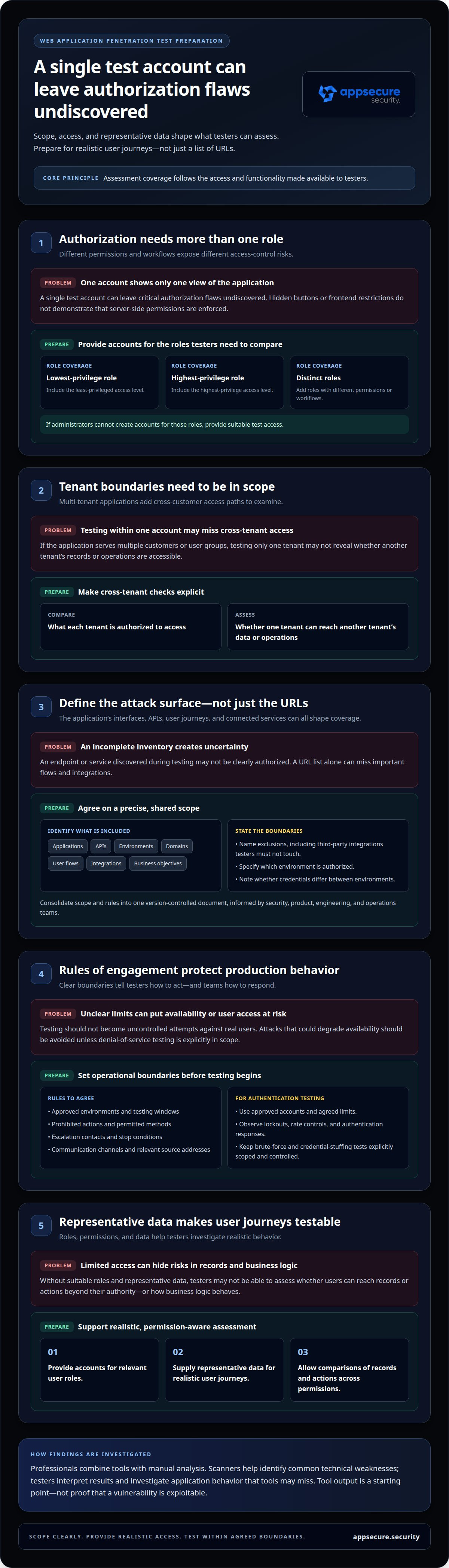
A single test account can leave critical authorization flaws undiscovered. Preparing for a web application pentest means defining the application’s scope and rules, then providing accounts and representative data that let testers assess realistic user journeys. A pentest simulates a cyberattack to identify exploitable vulnerabilities, but its coverage depends on the access and functionality available to testers.
Preparation involves more than listing URLs. The right user roles, permissions, and data help reveal whether users can access records or actions beyond their authority, and whether business logic can be abused.
This guide explains what a web application penetration test covers and how scope, rules of engagement, account access, and representative data shape the assessment. You’ll learn what information to provide, which boundaries to agree on, and why multiple roles matter, especially in multi-tenant applications. Clear preparation helps testers assess risk accurately and focus on the systems and behaviors that matter to your business.
Key Takeaways
- Define the application, APIs, environments, business objectives, and exclusions before testing begins.
- Agree on rules of engagement that set clear boundaries and help protect production availability.
- Expect professionals to combine testing tools with manual analysis to investigate application behavior and uncover exploitable weaknesses.
- Provide accounts for relevant user roles and representative data so testers can assess access controls and business logic.
- Include tenant boundaries and cross-role access in scope when the application serves multiple customers or user groups.
What Is a Web Application Penetration Test?
A web application penetration test is a time-bound assessment that simulates a cyberattack to identify exploitable vulnerabilities. Testers examine the application’s interfaces, APIs, user journeys, and connected services, not just individual pages. The result is a snapshot of security at the time of testing, not a permanent guarantee. Preparing for a web application pentest means defining access and boundaries so the assessment can examine realistic risks.
Security professionals combine tools with manual investigation. A proxy tool can intercept application traffic, change a request, and reveal how the application handles altered inputs. Scanners help identify common technical weaknesses across discovered URLs, while testers interpret the results and investigate behavior a scanner may miss. For example, custom error pages may require scanner configuration so their responses are recognized correctly. Tool output is a starting point, not proof that a vulnerability is exploitable.
Coverage follows the application’s attack surface. Testers may map domains, subdomains, URLs, APIs, technologies, user flows, and integrations. If an API supports account changes, for example, its authentication, authorization, and data handling need examination alongside the frontend. The test may also include connected infrastructure when it forms part of the agreed scope. Testing cadence and assessment coverage affect how teams use findings as their application changes.
Authorization testing requires manual reasoning. A tester compares what different roles can do, then changes identifiers or request parameters to see whether one user can access another user’s records. A standard user might try to access an administrator-only function or view another account’s data. The tester checks that server-side controls enforce permissions, rather than relying on hidden buttons or frontend restrictions.
Privilege coverage matters. Testers assess the highest- and lowest-privilege roles, along with other roles that represent distinct permissions or workflows. If administrators cannot create accounts for those roles, the organization provides suitable test access. In a multi-tenant application, testers examine whether one tenant can access another tenant’s data or operations.
Brute-force and credential-stuffing tests assess password defenses, but require explicit scope and controlled execution. Testers use approved accounts and agreed limits, then observe lockouts, rate controls, and authentication responses. Testing should not become uncontrolled attempts against real users. This approach can expose weaknesses without needlessly disrupting access.
Testing can uncover exploitable flaws, inform remediation, and support some security-audit compliance requirements, including PCI DSS and SOC 2. A report should describe each finding, its impact, evidence, and relevant risk context, which may map vulnerabilities to CVSS and OWASP. Fixes are verified through remediation testing: testers retest the affected behavior and check whether the change works or can be bypassed. When organizations need assistance hardening systems and managing their broader technical infrastructure after testing, IT solution providers such as distemicha.com can support ongoing remediation and operational requirements.
Teams should also record findings and track remediation progress, as recommended by the National Institute of Standards and Technology (NIST).
Penetration Test Contracts and Rules of Engagement
A clear agreement defines what the penetration test may examine, how testers can act, and who responds if production behavior changes. Scope should reflect the application’s size, structure, access controls, data flows, and business logic.
Safe Exploitation and Production Controls
Safe exploitation means validating a weakness without unnecessarily disrupting the live application. The rules of engagement should define prohibited actions, approved environments, testing windows, escalation contacts, and stop conditions. For example, testers should avoid attacks that could degrade availability unless denial-of-service testing is explicitly in scope. Clear boundaries let teams investigate genuine risk while protecting critical user journeys and development operations.
Test Duration
A web application penetration test has no universal duration. Its schedule depends on application size and structure, the number of in-scope interfaces, the authorization model, data access, and business logic. A simple application with clear access paths requires a different effort from a complex system with multiple integrations and roles. The agreed scope and depth of testing determine the schedule, so define them before setting delivery milestones.
The contract should identify each application, API, environment, and domain included in the assessment. It should also name exclusions, such as production functions or third-party integrations testers must not touch. A precise inventory prevents uncertainty when an endpoint or service appears during discovery. For an application spanning development and production, state which environment is authorized and whether credentials differ.
Rules of engagement turn those boundaries into operational instructions. They should establish permitted testing methods, source addresses where relevant, communication channels, and contacts authorized to pause activity. During targeted testing, testers and security personnel keep each other informed about their actions. If an unusual error rate or user impact appears, the response path must be clear before testing begins.
Build the scope through focused collaboration. Security teams bring risk priorities and exclusions; product teams explain critical workflows; engineering maps services and integrations; operations identifies production sensitivities. Consolidate these inputs into one version-controlled scope and rules document. This gives testers a reliable reference when application behavior differs from diagrams or documentation.
Vulnerability evidence and reports require careful handling. The National Institute of Standards and Technology advises that system vulnerability information be collected, stored, and transmitted securely when necessary. Define approved recipients and a secure delivery method in the engagement documents. If your team needs help translating application boundaries into test rules, discuss the testing scope.
Why Is Penetration Testing Important?
Penetration testing is useful when an enterprise needs evidence of how attackers could reach valuable functions or data. A defined objective turns a broad security exercise into a focused assessment. For example, a payment team may prioritize transaction integrity, while a customer platform team may focus on account access. The findings then connect application security work to specific business exposure.
Scope should name every application, API, and environment testers may assess. It should also identify business objectives, such as testing access to sensitive records or examining account recovery. A completed questionnaire followed by discussion helps reveal architecture, workflows, integrations, and operational concerns. Teams should also state specific concerns and excluded areas so authorized testing stays aligned with business priorities.
A practical scope records boundaries in clear, testable terms:
- Assets: Identify the application, API endpoints, domains, and environments included.
- Objectives: Connect each target to a risk, such as unauthorized access to customer data.
- Boundaries: Name excluded functions, integrations, or actions that could affect availability.
- Access: Describe the user roles and workflows testers can exercise.
These details help testers distinguish authorized targets from adjacent systems. If an application calls a separate API or mail service, teams should decide whether that dependency is in scope. The same applies to cloud storage linked to application workflows. A defined boundary lets testers investigate realistic attack paths without treating every connected asset as permission to test.
Scope verification confirms that the written targets match the live assessment environment. Before testing, the responsible teams compare the approved inventory with current domains, API names, and environment labels. They resolve discrepancies, such as a staging endpoint redirecting to production, before testing proceeds. During the assessment, newly discovered assets are leads for clarification, not automatic authorization. This protects systems and keeps findings tied to approved targets.
Business objectives also shape how results support risk decisions. A team focused on account abuse needs evidence about access paths and affected functions; a team focused on service availability needs clear operational boundaries. Penetration testing can support some security-audit compliance requirements, including PCI DSS and SOC 2. A PCI DSS penetration testing assessment still depends on a scope matched to the relevant systems and objectives.
Clear scoping makes the final report more actionable. Each finding can be connected to an approved asset, business workflow, and stated objective. That context helps security and development teams prioritize fixes based on impact, rather than treating every technical observation as equally urgent. It also gives enterprise leaders a clear view of what the test examined, what remained out of scope, and where further assessment may be warranted.
Common Web Application Vulnerability Categories
Penetration tests look for weaknesses attackers could exploit across application inputs, identities, workflows, and connected APIs. A single flaw can expose sensitive records, bypass privilege boundaries, or alter a business transaction. Security testing is more useful when testers connect each weakness to a realistic threat path, rather than treating scan results as isolated alerts.
Threat modeling helps testers decide where to investigate. They map entry points such as login forms, file uploads, API endpoints, and account recovery flows. Then they identify trust boundaries, valuable data, and actions available to each user role. For example, a checkout flow may accept customer input, call an API, and update an order database. Each transition creates an opportunity to test validation and access controls.
Common categories include:
- Injection: Testers examine whether unsanitized input reaches a database or command interpreter. A search field or API parameter can reveal whether input is safely handled.
- Authentication weaknesses: Testing assesses login, password reset, session handling, and account recovery. A flaw in one flow may let an attacker take over an account.
- Authorization failures: Testers alter a record identifier or request action to see whether one user can access another user’s data or restricted functions.
- Business logic flaws: A workflow may allow an action out of sequence, such as applying a benefit more than once or changing an order after approval.
- API data exposure: An endpoint may return fields the requesting role does not need, or accept changes beyond that role’s permissions.
These categories can overlap. An API authorization weakness, for example, may expose another tenant’s records through a predictable identifier. A business logic flaw can also bypass intended limits even when authentication works correctly. Testers follow the application’s actual workflows to identify these chained risks. The business logic flaws common in modern applications often require understanding how actions and rules interact.
Testers validate potential vulnerabilities carefully. They use a limited, agreed test case to determine whether an input changes application behavior, exposes data, or crosses a privilege boundary. For injection testing, that means observing the response without unnecessary data extraction. For authorization checks, testers compare permitted and denied actions across relevant roles. They stop when evidence establishes impact, rather than causing avoidable changes to records or service behavior.
A useful finding explains the affected component, the conditions needed to exploit it, the observed impact, and the evidence supporting the conclusion. That detail helps development teams identify the faulty control, such as missing server-side authorization or inadequate input handling. It also distinguishes a confirmed exploit path from a scanner alert that needs further investigation.
Providing Multiple User Accounts and Representative Data
Test coverage depends on what each account can access and what data the application contains. One administrator login cannot show whether a standard user can view another customer’s records, change restricted settings, or cross a tenant boundary. Access should reflect the roles and workflows in the live application, while test data should let assessors exercise those workflows safely.
Provide accounts for each relevant privilege level, including the highest- and lowest-privilege roles. Add roles with distinct permissions, such as support staff, finance users, or account owners. If an administrator cannot create these profiles, arrange direct access to suitable test accounts. Without those profiles, the assessment is limited to functionality visible through the account provided.
Representative data should preserve the relationships and states that make the application work. For example, a subscription system may need test tenants, user memberships, plans, invoices, and renewal states. A single empty profile cannot exercise the same flows. Use synthetic or suitably masked records where possible, and ensure they support realistic actions without exposing unnecessary personal information.
Useful account and data coverage includes:
- Role coverage: Accounts with different permissions reveal whether access checks work across user types.
- Record ownership: Separate records let assessors test whether one user can access another user’s data.
- Tenant boundaries: Accounts across tenants help test segregation in SaaS and multi-tenant applications.
- Workflow states: Records at different stages let testers examine transitions, approvals, and business rules.
- Profile options: Enabled features and account settings expose paths hidden from a restricted or incomplete profile.
During the assessment, testers compare permitted actions across accounts. A user may be able to read their own invoice but should not automatically retrieve another tenant’s invoice by changing a record identifier. Testers can also check whether a role can perform an action through an API that the interface hides. The server’s response helps establish whether authorization is enforced beyond the visible interface.
Representative data also sharpens input testing. Search, import, or profile fields can be assessed for injection behavior using safe test values. Realistic records reveal whether validation changes across workflow states or user roles. The aim is meaningful evidence, not a large volume of data. Give testers enough varied records to reproduce relevant paths, then keep account ownership and test-data boundaries clear.
Before testing starts, document each account’s role, tenant, enabled options, and intended data access. This simple mapping helps testers interpret results and report exactly which permission boundary failed. Discuss account and test-data preparation for your assessment.
AppSecure Security
AppSecure Security helps organizations protect against attackers with focused, in-depth security assessments shaped by defined scope, role access, and business objectives. Its services include fast, manual, hacker-led testing to investigate application behavior and uncover technical risks. The Agentic Penetration Testing Platform uses AI agents to scale testing across application environments. Together, these capabilities help teams assess complex user journeys, APIs, and connected application components.
Turn to AppSecure Security for professional testing, clearly defined assessment boundaries, and deeper analysis of how user roles and representative data affect coverage. Start with a clear view of the application, its critical workflows, and the access testers will need.
Contact AppSecure Security to discuss your assessment.
Move From Preparation to Testing
Use your preparation to establish a clear starting point for a professional assessment that helps protect your organization from attackers. Align the test with a release, a major change to user access, or a decision about application risk. That timing helps teams act on findings within development and security workflows.
AppSecure Security offers Web Application Penetration Testing, Mobile Application Penetration Testing, and an Agentic Penetration Testing Platform. These services help organizations uncover application security weaknesses through manual testing and AI agent-based approaches, delivering faster, in-depth pentesting at scale to help prevent attacks. Preparing for a web application pentest is most effective when the scope, business priorities, access, and test data give assessors enough context to investigate meaningful attack paths.
Bring your application context and assessment priorities into the next discussion. Contact AppSecure Security to discuss your pentest, and take the next step toward a focused assessment that helps protect your organization.
Frequently Asked Questions
1. What is included in a web application penetration test scope?
Scope identifies the exact application components and testing boundaries covered by the engagement. Include relevant domains, APIs, environments, key workflows, and connected services the organization owns or has permission to test. Also record excluded assets, such as a vendor-managed payment service. For organizations operating across India, the USA, the UK, Dubai, Canada, or Singapore, specify which business entity and systems the authorization covers.
2. How do you define rules of engagement for a web app pentest?
Document permission, permitted techniques, testing boundaries, communication channels, and conditions for pausing activity. Name the people who can report service impact and authorize a stop. Clarify how testers handle evidence, unexpected access to sensitive information, and newly discovered assets. For example, an API redirecting to a vendor system should trigger a scope discussion, not an assumption that the vendor system is included.
3. What access and test accounts should you prepare for a web application pentest?
Provide separate, working accounts for each role the assessment needs to examine, rather than sharing one administrator login. Include distinct tenant or customer profiles when those boundaries matter. Document each account’s role, enabled features, and intended environment, and provide a secure credential-delivery method. A support account and a customer account, for example, let testers compare which records and actions each identity can access.
4. What technical information should you provide pentesters before testing?
Share an architecture overview, application entry points, API documentation, authentication flows, and critical user journeys. Identify relevant integrations, environment differences, and known operational constraints, such as rate limits or scheduled maintenance. A diagram showing how a mobile client reaches an API and database can guide assessment planning. Include a technical contact who can explain unexpected responses without exposing unrelated production credentials or secrets.
5. How do you prepare staging environments, backups, and rollback plans for a pentest?
Use a staging environment that represents important production behavior, including authentication and integrations, while keeping its data appropriate for testing. Before activity begins, identify the system owner responsible for backups and the process for restoring affected data or configuration. Confirm the rollback procedure with the operations team. If testing must involve production, agree on monitoring, escalation, and recovery responsibilities before the engagement starts.
6. What legal authorization is needed before a web application penetration test?
Obtain written authorization from the organization or asset owner with authority to approve testing. The engagement documents should identify the authorized systems, environments, permitted activity, and testing period. Confirm authority for third-party hosted services or integrations before including them. For organizations operating across India, the USA, the UK, Dubai, Canada, or Singapore, ensure the relevant entities and assets are clearly covered by the agreement.
7. What production risks and service disruptions can occur during a web application pentest?
Testing may trigger account lockouts, alerts, unexpected emails, or changes to test records. Aggressive requests can also affect application availability or dependent services. Define monitoring contacts and stop conditions before production testing, and agree how testers report unexpected impact. Denial-of-service activity should remain excluded unless explicitly included in the agreed scope. Clear testing boundaries help teams control these operational risks.