
Automated scans can flag known issues, but may miss how weaknesses combine in a real attack. The benefits of hacker-led penetration testing include finding hidden vulnerabilities, validating their practical impact, and giving teams clear remediation priorities. This insight helps reduce risk before an attacker turns a technical gap into a business crisis.
Security teams need more than a list of potential flaws. They need to know which weaknesses are exploitable, what systems or data could be exposed, and where to focus remediation effort. A hands-on assessment brings an attacker’s perspective to these questions.
This article explains how hacker-led testing can find weaknesses automated tools overlook, support practical fixes, and help protect company reputation and customer loyalty. It also explores how penetration testing complements automated scanning and what to expect from the findings.
Key Takeaways
• Learn how manual testing can uncover application vulnerabilities and misconfigurations that automated scans may not reveal.
• Understand how ethical hackers simulate attacks to assess whether weaknesses could expose systems, networks, or mobile apps.
• Use validated findings and remediation guidance to prioritize fixes based on real-world risk.
• See how addressing security gaps can help protect sensitive data, company reputation, and customer trust.
• Discover how automated tools and human expertise work together to build a more complete view of security risk.
What are the key benefits of penetration testing?
Penetration testing turns potential security weaknesses into evidence teams can act on. A tester examines an application or infrastructure, attempts controlled attacks, and records which vulnerabilities are exploitable. For example, a misconfigured access control might let one user view another user’s records. Finding that path gives the organization a specific risk to investigate and fix, rather than a general warning that a system may be exposed.
Automated vulnerability scanning can quickly flag known software issues and configuration patterns across many assets. But it may not determine whether a finding creates a usable attack path in a particular environment. A human tester can examine how an application handles a sequence of actions, test the impact of an access-control flaw, and distinguish a real exposure from a false positive. Together, automated checks provide breadth, while manual testing adds context and validation.
Application testing can examine input validation, authentication, authorization, and how sensitive data moves between components. A tester might submit unexpected input to a form, then assess whether the application handles it safely. They can also test authenticated access to see whether a standard user can reach another user’s functions or information. The OWASP Top 10 provides a named reference for critical web application vulnerabilities, while a test investigates how weaknesses behave in the application being assessed.
Infrastructure analysis looks beyond individual application screens. A tester can review exposed services, network paths, software versions, and access permissions to understand how an attacker might move between systems. For example, a weakly protected service combined with excessive permissions may create greater risk than either issue alone. A useful finding describes the affected asset, how the weakness was validated, its potential impact, and recommended remediation. Teams can then prioritize fixes by exploitability, affected data, and business importance.
In the United States, penetration testing should be limited to systems the organization owns or is explicitly authorized to assess. Written authorization should define the assets, permitted testing methods, timing, and escalation contacts. Applicable federal or state requirements depend on the systems and data involved, so organizations should define the test scope and review relevant obligations before testing begins.
After testing, remediation turns findings into security improvements. Teams can correct a configuration, restrict permissions, update an affected component, or strengthen input validation, then retest the change to confirm the original attack path no longer works. For example, if an API exposes records across user accounts, the fix should address authorization at the relevant endpoint, not just hide the data in the interface. This evidence-led cycle is central to the API penetration testing process and the practical value of hacker-led assessment.
Simulated cyberattacks on systems, networks, and mobile apps
A penetration test recreates attacker behavior against agreed systems to reveal practical exposure. An ethical tester might begin with an external network, identify reachable services, then assess whether an authorized route reaches a sensitive application. The goal is to discover where security controls fail under realistic pressure, not to disrupt operations. Each test starts with a defined scope to keep activity focused on authorized assets and business priorities.
Different environments call for different attack paths. A web application test can examine login flows and account permissions, while mobile testing assesses how an app stores or transmits data. API testing traces requests between services, including whether one account can access another’s records. A tester may also assess wireless controls, cloud configurations, and network boundaries. For example, a cloud identity permission could expose data even when the public-facing application appears secure.
Simulated attacks can show whether a weakness is isolated or part of a larger chain. A tester might trace how access to one system could expose another, then document each step and its potential impact. For an API, testing can focus on authorization, data handling, and the behavior of connected endpoints. This detail helps teams distinguish an individual flaw from a broader infrastructure risk.
Protecting network uptime depends on careful scoping and controlled testing. Before active testing, the agreed plan can identify sensitive systems, restricted techniques, test windows, and escalation contacts. A tester can avoid destructive actions, use controlled requests, and pause if an unexpected service impact appears. For example, a production payment service may need a narrower approach than a staging environment. These limits help assess real exposure without treating availability as collateral damage.
After the exercise, findings should connect each simulated attack to affected assets, evidence, and practical remediation. Teams can use that record to prioritize network changes, strengthen mobile controls, or correct cloud permissions. If your organization needs to define a controlled scope across applications or infrastructure, discuss a penetration test.
Protecting company reputation and customer loyalty
A security breach can affect more than systems. If an application exposes a customer’s personal information, the organization may face incident response work, possible regulatory consequences, and difficult questions from customers. A penetration test helps teams find exploitable weaknesses before attackers use them. It cannot remove every threat, but it can give leaders evidence to reduce specific risks to critical software and sensitive data.
Financial exposure can arise in several ways. An attacker might exploit a payment application, interrupt an important service, or access data that requires investigation and response. A penetration test examines agreed systems for weaknesses that could enable such attacks. Its findings help teams prioritize fixes based on affected assets, potential data exposure, and business impact. This directs remediation toward flaws with a clear path to harm, rather than treating every software issue as equally urgent.
Customer trust depends on how an organization protects information and responds when weaknesses emerge. For example, a test may reveal that an account can access another customer’s records. Fixing the access-control flaw and validating the change demonstrates a concrete security action. Protecting the confidentiality, integrity, and availability of personally identifiable information also supports the security goals associated with data regulations, including HIPAA, PCI DSS, and GDPR.
Procurement decisions can bring security practices into customer relationships before a breach occurs. A prospective business customer may ask how a supplier tests its applications, tracks vulnerabilities, and verifies remediation. A clear report can explain the tested scope, validated findings, and completed fixes. It gives procurement and security teams specific evidence to discuss instead of broad claims that software is secure.
Compliance is another part of reputational risk. Penetration testing can help organizations identify security gaps that may affect applicable requirements. For example, PCI DSS addresses testing for relevant systems, while HIPAA and GDPR include security controls for data protection. Testing does not establish compliance on its own. However, it can expose weaknesses for the organization to address and document as part of its wider security process.
To turn findings into lasting protection, organizations can connect each critical issue to an owner, a remediation action, and a retest. If a weakness exposes customer records, the team should fix the underlying access control, not just the visible symptom. A follow-up test can validate that the attack path is closed. This cycle helps leaders explain what changed, reduce recurring risk, and make customer conversations more concrete. Responsible testing also supports reputation by grounding security decisions in evidence rather than assumptions.
Automated tools and manual assessments
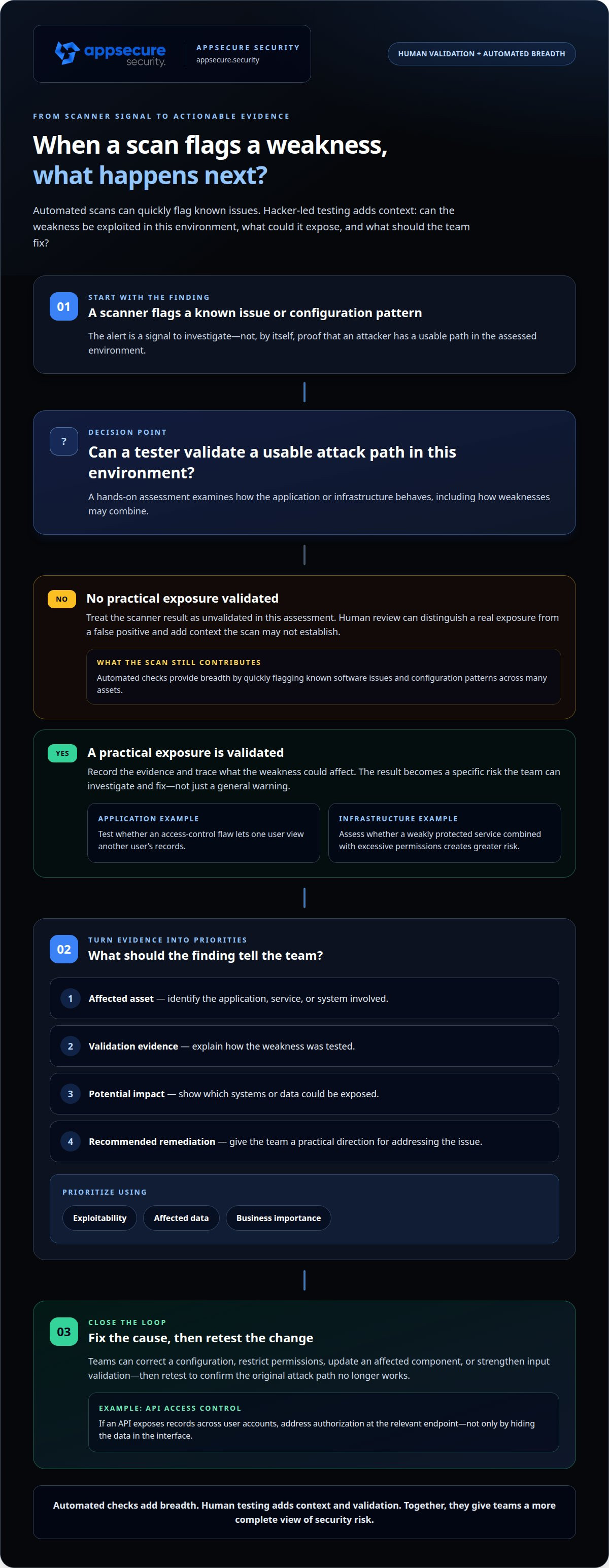
Automated vulnerability scans and manual penetration tests answer different security questions. A scan can check many assets for known software weaknesses, exposed services, or configuration errors. A penetration test examines how those findings behave in a real environment. For example, a scanner may flag an outdated component, while a tester investigates whether an attacker could use it to reach sensitive data.
Scanning works well as a recurring status check. Mature security programs may scan regularly, then use penetration testing for deeper assessment. A scan can identify a known issue across internal systems, but may not establish whether access controls prevent exploitation. Testers add context by examining permissions, application logic, and the path from an initial weakness to a meaningful impact.
Manual testing also helps separate signal from noise. An automated tool may report a possible weakness that depends on a specific configuration. A tester can inspect the affected component, attempt a controlled exploit within the approved scope, and record whether the issue is real. This validation helps teams avoid spending remediation time on false positives while surfacing attack paths that require human reasoning.
The strongest workflow connects both methods in a clear sequence: scan, validate, prioritize, remediate, and retest. For example, a scan might identify an exposed service on a cloud asset. A tester can assess whether its access controls or connected permissions create a route to sensitive resources. After the team changes the configuration, a targeted check can confirm whether exposure has been reduced.
Automation can expand coverage and speed up repetitive checks, while human testers interpret business context and adapt their approach. Investigating application behavior, testing unusual input, or connecting separate findings matters when a vulnerability depends on several conditions. A tool can flag an open administrative interface; a tester can assess whether authentication, network restrictions, and user privileges prevent unauthorized use.
Combining both methods supports a more useful response than either one alone. Scan results help teams track recurring issues across assets, while manual findings explain exploitability and likely consequences. Automated penetration testing can extend repeatable testing, but complex attack paths and remediation decisions still require skilled analysis. Retesting then checks whether a fix addresses the underlying weakness, not just the original alert.
What is hacker-led penetration testing?
Hacker-led penetration testing is a controlled assessment in which skilled security testers use an attacker’s perspective to examine agreed systems. They don’t stop at identifying a possible weakness. They investigate whether it can be exploited, what access it could provide, and how the organization can reduce the risk. For example, a tester may follow an authorized user journey through a web application to find a route into restricted account functions.
The work begins with scope. The organization and testing team define target applications and systems, permitted techniques, and operational boundaries. A clear scope helps avoid testing unrelated assets and gives testers a shared understanding of acceptable activity. For example, a test might include a customer-facing application and its API while excluding a third-party system outside the organization’s control.
Within that scope, a hacker-led assessment typically moves through connected activities:
Map the target
Identify relevant application features, interfaces, and access paths.
Test for weaknesses
Examine authentication, permissions, input handling, and configuration.
Validate exposure
Attempt controlled exploitation to establish whether a finding is real and assess its impact.
Report and retest
Document evidence and remediation guidance, then assess whether fixes address the tested weakness.
This approach differs from a scan that primarily checks for known issues. Human testers can adapt when an application behaves unexpectedly or when separate issues appear connected. For example, they may find that an account-level permission flaw becomes more serious when combined with an exposed API function. Comparing autonomous, agentic, and manual testing helps explain how different approaches contribute to an assessment.
A useful report connects each finding to evidence and consequences. It can describe the affected component, the steps used to validate the issue, and recommended remediation. A vague alert such as “access control weakness” gives a team little direction. A finding that explains which role accessed which restricted function gives engineers a more precise starting point for a fix.
Hacker-led testing is useful when an organization needs to understand exploitability, not just collect vulnerability alerts. A new application release, a major system change, or concerns about sensitive data can make a focused assessment relevant. Testing covers only the assets and methods defined in its scope, so results describe the systems examined, not every possible weakness across an organization.
To assess how an attacker could approach your environment, discuss a hacker-led security assessment.
AppSecure Security: Hacker-Led Deep Technical Security Assessment
AppSecure Security’s Hacker-Led Deep Technical Security Assessment helps organizations investigate exploitable weaknesses and prioritize remediation. It is a practical next step when automated scans do not explain how vulnerabilities connect or what they could expose. For application-specific testing, Web Application Penetration Testing and Mobile Application Penetration Testing assess risks in those environments. The Agentic Penetration Testing Platform can support testing across digital environments.
These assessments provide technical findings teams can use to understand exposure and plan fixes. The right scope depends on the applications and systems you need assessed.
Contact AppSecure Security to discuss a hacker-led assessment for your organization.
Make your next security decision evidence-led
The benefits of hacker-led penetration testing matter most when findings shape what happens next. Turn security observations into a focused plan: assign owners, set remediation priorities, and decide how fixes will be validated. This makes testing part of an ongoing risk-management process, not a report left untouched after delivery.
Start by choosing the systems and business concerns that need attention. A planned assessment can help your team build a clearer picture of exposure and focus effort on meaningful risk reduction. AppSecure Security can discuss a scope and approach suited to your security objectives.
Talk with AppSecure Security about your assessment. Take the next step with clear priorities and a stronger basis for protecting your organization.
Frequently Asked Questions
1. What Are the Pros and Cons of Pen Testing?
Pen testing gives decision-makers evidence to plan security work, but it requires time from technical and business teams. One practical advantage is a prioritized set of findings to support budget and engineering discussions. A limitation is that teams must decide what to do with findings after delivery. Assigning an owner and tracking each accepted fix helps turn the assessment into an ongoing risk-management input.
2. What are the main benefits of hacker-led penetration testing?
A valuable outcome is a clearer security baseline for future decisions. Teams can use assessment findings to compare risk before and after a major application change, architecture update, or remediation effort. For example, a security lead can record which issues remain open before a release and review them during release planning. This makes security discussions more specific without treating a single assessment as a permanent measure of protection.
3. How does hacker-led penetration testing compare with automated vulnerability scanning?
Scanning is useful for repeatable checks, while a penetration test is typically commissioned to investigate a defined security question or change. Mature security programs may conduct vulnerability scans regularly. A team might use those checks to track changing assets, then commission targeted testing after a major architectural change. The choice depends on whether the immediate need is recurring visibility or deeper examination of a particular system or scenario.
4. How does hacker-led penetration testing differ from traditional penetration testing?
The terms do not establish a universal distinction by themselves. “Hacker-led” generally describes an emphasis on human testers applying an attacker’s perspective, while “traditional” can refer to different methods across organizations. To compare engagements, examine the methodology, tester involvement, assessment scope, deliverables, and how findings are prioritized. These details reveal more than the label, especially when comparing proposals or setting internal expectations.
5. What security risks can hacker-led penetration testing uncover?
Beyond technical flaws, an assessment may reveal weaknesses in how security controls support business rules. For example, a workflow might allow an action without the expected approval, or a user might retain access after a role change. These issues can be difficult to identify through configuration checks alone. Reviewing the application’s intended rules alongside its behavior helps teams find security gaps tied to business logic.
6. How does hacker-led penetration testing test real-world attack paths and business impact?
Teams can make impact analysis more relevant by identifying important workflows before testing starts. For example, an organization may prioritize account recovery, approval processes, or administrative functions because they affect business operations. Testers can then assess the agreed scenarios and report which assumptions or controls did not hold. This helps leaders connect technical observations to process owners and decide which business functions need follow-up.
7. What steps are involved in a hacker-led penetration test?
Useful preparation includes identifying the application version under test, arranging representative test accounts, and documenting systems or activities outside the scope. The organization should also identify a contact to coordinate questions during the engagement. These details help distinguish testing activity from unexpected events and make findings easier to reproduce. At closure, teams can review the report with technical owners and agree how to track outstanding actions.
8. What are the limitations and risks of hacker-led penetration testing?
A test’s conclusions depend on the accuracy of its scope and the environment assessed. For instance, results from a staging environment may not reflect production settings if configurations differ. External services and dependencies may also be outside the authorized assessment boundary. Organizations should interpret findings in that context and avoid treating a successful test as certification that every system, supplier, or future change is secure.