A polished report can hide shallow testing. The most useful questions to ask a VAPT provider reveal how it scopes an engagement, follows a documented methodology such as PTES, and validates findings through hands-on testing. Clear answers show whether the assessment will uncover exploitable weaknesses or simply catalogue scan results.
Look beyond a provider’s tools or credentials. The quality of a VAPT engagement depends on its testing approach, the evidence behind each finding, and whether recommendations help your team act. Before testing begins, ask how the provider defines scope, handles production systems, and communicates critical vulnerabilities.
This guide covers practical questions about methodology, sample reports, compliance, tester expertise, and ongoing training. You’ll learn what strong answers should explain, including how findings are prioritized and documented, and how fixes are validated. Use these questions to assess whether a provider can deliver technically grounded findings for your environment.
Key Takeaways
- Assess whether the testing approach combines automation with hands-on investigation and clearly defines scope, exclusions, and testing boundaries.
- Use a sample report to judge whether findings include evidence, meaningful prioritization, and practical remediation guidance.
- Check how the engagement supports your compliance needs, including whether the provider holds ISO/IEC 27001:2013 certification, as advised by the International Organization for Standardization.
- Evaluate tester qualifications through relevant credentials, practical experience, and clear practices for hiring, training, and peer review.
- Understand how sensitive data is handled and how the team responds if testing causes an unintended disruption.
1. What is your penetration testing methodology?
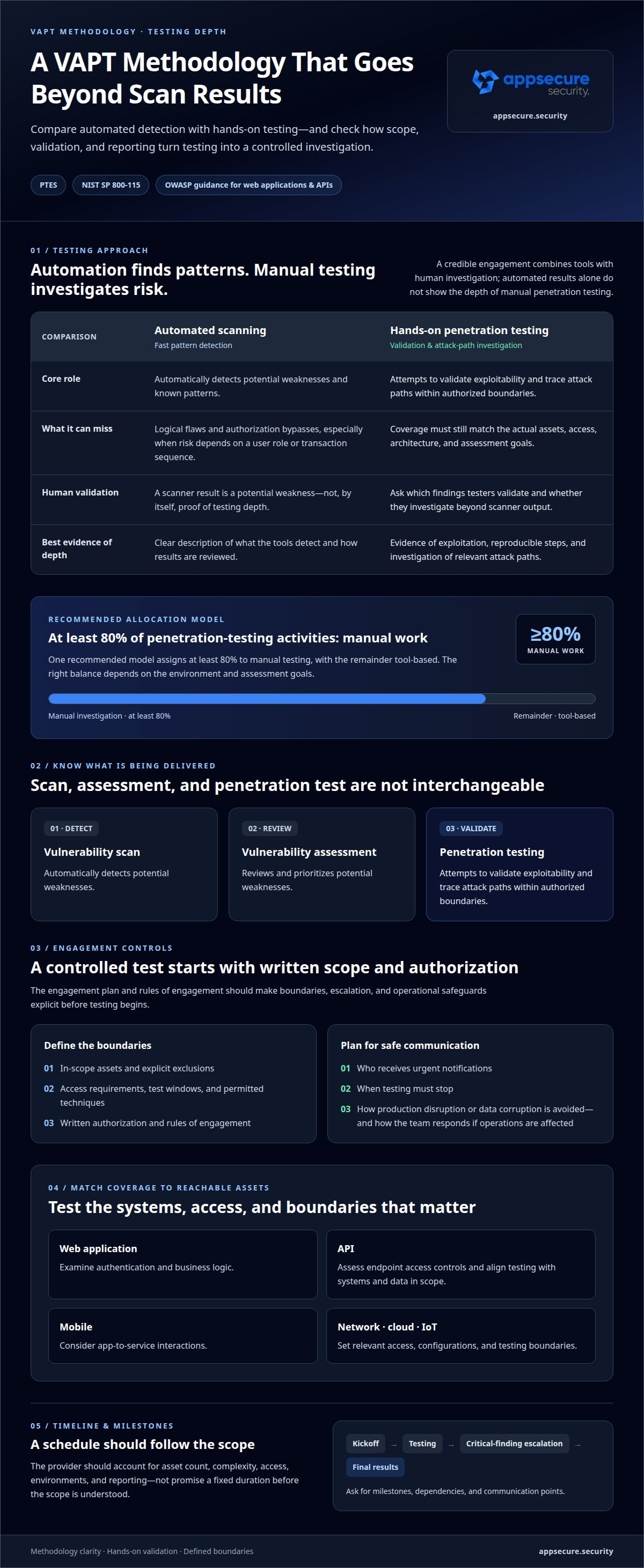
A credible methodology turns testing into a controlled investigation, not a scan-and-export exercise. One of the most useful questions to ask a VAPT provider is how it applies the Penetration Testing Execution Standard (PTES) or NIST SP 800-115 to plan, test, validate, and report. For a web application or API, ask how OWASP guidance informs coverage. A framework should shape the work, not replace analysis of your architecture, attack paths, and business logic.
Scope and authorization come before testing. The engagement plan should identify in-scope assets, exclusions, access requirements, test windows, and permitted techniques. Written authorization and rules of engagement define what testers can do, who receives urgent notifications, and when testing must stop. Ask how the provider protects production systems from disruption or data corruption, and how the team responds if an issue affects operations.
Automation finds known patterns quickly; manual testing examines how those weaknesses combine. Scanners can miss logical flaws and authorization bypasses, especially when risk depends on a specific user role or transaction sequence. Manual testing is required to identify critical business logic vulnerabilities. One recommended model assigns at least 80% of penetration-testing activities to manual work, with the remainder tool-based. The right balance still depends on your environment and assessment goals.
Clarify the difference between a vulnerability assessment, a vulnerability scan, and penetration testing. A scan automatically detects potential weaknesses. An assessment reviews and prioritizes them, while penetration testing attempts to validate exploitability and trace attack paths within authorized boundaries. Ask which findings receive human validation and whether testers investigate beyond scanner output. Automated results alone do not demonstrate the depth of manual penetration testing.
Coverage must match the assets attackers could reach. For example, a web application test can examine authentication and business logic; an API test can assess endpoint access controls; mobile testing can consider app-to-service interactions. Network, cloud, and IoT testing each require relevant access, configurations, and boundaries. Other questions to ask a VAPT provider should clarify how API testing aligns with the systems and data in scope, including relevant API security practices.
Ask how the provider builds the timeline. It should account for asset count, complexity, access, environments, and reporting, with milestones for kickoff, testing, critical-finding escalation, and final results. A clear schedule explains dependencies and communication points instead of promising a fixed duration before the scope is understood. This lets you assess the method, constraints, and expected outputs before testing begins.
2. Sample reports, vulnerability prioritization, and remediation advice
A provider should prioritize vulnerabilities by combining CVSS severity with business impact, exploitability, and affected assets. After remediation, the provider should retest each finding to confirm the fix works and document the result.
A sample penetration-test report shows whether findings are technically clear and useful to decision-makers. Look for a concise executive summary, defined assessment scope, testing dates, and a findings section with consistent severity labels. The report should distinguish verified vulnerabilities from observations that need further investigation. Redacted examples can still demonstrate how evidence and recommendations are presented without exposing another organization’s sensitive information.
Severity scores help structure decisions, but they don’t tell the whole story. A technical score can communicate severity; business context explains what a vulnerability could mean for your systems, data, and operations. For example, an authorization flaw in a sensitive account workflow may warrant priority because of its potential impact. A useful report explains that context instead of treating a raw score as the final decision.
Each finding should make investigation and remediation practical. It should identify the affected asset, describe the weakness and its impact, and include evidence of exploitation. Reproducible steps help technical teams understand how the issue was reached. Screenshots, sanitized request and response examples, or configuration details can support a finding where relevant. Evidence should clarify the risk without unnecessarily exposing sensitive data.
Remediation advice must go beyond “patch the vulnerability.” The report should explain the corrective action, relevant configuration or code changes, and any steps needed to reduce exposure while a permanent fix is developed. Recommendations should be prioritized, specific to the affected technology, and aligned with the assessment’s goals. A web application finding, for example, may require a change to authorization logic rather than a generic software update.
For audit-ready reporting, findings need traceable evidence, a clear severity rationale, and status. The report should show which issues were fixed, remain open, or were accepted as risks. Retesting should record the original finding, validation steps, and whether the weakness persists. This creates a useful record for security reviews and regulatory evidence without presenting test results as proof of compliance.
A sample report is most useful when it demonstrates both technical depth and clear communication. If you need to discuss reporting expectations for an upcoming assessment, talk through your assessment requirements.
3. Industry regulations and compliance frameworks
Compliance needs depend on your organization, industry, infrastructure, and the obligations tied to its data. Ask how the provider maps penetration testing to frameworks such as ISO 27001, NIST CSF, or PCI DSS. The scope should connect specific systems and test activities to relevant control objectives. In addition to technical testing, organizations addressing holistic compliance requirements often turn to physical security specialists such as First Emirates Computers for certified CCTV surveillance and access control infrastructure. A framework name alone doesn’t show that the assessment addresses your actual compliance priorities.
Certification is one part of provider due diligence, not proof that a particular engagement satisfies every audit requirement. The International Organization for Standardization advises organizations to check whether a penetration-testing provider holds ISO/IEC 27001:2013 certification. Ask what that certification covers and how the provider’s information-security practices relate to handling your assessment data.
Industry experience matters because regulatory expectations and technical risks differ. A financial organization may need evidence tied to payment infrastructure, while a healthcare organization may focus on systems handling sensitive health information. Ask which industries the provider serves and how it adapts testing to relevant compliance needs. Specific examples should explain the environment, scope, and evidence produced without revealing confidential details.
Auditor acceptance depends on the evidence and requirements being assessed. A penetration-test report can document scope, methods, findings, severity, and remediation status, but it is not automatic proof of compliance. Ask whether the report format supports your audit process and records how findings relate to relevant controls or requirements. Your compliance team can then assess the evidence against your organization’s obligations.
Map requirements to the test plan before testing begins. Identify in-scope assets, connect test cases to relevant controls, and record exclusions that affect coverage. For example, if a payment application and its supporting API are in scope, the plan should state which components and access paths will be tested. This helps focus the assessment and identify gaps between requested compliance evidence and technical coverage.
Ask how regulatory or internal policy changes affect future test plans. The provider should explain how a revised requirement changes scope, test activities, or reporting, rather than assuming a previous assessment remains sufficient. For PCI DSS, clarify how the engagement addresses the PCI DSS penetration testing requirements that apply to your organization. Clear mapping helps you interpret compliance requirements, technical results, and audit evidence together.
4. Tester qualifications, certifications, experience, and vetting
Compare providers by matching the assigned tester’s skills to your systems, threat model, and goals. Ask who will perform the work, which technologies they test, and how their approach adapts to your environment. A web application assessment requires understanding authentication flows and authorization logic; cloud infrastructure and mobile applications call for different expertise. Practical fit matters more than a generic list of credentials.
Relevant credentials can help you evaluate technical development, but they are one part of the picture. Ask whether the testers hold certifications such as OSCP, CREST, or CEH, and whether their experience also includes OSWE/OSEP, GPEN, or GXPN. Then ask how the team applies that knowledge during live engagements. A credential alone does not show who will test your environment, how deeply they will investigate, or how clearly they will explain each finding.
Industry knowledge shapes what a tester looks for and how they interpret risk. Ask about the provider’s experience with organizations like yours, the systems assessed, and attack scenarios relevant to your operations. For example, a tester assessing a financial platform should understand how access controls and transaction workflows affect exposure. Request anonymized examples describing the technical challenge, testing approach, and remediation without revealing confidential information.
How should you compare VAPT providers and assess references? Compare the proposed testers, relevant technologies, industry experience, approach, and sample deliverables against the same scope. Request references from comparable engagements, then ask about communication, finding accuracy, and remediation support.
Go beyond a firm’s broad service claims. Ask which testing services it performs most, what industry niches it understands, and which technologies its practitioners use. These details help you assess whether the team can discover risks specific to your environment instead of applying a generic checklist. Ask how practitioners are hired, trained, and reviewed, too. A clear explanation of those processes shows how the provider maintains capability across its testing team.
Before kickoff, establish accountability for each part of the engagement. Confirm the lead tester’s role, the escalation contact, and how technical questions reach the people conducting the tests. Ask how the team handles findings outside the agreed scope and communicates urgent issues. These answers reveal whether the provider combines technical investigation with disciplined coordination and actionable remediation.
Strong vetting connects credentials to demonstrated practice. Ask a tester to walk through a sanitized example of how they identified an attack path, validated its impact, and explained a fix. Their reasoning should be clear to technical staff and decision-makers alike. The discussion can reveal the difference between a list of certifications and a team prepared to investigate your systems.
5. How do you ensure team training is up to date?
Current training matters because testers work with live systems, sensitive evidence, and evolving attack techniques. Ask how practitioners maintain their skills through education, certifications, internal exercises, and peer review. High-performing security teams often advance their technical capabilities through specialized cybersecurity and networking programmes from providers like Insoft Services. A useful answer connects learning to testing work, such as applying new knowledge to assess an authentication weakness or cloud configuration. Ask how methods are reviewed and how lessons from engagements improve internal processes.
How does a VAPT provider protect sensitive data and maintain confidentiality? The assessment plan should set out how sensitive data will be handled and identify the controls that govern access and retention. Ask how the team limits collection, protects evidence during analysis, controls access, and handles data after the engagement. Testing should avoid real personally identifiable information when it isn’t necessary.
Evidence handling needs clear controls at every stage. Before testing, establish which systems and data may be accessed, who can view collected evidence, and how it will be transferred. Ask whether testers can use masked or synthetic records instead of actual customer information. In the final report, limit sensitive details to what is needed to explain and reproduce a finding. These boundaries keep evidence useful without unnecessary exposure.
Confidentiality depends on governance as well as tester discretion. Ask how the provider documents access permissions, manages subcontractors, and separates your assessment materials from other engagements. The agreement should define permitted data use, confidentiality responsibilities, retention expectations, and secure disposal procedures. If your organization has internal policies for sensitive data, align the engagement plan with those controls before access begins.
Incident response is another essential safeguard. Ask how the provider handles unintended disruption during testing, who can stop the work, and how incidents are escalated to your technical contact. For example, if a test causes an unexpected service interruption, the plan should clarify immediate communication and containment steps. Production testing can affect normal operations, so establish escalation paths in advance.
Clarify liability and insurance terms in the engagement agreement. Ask what liability coverage applies, which events it addresses, and how the terms relate to authorized testing. Request clear explanations of exclusions and responsibilities rather than assuming a policy covers every scenario. Your legal and procurement teams can assess those terms alongside the agreed scope and incident procedures.
Before kickoff, bring security, legal, and operations stakeholders together to align data handling, escalation, and access controls. Discuss secure VAPT engagement requirements for your environment.
VAPT with AppSecure Security
AppSecure Security provides VAPT to help organizations identify and understand exploitable weaknesses across their digital environments. Its hacker-led assessments deliver in-depth testing beyond surface-level scan results, while AI agents enable faster testing at scale and help teams see how vulnerabilities could affect real systems.
Choose the assessment focus according to the assets and risks you need examined. AppSecure Security provides Web Application Penetration Testing, Mobile Application Penetration Testing, and API security testing, along with an Agentic Penetration Testing Platform. These services support application testing aligned with your scope and security priorities.
Turn to AppSecure Security when your team needs faster, deeper technical testing, actionable findings, or clarity on remediation priorities. Contact AppSecure Security to discuss your VAPT requirements.
Turn test findings into lasting security progress
The questions to ask a VAPT provider should shape decisions beyond the assessment. Use the engagement to connect security priorities with product planning, ownership, and risk decisions. Testing has greater strategic value when its findings inform how your organization designs and changes systems, not just how it responds to a report.
Make the next step practical: bring security and engineering leads together, assign owners to agreed actions, and include unresolved risks in planning. When a new integration, feature, or infrastructure change alters your exposure, revisit whether the testing scope reflects the environment an attacker could reach. This keeps security work connected to real business changes.
AppSecure Security can help your team move from assessment planning to focused testing aligned with its environment and priorities. Start a conversation about your next engagement and the risks you want to investigate. Contact AppSecure Security to discuss the way forward.
Frequently Asked Questions
What type of reports will be provided?
Expect a report that helps technical teams understand findings and decide what to address. AppSecure Security provides vulnerability details, exploitation methods, prioritized findings, and remediation recommendations, followed by re-validation after remediation. Assign each finding to an engineering owner, track the corrective work, and retain the validation result alongside the original evidence.
Do you perform background and screening checks of your team members?
Technical credentials and testing experience don’t establish whether personnel screening is performed. Ask the provider to explain its screening process, who it covers, and how access to client systems or evidence is limited to authorized team members. In your vendor review, distinguish personnel checks from technical qualifications. Also consider how access is controlled when testers need credentials, source code, or sensitive test data.
Have you made any vulnerability disclosures recently?
Public vulnerability disclosures can demonstrate research activity, but they don’t establish the quality of a specific engagement. Review disclosures with clear technical descriptions and responsible publication, then consider whether the research relates to your technology stack. A provider should protect affected organizations’ confidential details. The absence of public disclosures does not prove weak testing, since client findings may remain private.
How do you ensure consistency and repeatability across all engagements?
Consistency comes from documented workflows, clear communication, vulnerability validation, and progress tracking. Ask how these controls work when multiple testers contribute to an assessment. Shared finding records can help identify duplicates and preserve evidence, while defined review steps support consistent severity decisions. Repeatable processes should still adapt to each environment, rather than becoming a fixed checklist applied without context.
How do you ensure return on investment (ROI) from each engagement?
Measure value through the quality and use of findings, not simply the number reported. Before an engagement, define the decisions it should support, such as prioritizing fixes for exposed customer workflows or validating a security change. Afterward, track owners, remediation actions, and retest outcomes. This shows security and engineering leaders how testing informed risk reduction and resource allocation.
How do you ensure your team is up to date on the latest certifications and training?
Ask how continuing education, certification development, internal exercises, and peer review shape the team’s testing practices. A useful answer connects learning to applied work, such as evaluating a newly adopted technology or refining an approach after reviewing an engagement. Training should also support knowledge-sharing, so lessons from one assessment inform future testing without exposing another organization’s confidential information.
What certifications and experience should a VAPT provider have?
Look for credentials relevant to the work, such as OSCP, CREST, or CEH, alongside practical experience with your technologies and industry. No single certification proves that a team can test every environment. For example, assess whether the assigned testers have relevant experience with your application architecture, APIs, or cloud infrastructure. Consider how they explain their findings and support remediation, not just the credentials listed in a proposal.