



At AppSecure Security, we test connected devices and the systems around them to help protect organizations from compromise. Our IoT penetration testing services in Dubai assess firmware, APIs, wireless interfaces, cloud services, mobile applications, third-party integrations, and network boundaries. We identify exploitable weaknesses before attackers can use them.
Our testing can uncover weak authentication, insecure communications, exposed interfaces, and risky configurations. We go beyond listing flaws: we explain severity and potential business impact, provide evidence of exploitation where appropriate, and recommend practical fixes.
This article explains what IoT security testing covers, which device weaknesses it can reveal, and how reporting and remediation turn findings into action. It also outlines what to look for when assessing IoT penetration testing services in Dubai, so you can evaluate the scope and deliverables.
Key Takeaways
• Our assessments cover the full IoT environment, including devices, firmware, networks, applications, APIs, and cloud services.
• We trace attacker paths across connected systems to expose risks isolated device checks can miss.
• We deliver clear findings, severity ratings, proof-of-concept evidence, and remediation guidance to help teams prioritize fixes.
• We test firmware, credentials, communications, and device configurations to identify weaknesses attackers could exploit as entry points.
• We tailor assessment scope to your IoT environment and the business impact of a successful attack.
What is IoT Security Testing?
Our IoT security testing identifies whether attackers can compromise connected devices and their supporting systems. In Dubai, we assess hardware, firmware, networks, applications, and cloud services to expose exploitable weaknesses before attackers can use them.
Device and Network Security Assessments
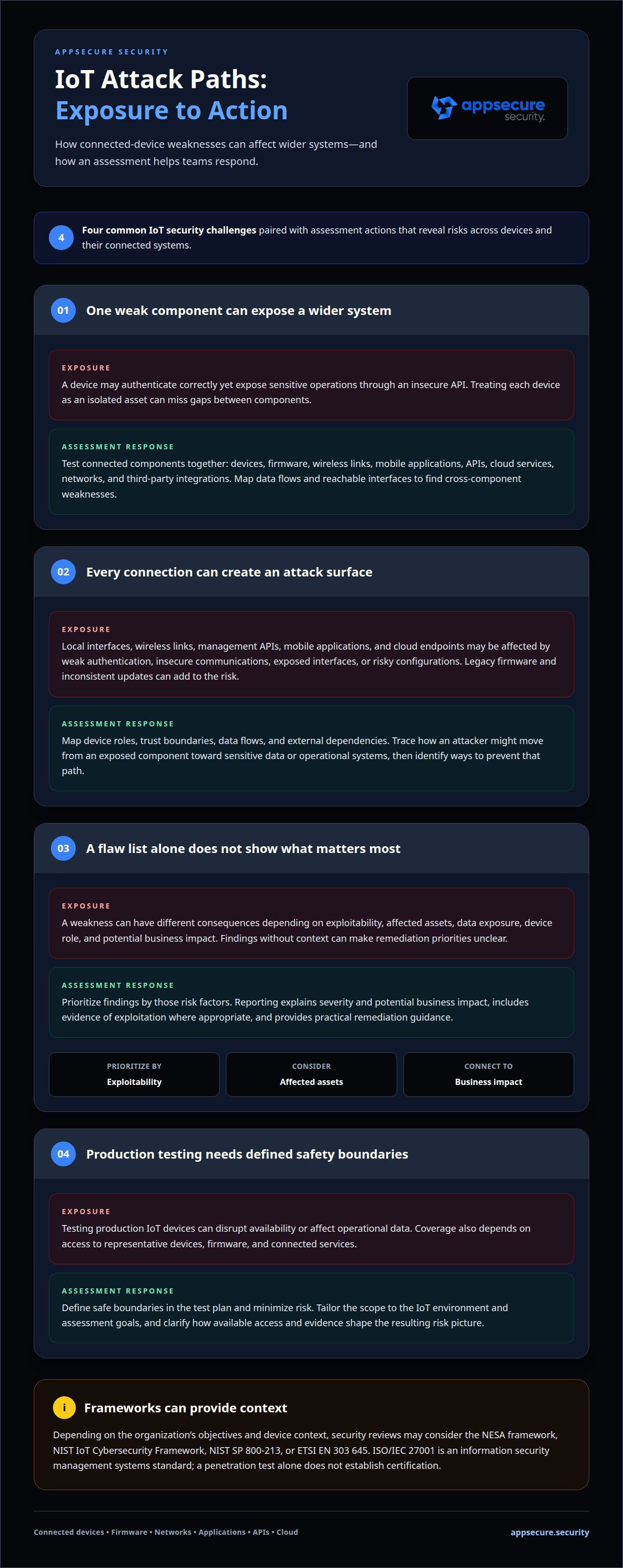
We test devices across their operating environments, examining exposed interfaces, firmware behavior, wireless communications, network boundaries, mobile applications, APIs, and cloud connections. For example, a device may authenticate correctly but expose sensitive operations through an insecure API. Testing these components together reveals how attackers could exploit one weakness to affect the wider enterprise environment.
Our assessment records device and firmware versions in scope, maps data flows, and tests reachable interfaces. This helps us uncover gaps between components instead of treating each device as an isolated asset. Scope can also include third-party integrations that exchange data with the device or control its functions.
Attack Surfaces and Security Challenges
Each connection creates a potential attack surface: a local interface, wireless link, management API, mobile application, or cloud endpoint. Legacy firmware, inconsistent updates, weak authentication, and unclear device ownership can leave these surfaces exposed. We trace how an attacker might move from an exposed component toward sensitive data or operational systems, then identify ways to prevent that path.
We map device roles, trust boundaries, data flows, and external dependencies before testing. In Dubai, businesses may consider the National Electronic Security Authority (NESA) framework when aligning security practices. The NIST IoT Cybersecurity Framework, NIST SP 800-213, and ETSI EN 303 645 can also inform security reviews, depending on the organization’s objectives and device context.
Architecture, Risk Priorities, and Testing Limitations
Our architecture review identifies where IoT devices connect to enterprise networks, cloud services, and critical operational systems. We prioritize findings by exploitability, affected assets, data exposure, and potential business impact. This separates urgent security gaps from lower-risk issues and helps direct remediation toward the attack paths that matter most.
For IoT penetration testing services in Dubai, we tailor assessment goals to vulnerability discovery, architecture review, or alignment with a security management system. According to the International Organization for Standardization, ISO/IEC 27001 is an information security management systems standard. It can provide context for organizational controls, but a penetration test alone does not establish certification.
What risks and limitations should clients consider before testing production IoT devices? Testing can disrupt device availability or affect operational data, so we define safe boundaries in the test plan and minimize risk. According to the Centers for Medicare & Medicaid Services, penetration testing on a production system must minimize the risk of information corruption or service outage.
Assessment coverage also depends on access to representative devices, firmware, and connected services. A review of penetration testing coverage and accuracy can help clarify how test scope and evidence shape the resulting risk picture.
What are the benefits of doing IoT penetration testing?
IoT penetration testing turns an inventory of connected assets into evidence of real attack paths. We help organizations identify how weaknesses in devices, radio links, applications, and cloud services could combine to expose them to attack.
Threat Modeling and Attack-Surface Discovery
This map helps security teams identify interfaces routine device checks might miss. For example, a mobile application may expose an API that accepts commands from an inadequately protected account. Testing the complete path shows whether an attacker could move from that account to device control or sensitive information, so your team can address the exposure before attackers exploit it.
For enterprise teams, the benefit is a prioritized view of threats tied to business functions. A temperature sensor, door controller, and production monitor have different consequences if compromised. Risk modeling connects each asset’s role to the impact of unauthorized access, data changes, or interrupted operations, helping your organization focus defenses where they matter most.
Simulated Attacks and Validation
We use controlled simulated attacks to test whether suspected vulnerabilities are exploitable under defined conditions. Assessors can attempt access to device interfaces, test authentication boundaries, and trace whether a compromised component exposes another. This goes beyond listing possible weaknesses: it shows which attack paths work and where your defenses need to hold.
Testing can also validate defensive controls. If network segmentation blocks a device from reaching a critical system, the assessment examines that boundary. If an application limits commands by user role, testing probes whether those restrictions hold across valid and invalid access paths.
IoT penetration testing is most useful when its scope reflects connected dependencies. A device may appear secure while its gateway, application, or cloud integration provides a route into the wider environment. We map the complete attack path to give security teams clearer remediation priorities and help protect critical systems.
Radio Protocol Testing and Replay Attacks
Wireless testing examines how devices exchange commands and data over radio protocols. In a replay attack, an adversary records a legitimate transmission and sends it again later. Testing determines whether the device accepts the repeated message or rejects it using protections such as message freshness checks.
Software-defined radio can capture and analyze radio signals within an authorized test scope. Assessors examine how a device responds to repeated or altered messages, then document the exposure. This can reveal whether a wireless interface trusts commands without adequately validating their origin or timing, helping your organization close a potential attack route.
These tests require clearly defined boundaries. Radio behavior depends on the protocol, device design, and surrounding environment. A controlled assessment focuses on approved equipment and frequencies, avoiding interference with unrelated devices or services.
From Vulnerabilities to Defensible Priorities
Testing connects individual vulnerabilities into practical attack scenarios. For example, exposed credentials might enable access to a management interface, which could then reveal connected devices. Mapping each transition helps distinguish an isolated flaw from a route to sensitive data or operations.
Teams can use these results to prioritize fixes by exploitability and business impact. A weak control on a device managing a critical process may need attention before a lower-impact issue. This evidence gives architects a concrete basis for strengthening trust boundaries across the IoT ecosystem and reducing the risk of real-world attacks.
Organizations planning this work can discuss a scoped IoT security assessment that reflects their devices, radio interfaces, and operational boundaries.
Penetration testing reporting and remediation support
An IoT penetration test helps reduce exposure when its findings drive clear decisions, assigned fixes, and retesting evidence. A capable VAPT firm connects each vulnerability to affected devices, business impact, and a specific remediation action, helping clients close attack paths before they lead to compromise.
How long does an IoT penetration test take in Dubai? The timeline depends on scope, device diversity, firmware access, network complexity, and connected applications. Testing one device type differs from assessing an ecosystem that spans hardware, APIs, cloud services, and third-party integrations.
What are the steps in a typical IoT penetration test, from scoping to remediation? A thorough assessment moves from defining assets and test boundaries to actively testing for vulnerabilities, validating findings, reporting risks, applying fixes, and retesting affected components. Clear ownership and status updates help clients reduce exposure at every stage.
Reporting Findings and Risk
A strong VAPT firm delivers a report that gives technical teams the evidence to reproduce findings and decision-makers a clear view of exposure. Each item should identify the affected component, test conditions, severity, evidence of exploitation where appropriate, and likely business impact. For example, a flaw in an application API should identify the affected function and the conditions that expose it.
Prioritization should distinguish an exploitable weakness in a critical device from a lower-impact issue. Reports can group findings by hardware, firmware, network, application, and cloud dependencies. This helps clients assign remediation to the people responsible for each system and close attack paths, instead of treating every issue as an isolated ticket.
Finding
State the affected device, interface, or service.
Evidence
Record the test conditions and reproducible proof.
Impact
Explain the risk to data, operations, or connected systems.
Remediation
Recommend a specific control or configuration change.
Retest
Record whether the fix closes the demonstrated attack path.
Scope, Status, and Report Format
During scoping, define the device models, firmware versions, interfaces, applications, and network boundaries included. Record exclusions and operational constraints. This makes clear what the assessment covered and prevents the report from implying that untested components were examined.
Status updates should communicate completed test areas, active issues, and changes to scope. A consistent format makes findings easier to compare across teams. For regulatory reviews, map evidence to the organization’s stated control objectives without claiming that a penetration test alone establishes compliance.
Remediation and Retesting
Remediation turns findings into controlled changes that reduce exposure and help prevent compromise. A firmware weakness may require a vendor update; an exposed service may need a configuration change or network restriction. Track each action against its finding, owner, and target system. This traceability matters when device fleets span separate operational groups.
Retesting verifies whether the original vulnerability remains exploitable after an update or configuration change. It should also check whether the fix causes a new failure in a connected application or device workflow. A final status record can distinguish resolved findings from issues that still need action, giving clients a clear path to reduce risk.
Firmware, authentication, communications, and configuration weaknesses
Firmware and device settings can expose infrastructure through overlooked credentials, stored secrets, or unprotected communications. Our assessment tests how attackers could exploit these weaknesses to reach devices and connected systems.
Default Credentials and Firmware Updates
We test whether default credentials remain active and whether devices accept weak authentication. Our assessors examine firmware update processes, including how devices receive and validate updates. An outdated component may retain known weaknesses, while an improperly protected update path could let attackers make unauthorized changes. We test device configurations and the management interfaces used to administer them.
Firmware analysis can reveal what ordinary network testing cannot. With authorized access to a device image or storage component, our assessors inspect the filesystem for configuration files, embedded credentials, private keys, debug settings, and unused services. This shows how a weakness in device software could give attackers access to the wider system.
Extraction is only the first step. Our assessors review recovered files and strings in context, then determine whether discovered secrets are active, reusable, or limited to development. For example, a credential embedded in firmware may also unlock a device management interface. Our findings identify the affected component and recommend removing secrets from images, rotating exposed credentials, or restricting access to block unauthorized entry.
Filesystem analysis also examines how devices store operational data. Logs, cached records, and configuration backups can reveal information beyond the device itself. Our assessors trace whether sensitive values remain readable after storage or appear in diagnostic output. A mobile application connected to the same device may also expose data through local storage or application logs, so our review follows relevant data flows to identify paths attackers could use.
Data Leakage and Firmware Tampering
Our communication testing examines whether device data is protected while moving between components. We review protocols, certificates, and configuration for cleartext transmissions or weak validation. TLS can protect data in transit, while AES-256 can protect data at rest. Our assessment tests implementation and exposure rather than assuming that naming an encryption method proves protection.
Our firmware integrity checks examine whether a device can detect unauthorized software changes. We inspect update validation, access controls, and recovery behavior. A weak process could let attackers persist tampered firmware or expose secrets during recovery. Our report connects each condition to affected devices and recommends focused fixes to block these attack paths.
Finally, our assessors test authentication and configuration together. We examine whether credentials are unique, privileged functions require appropriate access, and exposed services are necessary. Organizations should change default device credentials before deployment, avoid hardcoded credentials, and update or patch firmware. These controls help block common routes attackers use to enter connected infrastructure.
Dubai penetration testing providers and their services
Dubai providers differ in the environments they assess, testing depth, and clarity of reporting. To protect your organization from compromise, choose a provider that can test connected devices across hardware, firmware, communication protocols, APIs, applications, cloud services, and the paths between them. Testing these components together helps identify attack paths where an exploit could cross system boundaries.
How much does IoT penetration testing cost in Dubai? Price depends on the scope and is provided after a quote request. Cost factors include device quantity and type, network complexity, data sensitivity and volume, third-party integrations, and industry requirements.
A Dubai IoT security testing company list recorded 29 company records in September 2026. As of Sep 28, 2026, it included 16 companies with 1-10 employees, 11 companies with 11-50 employees, and 2 companies with 51-200 employees. These figures describe list entries and employee bands, not testing quality or IoT specialization.
A provider’s size alone does not show whether its team can uncover vulnerabilities in device firmware, wireless protocols, and cloud integrations. Assess whether testers can validate vulnerabilities and trace realistic attack paths from exposed interfaces to business impact. For example, a report should connect an API weakness to the affected device function and explain the risk to your organization.
Compare Scope, Methods, and Deliverables
Use a consistent evaluation sequence. First, map the connected devices and dependencies in scope. Next, confirm that testers can assess firmware, radio interfaces, applications, and network boundaries using relevant methods. Then verify that evidence, severity, exploitability, and remediation are documented clearly. This helps you compare providers’ capabilities and choose a team equipped to find and validate weaknesses before attackers exploit them.
Scope
Identify device models, firmware, APIs, cloud services, and third-party links.
Testing
Require manual validation of vulnerabilities and realistic attack paths.
Reporting
Look for reproducible evidence, risk context, and prioritized fixes.
Retesting
Define how corrected findings will be checked and recorded.
Compliance work also requires evidence mapped to the organization’s objectives. A penetration test can document technical findings, but it does not itself establish regulatory compliance or certification. Teams preparing audit evidence can align test scope, system boundaries, and report format with the controls they need to assess. Clear exclusions prevent readers from assuming untested components were covered.
For a broader view of audit-focused provider criteria, compliance audit penetration testing services offer a useful comparison point. For IoT penetration testing services in Dubai, define the connected assets and business risks, then align the engagement with those priorities to test the weaknesses that could expose your organization to attack.
To scope an assessment around your devices, protocols, and reporting needs, discuss your IoT testing requirements.
AppSecure Security: Red Teaming as a Service
AppSecure Security’s Red Teaming as a Service helps organizations test how well their defenses withstand realistic, authorized attack scenarios. Choose red teaming when you need to understand how individual weaknesses could combine into a broader path through connected systems, beyond a focused device assessment.
For defined technical scopes, AppSecure Security’s Agentic Penetration Testing Platform uses AI agents to accelerate in-depth testing across IoT environments at machine scale, while Web Application Penetration Testing and Mobile Application Penetration Testing address connected applications. The right approach depends on the assets, attack paths, and business risks in scope.
Use findings to strengthen controls, prioritize remediation, and plan follow-up testing. Contact AppSecure Security to discuss an IoT security assessment.
Turn Security Priorities Into a Testing Plan
Connect device testing to a business decision: which assets need deeper scrutiny, which attack paths matter most, and who owns remediation. Set clear objectives before testing begins. This keeps the work focused on operational risk and makes the resulting evidence easier to use in planning.
For organizations evaluating IoT penetration testing services in Dubai, AppSecure Security can align technical testing with connected application environments. Its Agentic Penetration Testing Platform uses AI agents to test IoT environments faster and in depth at machine scale. Web Application Penetration Testing and Mobile Application Penetration Testing can address application layers connected to device workflows. This approach is relevant when device exposure crosses into APIs, mobile interactions, or enterprise systems.
Bring your scope, device context, and security objectives into the next discussion. Identify the systems that matter most and the decisions the assessment should support. Start a scope discussion with AppSecure Security. A clear plan gives your team a practical basis for moving forward with stronger security decisions.
Frequently Asked Questions
1. What are the future trends in IoT penetration testing?
IoT testing is likely to place greater emphasis on validating connected attack paths, not just individual devices. Security teams can use automation and AI-assisted analysis to map large environments and prioritize findings. AI agents can help deliver faster, deeper testing at machine scale by assessing more devices and connected attack paths. Human-led validation remains important for judging business logic and operational impact. For Dubai organizations, useful testing connects technical evidence to device ownership, system dependencies, and remediation decisions.
2. Which companies offer IoT penetration testing services in Dubai?
AppSecure Security offers an Agentic Penetration Testing Platform that uses AI agents to deliver faster, deeper IoT penetration testing at machine scale, alongside penetration testing and red teaming services. A Dubai IoT security testing company list recorded 29 company records in September 2026. That count describes listed businesses, not verified service quality or a ranking. Compare providers by relevant IoT scope, testing approach, evidence quality, and whether their assessment covers the device’s connected applications and infrastructure.
3. What IoT devices and technologies do Dubai penetration testing providers assess?
IoT assessments can cover devices, firmware, APIs, wireless interfaces, networks, cloud services, mobile applications, and third-party integrations. The precise scope depends on how an organization’s devices communicate and which systems they affect. For example, testing a connected sensor may include its firmware, gateway, management application, and cloud endpoint. Include the protocols and dependencies that support the device’s actual operating environment.
4. What is included in an IoT penetration test in Dubai?
A scoped test typically defines the devices and connected components, then assesses relevant interfaces and attack paths. AI agents can accelerate this work and help examine attack paths at machine scale, while human-led validation assesses business impact. Deliverables can include vulnerabilities, severity, evidence of exploitation, business impact, and remediation recommendations. The scope should identify device versions, network boundaries, and excluded systems. For a mixed fleet, separating device families in the report helps teams connect findings to the right owners and remediation work.
5. How do Dubai IoT security testing firms compare by services, certifications, and experience?
Compare firms on IoT-specific testing depth, documented methodology, report quality, and experience with your device architecture. CREST-Approved status, OSCP, and ISO 27001 can indicate relevant provider expertise or professional practices, but credentials alone don’t demonstrate IoT testing capability. Look for clear evidence of firmware, wireless, API, and cloud assessment experience. Also assess whether findings are reproducible and tied to practical remediation.
6. What UAE regulations and standards apply to IoT penetration testing and cybersecurity?
Relevant Dubai references include the National Electronic Security Authority framework, UAE Information Assurance Regulation, Dubai Information Security Regulation, and Federal Personal Data Protection Law. Standards and guidance named for IoT security include NIST SP 800-213, the NIST IoT Cybersecurity Framework, and ETSI EN 303 645. Which references matter depends on the organization, sector, systems, and data involved; testing supports security assessment but does not itself establish compliance.
7. How can organizations in Dubai choose a qualified IoT penetration testing provider?
Match the provider’s scope to your device ecosystem. A manufacturer may need firmware and update-path testing, while a property operator may prioritize wireless access and building-system boundaries. Review the proposed methodology, tester experience, evidence format, and remediation process. Confirm that the engagement distinguishes production systems from test environments and states which connected services are included.
8. Do Dubai IoT penetration testing providers offer retesting and remediation support?
Remediation guidance and retesting can form part of an IoT assessment’s deliverables. AppSecure Security provides detailed vulnerability reporting with remediation recommendations and final re-validation after remediation. Retesting checks whether fixes address the original exposure, such as a firmware weakness or insecure device interface. Define which findings will be retested and how closure evidence will be recorded, so technical teams can track corrective work.




































































































