The cheapest pentest can become the most expensive security mistake. VAPT cost in India depends on the assets in scope, testing type, application complexity, and compliance needs. Choosing the best pentesting company in India for startups means looking beyond a low quote to what the engagement actually tests and delivers.
It’s reasonable to want clear costs and a focused test that fits a startup’s budget. But a quick scan can miss flaws a hands-on assessment may uncover, and a report without practical remediation guidance can leave your team unsure what to fix next.
This guide explains the factors that shape VAPT costs and how to compare providers by startup fit, tester expertise, methodology, reporting, remediation support, and retesting. It also shows how to match testing to your web application, mobile app, API, or cloud environment, so you can judge the security coverage rather than just the headline price.
Key Takeaways
- Assess VAPT quotes by scope, testing depth, and the assets involved, not price alone.
- Use relevant tester certifications and CERT-In empanelment as evaluation criteria, alongside clear testing methods.
- Look for reports that make findings actionable and explain remediation and retesting.
- Match the provider’s expertise to your startup’s web application, mobile app, API, or compliance needs.
- Avoid buying based on speed or a low quote before understanding what the test covers and what happens after findings are delivered.
Security certifications and CERT-In empanelment
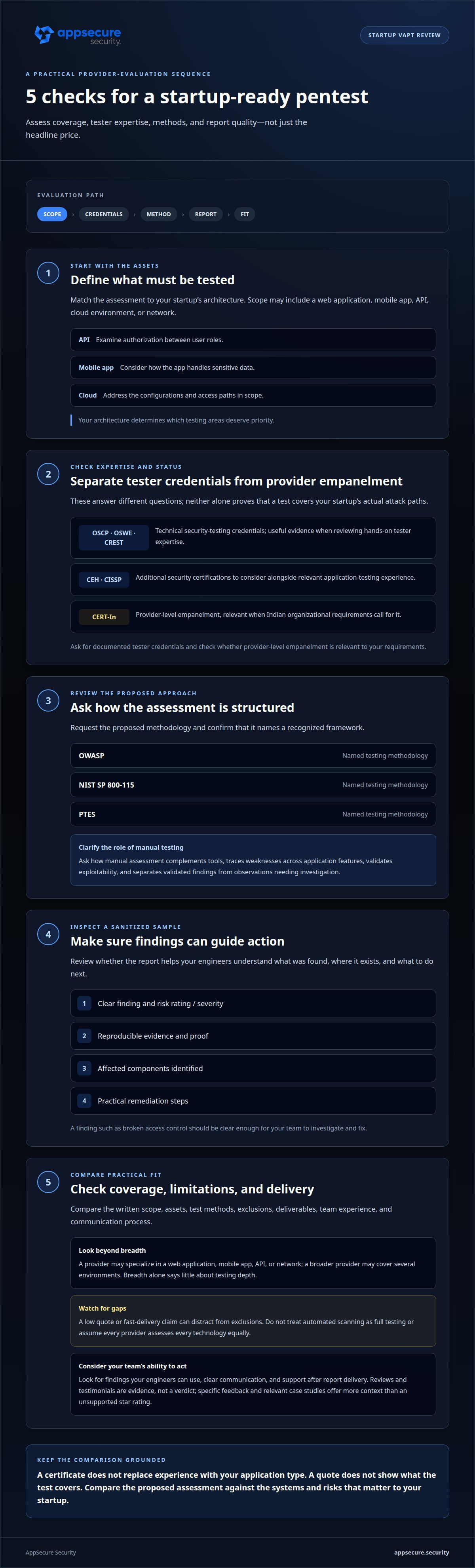
A tester’s credentials and an organization’s empanelment answer different questions. OSCP, CEH, CISSP, OSWE, and CREST are certifications to consider when assessing individual expertise. CERT-In empanelment is a separate organizational status relevant to Indian security work. Neither credential alone proves that a test will cover your startup’s actual attack paths.
For a startup, the best pentesting company in India for startups should combine evidence of expertise with reporting engineers can act on. Ask for documented tester credentials, the proposed methodology, and a sanitized sample report. Check that findings include reproducible evidence, severity, affected components, and practical remediation steps. A finding such as broken access control should be clear enough for your team to investigate and fix.
How can a startup verify a pentesting company's credentials and report quality? Review evidence of tester certifications and CERT-In empanelment, then assess a sanitized report for clear findings, risk ratings, proof, and remediation guidance. Confirm that the proposed testing method names a recognized framework such as OWASP, NIST SP 800-115, or PTES.
| Credential or approach | What it indicates | Startup relevance |
|---|---|---|
| OSCP, OSWE, or CREST | Technical security testing credentials | Useful evidence when reviewing hands-on tester expertise |
| CEH or CISSP | Additional security certifications | Consider alongside relevant application-testing experience |
| CERT-In empanelment | Provider-level empanelment | Relevant when Indian organizational requirements call for it |
| OWASP, NIST SP 800-115, or PTES | Named testing methodologies | Shows how assessment activities are structured |
Use the table as a comparison framework, not a scoring shortcut. A certificate does not replace experience testing your application type. Match the assigned tester’s background to the systems in scope, then assess the sample report for technical detail and actionable fixes.
Scope matters across API, cloud, mobile, and web application security. An API assessment, for example, should examine authorization between user roles, while mobile testing should consider how the app handles sensitive data. A cloud security assessment should address the configurations and access paths in scope. Your startup’s architecture determines which testing areas deserve priority.
Manual vulnerability assessment and penetration testing provide context that automated checks alone may miss. A tester can trace a weakness across application features, validate whether it is exploitable, and explain its likely impact. Ask how manual testing complements tools and how the report distinguishes validated findings from observations that need investigation.
Penetration testing and managed SOC monitoring serve different purposes. A pentest actively evaluates defined systems for exploitable weaknesses; continuous monitoring watches for suspicious activity over time. Neither replaces the other. Similarly, technical assessments should be paired with operational readiness drills; providers such as cyberone.security offer tabletop exercising to ensure teams can effectively manage simulated breach scenarios. For startup security and data-breach prevention, use testing to identify weaknesses to remediate, and treat ongoing monitoring as a separate security function.
For a startup-focused overview of assessment scope and fit, explore penetration testing for startups.
Pentesting providers suited to startups and SMEs
For a startup, provider fit depends on the systems in scope, your team’s capacity to act on findings, and the test’s depth. Compare providers by practical coverage and delivery, not company size alone.
Provider Capabilities and Limitations
A focused provider may specialize in a web application, mobile app, API, or network assessment. A broader provider may cover several environments, but breadth alone says little about testing depth. Compare the proposed scope, manual testing approach, and report examples. A mobile app test, for instance, should address the app’s actual functions, not just repeat generic web checks.
Provider Selection Pitfalls
A low quote or fast-delivery claim can distract from what the test excludes. Common pitfalls include accepting an unclear scope, treating automated scanning as full testing, and assuming every provider can assess every technology equally. Ask for a written outline of assets, test methods, exclusions, and deliverables. If your startup has an API and a mobile app, both should appear in the assessment plan.
India-Based VAPT Providers
India-based providers can work with startups across the country, with delivery on-site, remotely, or through a combination of both. Location alone does not establish testing quality or the ability to detect vulnerabilities. Compare relevant team experience, communication processes, and familiarity with your architecture. A Bengaluru startup and a Pune startup may both need an assessment shaped around their application, infrastructure, and release process.
Customer and Reviewer Ratings
Indian pentesting providers do not share one universal customer-rating scale, so treat reviews as evidence, not a verdict. Look for specific feedback about technical depth, clear findings, communication, and support after report delivery. Independent reviews and testimonials can offer different perspectives. A detailed case study involving similar systems is more informative than a short, unsupported star rating.
City-based options can help when a startup values in-person workshops or local coordination, but geography is only one criterion. A remote provider may still fit if the team can explain testing boundaries, manage access securely, and communicate findings directly to developers. Compare these details with your operating needs instead of assuming the nearest provider offers better technical coverage.
Before deciding, map each provider’s capabilities against your current network and application risks. Check whether the team can test the assets that matter now, explain limitations plainly, and deliver findings your engineers can use. For help defining a suitable assessment scope, discuss your startup’s security testing needs.
Reporting, remediation, and retesting
A penetration test is useful only when its findings lead to engineering action. The report should help technical teams reproduce vulnerabilities, prioritize remediation, and determine whether fixes withstand retesting. For executives, it should connect technical exposure to business risks without burying decisions in exploit details.
What is the typical timeline and process for a startup penetration test in India? The process moves from defining scope and access to testing, reporting, remediation, and retesting. The timeline depends on the assets, complexity, and scope agreed for the engagement.
Make reports useful to both technical and executive teams
A strong report serves two audiences. Developers need affected endpoints, reproduction steps, evidence, impact, and a practical fix. Leadership needs a concise view of priority risks, affected business functions, and remediation status. For example, an access-control finding should identify the affected role and explain how unauthorized access could occur. Clear severity ratings help engineering teams prioritize work without treating every finding as equally urgent.
Proof of exploit should demonstrate a vulnerability without exposing unnecessary sensitive data. A report can include a redacted request and response, the affected component, and steps to reproduce the issue in the test environment. This gives engineers evidence to validate the finding while limiting exposure of credentials, customer records, or production data. Each finding should distinguish confirmed exploitation from a potential weakness that needs further investigation.
Connect findings to remediation and retesting
Remediation works best when each finding has an owner, a clear corrective action, and a status. For a broken authorization check, engineering might enforce server-side role validation, then test access with accounts that have different permissions. Retesting should verify that the original weakness is closed and check for regressions in related functions. Without retesting, teams lack evidence that a fix addressed the tested attack path.
- Scope: Define the application, environment, and access needed for testing.
- Testing: Record validated vulnerabilities, exploitability, and supporting evidence.
- Reporting: Provide technical findings and an executive risk summary.
- Remediation: Assign fixes and track their status through engineering.
- Retesting: Reassess fixes and document the outcome.
Prepare evidence for SOC 2 Type 2
SOC 2 Type 2 evidence should document what was tested, findings, exploitability, risk scoring, recommended remediation, retesting, and evidence timing. Keep the report and remediation records together so the evidence connects identified issues with corrective action. A finding without status or retest details creates a gap in that narrative. Testing records should also identify the assessment scope and when evidence was produced.
Penetration testing supports a point-in-time assessment; it isn’t continuous monitoring. Startups making frequent releases can connect assessment findings to their ongoing security process, so engineering teams consider vulnerabilities as applications change. A practical continuous security testing approach for SaaS startups can help frame that work. The objective is direct: reduce exploitable weaknesses before attackers use them, then preserve clear evidence of the response.
Vendor comparison by expertise and buyer fit
Compare providers by the systems they assess, relevant industry experience, and ability to adapt testing to your architecture. Your startup’s cybersecurity partner should fit its digital infrastructure, not just offer a broad service catalogue.
Industry Experience and Adaptability
Industry experience helps a provider understand how risks affect real workflows. A fintech startup handling payment APIs has different priorities from a mobile-first health platform. Compare case studies and customer feedback from organizations with similar technologies or operating models. Then assess adaptability: can the scope reflect your architecture, release process, and business priorities? Industry fit adds context; adaptability shows whether the provider can apply it to your environment.
Company History and Experience
Company history can show how long a provider has operated, but age alone does not demonstrate current testing expertise. Compare its track record with the practitioners’ experience on your assessment. Look for work across businesses of different sizes, relevant technical environments, and documented examples. A provider’s ability to explain its methods and findings clearly can matter more than a long company timeline.
Use a buyer-fit comparison to connect your immediate needs with the provider’s demonstrated experience. The table distinguishes common assessment priorities, not vendor rankings.
| Buyer or environment | Expertise to compare | Fit indicators |
|---|---|---|
| Early-stage SaaS | Web application and cloud assessment experience | Scope reflects product architecture and release patterns |
| Fintech startup | API and payment workflow testing | Relevant examples involving sensitive transaction paths |
| Mobile-first business | Mobile application security testing | Testing covers app-specific features and data flows |
| Compliance-focused organization | Experience supporting ISO 27001-related security work | Reports document scope, findings, and corrective actions |
Use ISO 27001 as a framework relevant to your security objectives, not as a shortcut for judging a pentesting provider. A provider’s own certifications and your organization’s compliance needs are separate considerations. Compare the proposed assessment against the evidence your team needs, then decide whether the scope addresses the actual systems under review.
For example, a company preparing a mobile launch should prioritize mobile testing experience over a provider’s unrelated network case studies. A startup expanding its cloud infrastructure should ask whether past engagements covered comparable configurations. Ask providers how their approach changes across these environments and how they adapt findings to each organization’s technical context.
Build a shortlist by matching three factors: relevant industry work, comparable technical scope, and clear evidence of adaptable testing. Customer testimonials and case studies can help reveal whether a provider has supported organizations like yours. A practical guide to choosing a penetration testing company can also help structure that comparison. Choose the partner whose experience aligns with your current assets and next security priorities.
Common startup pentest buying mistakes
A startup can pay for an assessment and still leave key risks untouched. The problem often starts before testing: unclear assets, mismatched scope, or findings the team cannot act on. Avoid these mistakes by connecting the test to your environment, release plans, and engineering capacity.
- Buying a scan instead of a penetration test: A tool can flag known patterns, but a scan alone may not show how separate weaknesses combine. Ask the testing company to explain where manual investigation fits. For example, a tester should assess whether an exposed function can be chained with a permissions flaw to reach sensitive records.
- Leaving assets out of scope: An assessment focused only on a web application may miss its API, mobile app, or supporting cloud environment. Map the product’s user-facing components and important connections before defining scope. If customers use both an app and an API, include those interacting assets where relevant.
- Testing the wrong environment: A staging environment may differ from production in access controls, integrations, or configuration. Define which environment the test covers and document material differences. For example, if a payment integration exists only in production, an assessment limited to staging won’t exercise that path.
- Choosing on speed or price alone: A short delivery promise says little about assessment depth or useful coverage. Compare what each proposal will test, what it excludes, and what evidence it will deliver. A fast test that omits a critical account role can leave a product’s main authorization risk unexplored.
- Ignoring the team’s capacity to fix findings: A report can identify vulnerabilities without giving engineers enough context to prioritize them. Before testing begins, decide who will receive findings and how fixes will be tracked. For example, assign an engineering owner for authentication issues and reserve time to address validated high-impact weaknesses. For organizations looking to strengthen internal skills to handle technical recommendations effectively, training providers like traineticsacademy.com.sg offer educational programs designed to upskill teams.
A practical safeguard is to document the pre-test scope. List application components, user roles, integrations, the environment, and excluded assets. Then connect each item to a business function. A customer portal, administrator console, and API may share infrastructure but expose different attack paths. Naming them separately makes omissions easier to spot before testing starts.
Do not treat a clean report as proof that every digital risk is gone. A penetration test assesses defined assets and conditions; a new feature or major architecture change can introduce different weaknesses. Tie assessment planning to meaningful product changes, such as adding a user role or connecting another data service.
Use this final decision rule: choose the testing company whose scope matches your assets, whose methods fit your environment, and whose deliverables your team can use. To discuss a startup-focused assessment, contact the security team.
AppSecure Security
AppSecure Security helps startups align penetration testing with the systems and risks that matter most. If your product includes a web application, mobile app, or API, choose a scope that reflects how those components connect. AppSecure’s Web Application Penetration Testing, Mobile Application Penetration Testing, and API Penetration Testing address these distinct surfaces. Its Agentic Penetration Testing Platform uses AI agents for faster, in-depth testing at machine scale.
Bring your architecture, key assets, and security priorities into the discussion. This gives the assessment a practical focus rather than a generic checklist, and helps your team choose a testing approach that fits its needs. Contact AppSecure Security to discuss your startup’s pentesting requirements.
Make security part of your next release
Your next product change can alter the attack surface. Treat security testing as part of product planning, not a task reserved for a future audit. When a new feature, mobile release, or integration changes how users access data, use faster, in-depth pentesting to assess that change.
Choosing the best pentesting company in India for startups means finding a partner whose work aligns with your product and engineering priorities. AppSecure Security offers Web Application Penetration Testing, Mobile Application Penetration Testing, and an Agentic Penetration Testing Platform. AI agents help deliver faster, in-depth testing at machine scale across different parts of your digital environment.
Bring your current security priorities and product context into the next conversation. AppSecure Security can help you consider an appropriate testing approach for your startup’s needs. Contact AppSecure Security to discuss your requirements and take a clear next step toward strengthening your security.
Frequently Asked Questions
1. Is it necessary to do VAPT?
For startups operating a web application, mobile app, or API, VAPT is a practical way to identify exploitable weaknesses before release or expansion. Plan testing at least annually and after major changes to applications, infrastructure, or cloud configuration. A new authentication flow, payment integration, or role model can alter exposure. Testing scope should follow the product’s real attack surface, not just the systems easiest to assess.
2. What are the top pentest companies for fast-growing startups?
Shortlist providers based on hands-on expertise, relevant application coverage, adaptable scope, and useful reporting, not an unsupported universal ranking. AppSecure Security provides manual, hacker-led vulnerability assessments and penetration testing, alongside an Agentic Penetration Testing Platform. Map provider capabilities to your release pace and technology stack, then assess whether the engagement covers your current assets and security priorities.
3. What SLAs should startup pentest vendors guarantee?
Put measurable service expectations in the contract, not vague promises. Define scope approval, the test window, communication channel, escalation for critical findings, report delivery, remediation support, and retesting terms. For example, specify how a critical issue found during testing will be reported and who will receive it. Set timelines only after scope and access are agreed. A useful SLA makes responsibilities clear without promising that testing will find every vulnerability.
4. Why should you trust this guide?
Use this guide as a decision framework, not an endorsement or ranked review. It focuses on practical selection criteria: tester credentials, relevant scope, methodology, report usefulness, remediation, retesting, and startup fit. These criteria can reveal gaps between a proposal and your actual environment. Compare providers against your technical priorities and the evidence they share, rather than relying on a headline claim or a single rating.
5. Which penetration testing companies in India specialize in startups?
Indian startups can consider AppSecure Security for offensive security testing, including manual, hacker-led vulnerability assessments and penetration testing. Its offerings include Web Application Penetration Testing, Mobile Application Penetration Testing, API Penetration Testing, and Cloud Security Assessment. The right fit depends on the assets under review: a SaaS product may prioritize its web application and API, while a mobile-first product needs mobile coverage alongside connected services.
6. What types of penetration testing do Indian startups typically need?
Startups often prioritize web application and API penetration testing when customer accounts, business logic, or data exchange drive the product. Add mobile application testing for native apps, and cloud assessment when cloud configuration and access are in scope. A payment-focused product may need deeper API and authentication testing; a mobile-first service should include app-specific flows. Choose scope based on architecture and data paths, rather than ordering every test type by default.
7. How much does penetration testing cost in India for startups?
The cost depends on the engagement and is provided after a quote request. Scope, asset count, application complexity, testing type, environment, and compliance needs shape the estimate. A single web application assessment differs from work covering a mobile app, APIs, and cloud assets. Define the systems and testing depth first; otherwise, quotes may cover different work and cannot be compared directly.
8. Which Indian pentesting companies offer startup discounts or flexible packages?
Startup discounts and flexible packages vary by provider, so compare the written scope rather than assuming either is available. Check which assets, test types, reporting, remediation guidance, and retesting the engagement includes. If your budget is constrained, prioritize the highest-risk application paths first, then plan additional assets as the product expands. A lower fee can mean narrower coverage, so weigh the offer against the testing delivered.