



Fintech application penetration testing services examine how attackers could compromise a financial web application, its APIs, user permissions, and payment workflows. A useful scope goes beyond technical weaknesses to uncover flaws in transaction logic, identity controls, and access to sensitive data. Under DORA, financial entities performing critical functions must conduct threat-led penetration testing at least every three years, according to the European Union.
That makes scope a business decision as well as a technical one. A test limited to the public-facing interface can miss risks in authenticated customer and staff workflows, connected services, or rules governing transfers and fees. Payment integrations also affect what can be tested and where.
This guide explains what fintech penetration testing covers, how compliance and payment logic shape an engagement, which environments may be assessed, and what affects cost. The right scope depends on the application’s architecture, integrations, data flows, and testing objectives, not simply the number of screens or features.
Key Takeaways
• Map the full attack surface across web and mobile applications, APIs, cloud environments, and connected systems.
• Align testing scope with applicable compliance requirements, but treat compliance evidence as distinct from proof that an application’s attack paths have been tested.
• Test authenticated user and staff workflows, permissions, identity controls, and payment logic, not just the public-facing interface.
• Define safe test environments and boundaries for payment integrations so the assessment focuses on your systems and the exchanges between them.
• Understand how application complexity, integrations, environments, and compliance objectives shape the effort and cost of an engagement.
What is Fintech penetration testing?
Fintech penetration testing probes financial applications and connected systems in a controlled way to identify exploitable weaknesses. It examines technical controls and whether payment, identity, and data-handling workflows can withstand attack.
Testing Methods and Schedules
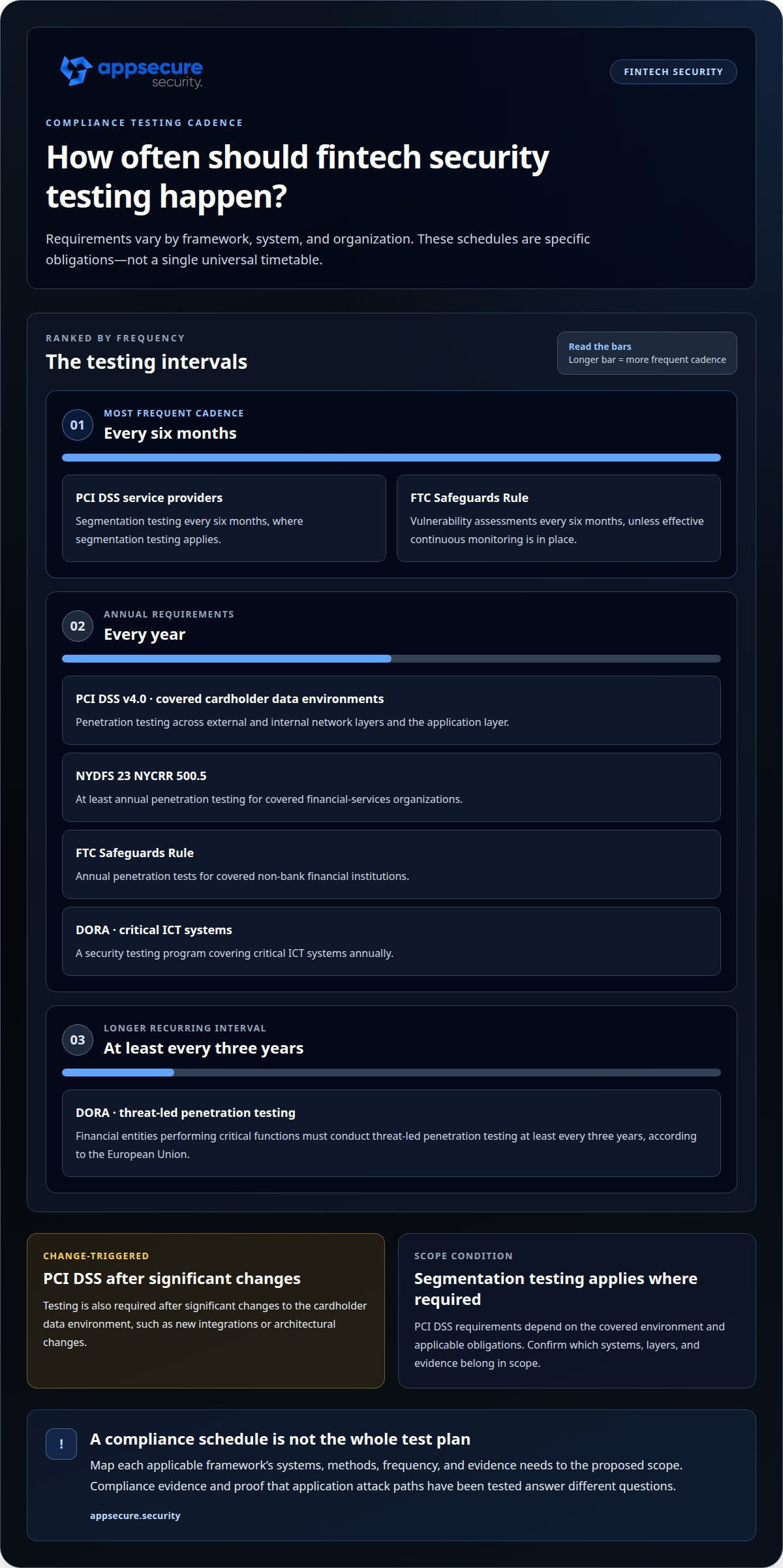
A vulnerability scan identifies known weaknesses; penetration testing validates exploitable paths; red teaming simulates adversary objectives across agreed systems. Each method answers a different question, so fintech teams shouldn’t treat one as a substitute for another. DORA requires annual security testing programs covering critical ICT systems, while the European Union requires financial entities performing critical functions to conduct threat-led penetration testing at least every three years.
Scope should follow the financial product’s attack surface. A web application test can examine session handling, injection, and access to another customer’s account. API testing can probe authorization and transaction validation. Mobile testing examines app-specific controls and how the client communicates with services. Cloud and network assessments look at exposed services, configuration, and segmentation. Market figures indicate that 72% of fintech companies prioritize web application security, while 57% focus on web applications and APIs.
Test protections for personal, banking, usage, and business data, including billing or payroll records. For a crypto wallet, testers can check whether cross-site scripting (XSS) could compromise a user session or expose sensitive interface actions. A Content Security Policy (CSP) can restrict which scripts a browser accepts, reducing some XSS risks, but it doesn’t replace identifying and fixing the underlying flaw.
Payment scope matters, too. PCI DSS penetration testing includes segmentation testing where applicable. Fintech companies developing payment solutions should test systems that process banking data, including technically linked applications. For a third-party processor, focus on calls and data exchanges between the fintech application and payment system, not the provider’s infrastructure.
Test Planning, Reporting, and Retesting
A fintech test moves from agreed scope through controlled assessment, evidence gathering, reporting, remediation, and retesting. Scoping identifies applications, APIs, environments, test accounts, and permitted techniques. Testing validates attack paths, and the report documents scope, confirmed findings, demonstrated impact, actionable remediation, and limitations. Set delivery timing as an engagement milestone; retesting then checks whether fixes close the original path.
To limit production disruption, authorize testing explicitly and define transaction controls, stopping conditions, and escalation contacts. Where payment logic allows, use staging or sandbox environments, processor test modes, and test card ranges. If production testing is necessary, restrict activity to approved systems and transactions, with clear stop and escalation procedures.
Fintech penetration testing regulations and compliance
Compliance requirements shape which systems, attack paths, and evidence belong in a fintech penetration test. Before setting scope, map the entity, jurisdictions, sensitive data, payment flows, and assessment obligations.
For covered payment environments, PCI DSS v4.0 requires annual penetration testing of the cardholder data environment across external and internal network layers and the application layer. PCI DSS testing must also follow significant changes to that environment, such as new integrations or architectural changes. Segmentation testing applies where required; PCI DSS service providers must conduct it every six months.
Other obligations depend on the organization and its regulatory status. NYDFS 23 NYCRR 500.5 requires covered financial-services organizations to conduct penetration testing at least annually. Under FTC Safeguards Rule 314.4(d)(2), covered non-bank financial institutions conduct annual penetration tests and vulnerability assessments every six months, unless effective continuous monitoring is in place. In the European Union, DORA requires a security testing program covering critical ICT systems annually. Financial entities performing critical functions must conduct threat-led penetration testing at least every three years, according to the European Union.
A single engagement can address overlapping requirements, but one report doesn’t automatically satisfy every framework. Map each framework’s systems, test methods, frequency, and evidence needs to the proposed scope. For example, a payment application test may support PCI DSS evidence while also examining controls relevant to SOC 2. Acceptance of the report depends on the receiving assessor, regulator, or organization.
GDPR, ISO 27001, NYDFS 500, and the FTC Safeguards Rule may also affect fintech security programs. The Australian Signals Directorate’s Essential Eight addresses baseline mitigation strategies; penetration testing examines exploitable weaknesses within an agreed scope. Essential Eight compliance therefore doesn’t replace a penetration test. A control checklist and an attack-path assessment answer different questions.
Choose a qualified provider by checking whether the proposed scope reflects financial workflows, internal and external systems, payment integrations, and applicable regulatory requirements. Look for findings tied to demonstrated impact, clear remediation guidance, and evidence relevant to the intended assessment. A report should state its scope and limitations, not imply universal compliance.
Before commissioning work, map the target framework clauses to test coverage and report evidence. This makes gaps visible before the engagement begins. For help defining a fintech assessment scope, discuss your testing requirements.
Identity, permissions and payment logic testing
Fintech platforms must control who can access each account and which actions each role can perform. Testing probes those boundaries and the rules governing financial transactions.
Identity and Permission Testing
Identity and permission testing checks whether authentication and authorization controls stop users from reaching accounts or functions they shouldn’t access. Prepare two test customer accounts to expose cross-customer access flaws, such as one user retrieving another customer’s transaction history. If staff administration is in scope, include at least one privileged role. Compare standard, premium, business, and admin workflows to uncover excessive permissions and inconsistent enforcement.
Test identity verification by attempting to bypass required checks or reuse a session beyond its intended permissions. Examine password-reset, account-recovery, and multi-factor authentication flows for gaps that could let an attacker take over an account. For SaaS financial services, verify customer-data isolation and test access between tenants, as well as between standard users and administrators. A vulnerability scan may identify known issues, but it won’t establish whether role boundaries hold across real workflows.
Transaction Integrity and Payment Logic
Transaction testing examines whether the application correctly validates, authorizes, and records payments and transfers. Probe balance manipulation through concurrent requests, payment bypass, transfer-amount validation failures, fee avoidance, and transaction replay. For example, replaying a valid request should not create an unintended second transaction. Trace the full transaction path, including the application’s calls to a payment processor and the data exchanged.
Use staging or sandbox environments to test payment logic, with processor test modes and test card ranges. Verify that changing the amount, recipient, currency, or transaction state cannot bypass server-side checks. Confirm that a rejected or interrupted request doesn’t leave inconsistent records. These checks assess transaction integrity, not merely whether the payment screen displays expected values.
Business Logic and Workflow Bypasses
Business logic testing challenges the constraints connecting steps in a financial workflow. A tester might try to skip identity verification, submit an action before approval, or access a feature reserved for another account tier. Each attempt checks whether the backend enforces the same rules as the interface instead of trusting client-side controls.
Penetration testing across FinTech apps, APIs, cloud environments, and networks
A fintech attack surface spans user interfaces, backend services, APIs, cloud infrastructure, and network paths. Include connected components in scope so testers can trace how a vulnerability in one environment could affect another.
Application and API Testing Scope
Application and API testing examines the web application, its backend, and the interfaces that exchange financial data. Scope matters because one broken authorization check can expose records across connected services. For REST APIs, testers assess broken object-level authorization, mass assignment, rate-limiting gaps, and improper handling of JWT tokens or API keys.
GraphQL requires distinct checks. Test whether production introspection endpoints expose schema details, deeply nested queries create denial-of-service risks, or field-level authorization leaves sensitive data accessible. Map third-party payment, banking, and data-aggregation integrations, too. Assess whether channels authenticate properly and imported or exported financial data is validated. Automated scanning can flag common flaws, but testers need to examine how these controls work in real workflows.
Mobile, Wallet, and Smart-Contract Testing
Mobile, wallet, and smart-contract testing assesses client software and the financial actions it can initiate. For a mobile application, trace requests from the device to backend APIs and check whether sensitive actions rely on server-side authorization. For a crypto wallet, include the interface and connected services in scope, then assess how they handle account access and transaction requests.
For smart contracts, define the contract addresses, functions, and interactions included in the assessment. Examine whether access restrictions and transaction rules match the intended design. Scope matters: testing a mobile interface alone won’t assess the APIs or contracts it calls.
Cloud testing examines infrastructure and configuration across the fintech’s agreed cloud environments, such as AWS, Azure, or Google Cloud. Assess externally reachable services, identity permissions, storage access, and paths between application components. For example, check whether a storage resource holding financial data is exposed through its configuration or reachable through an unintended service role. Trace how cloud controls protect data moving between the application and backend.
Network testing adds internal and external paths to the assessment. Identify exposed services, check whether network boundaries isolate sensitive systems, and test segmentation where applicable. Connect each finding to an affected application or data flow: an exposed backend service may create a route to an API or cloud resource. Fintechs should revisit scope after material changes to payment flows, authentication, or infrastructure, since a new integration can create a different attack path.
Fintech penetration testing costs
The cost of a fintech penetration test reflects the work required to test its actual attack surface. A single payment API differs from a platform spanning a web application, mobile clients, cloud infrastructure, and partner integrations. The key question is how much manual investigation is needed to validate attack paths, not simply how many screens the product contains.
Scope is a major cost driver. A focused external test of one API differs from an assessment covering internal networks, multiple applications, staff workflows, and cloud configuration. Each additional component adds effort when testers trace authentication, permissions, and sensitive financial data across system boundaries. A payment feature linked to banking or data-aggregation services also requires examining exchanges between those systems.
Complexity matters as much as breadth. A basic endpoint check won’t reveal whether a user can bypass authentication, change a transfer amount, or manipulate transaction state through concurrent requests. Business-logic testing requires understanding the intended workflow and manually probing its controls. When a fintech needs both technical coverage and payment-behavior validation, the work goes beyond automated scanning.
Compliance objectives can expand the assessment. A PCI DSS-aligned scope may include application, internal and external network layers, and segmentation testing where applicable. An assessment across multiple environments also requires clarity about which systems support payment processing and which are technically connected. Reports should clearly identify assessed assets, confirmed findings, demonstrated impact, remediation guidance, and testing limitations.
The testing environment and coordination also affect the effort. A sandbox with processor test modes can support safe payment-flow testing. Production testing requires explicit authorization, transaction controls, stopping conditions, and escalation contacts. Different access levels, test accounts, and cloud environments may require additional setup. Retesting exploitable findings adds work, but verifies whether remediation closes the original attack path.
The price depends on the engagement and is provided after a quote request. Main cost factors include the number and complexity of applications and APIs, environments, user roles, integrations, compliance objectives, testing depth, reporting needs, and retesting scope. A tightly defined assessment can focus effort on priority risks; a broader scope takes more time to trace attack paths across connected systems.
To shape a useful budget, define the assets, payment flows, authentication paths, and compliance evidence the assessment must cover. Then separate essential systems from optional additions and identify what needs retesting. Request a scoped penetration testing quote based on your fintech environment and assessment objectives.
AppSecure Security: Web Application Penetration Testing
AppSecure Security provides Web Application Penetration Testing to investigate vulnerabilities in fintech web applications, including authenticated workflows and access to sensitive data. Choose this assessment when a launch, major change, or security review calls for evidence beyond automated scanning. Testing can examine application behavior and how permissions or payment-related functions are enforced.
For a broader attack surface, AppSecure Security also provides Mobile Application Penetration Testing and API Penetration Testing. These assessments cover connected application and interface risks within an agreed scope. The Agentic Penetration Testing Platform can also support fintech environments that need coverage across application areas.
Contact AppSecure Security to discuss your fintech testing requirements.
Make Security Testing Part of the Release Cycle
Turn assessment findings into owned engineering work. Assign each issue to a responsible team, link remediation to the affected workflow, and track whether the fix closes the demonstrated path. This creates a practical bridge between security testing and release decisions, rather than leaving the report disconnected from product delivery.
As your fintech product changes, revisit its threat assumptions. A new integration, authentication flow, or feature can shift where risk lies. Treat fintech application penetration testing services as an input to planning, so testing priorities follow meaningful changes rather than the calendar alone. The goal is a clear cycle: test, remediate, validate, and apply lessons to the next release.
AppSecure Security can help assess web and mobile applications and support broader testing through its Agentic Penetration testing Platform. Contact AppSecure Security to discuss the testing needs and scope that fit your fintech environment. Take the next step with a focused plan your teams can act on.
Frequently Asked Questions
What types of Fintech applications can be tested?
Testing can cover digital banking, lending, payments, money-transfer, investment, and cryptocurrency applications—from international remittance platforms like ducapp.com to peer-to-peer payment tools. An assessment can include customer-facing interfaces and the supporting systems that process requests. For example, a mobile banking app may rely on a web application for account management and APIs for transaction data. Scoping these dependencies helps reveal risks a test limited to one interface could miss.
How much do fintech pentesting services cost in 2026?
There is no single price for every fintech engagement. Cost depends on the systems in scope, their complexity, testing depth, integrations, compliance objectives, reporting needs, and retesting. A single payment interface differs from a platform spanning several applications and environments. A project-specific quote follows a defined scope, helping teams compare the proposed work with their assessment needs.
Perform a pentest?
To arrange a fintech penetration test, first identify the application owner, systems involved, and business workflows the assessment should examine. Prepare test accounts with appropriate roles and document permitted actions, especially for payment activity. Set an escalation path for unexpected behavior. These preparations give testers a controlled way to assess the application and help internal teams respond quickly to operational concerns.
What is included in fintech application penetration testing services?
A scoped assessment typically combines technical testing with investigation of how the application behaves under adversarial use. It can examine authentication, access controls, APIs, integrations, and the handling of financial information. The deliverable should identify confirmed findings, explain demonstrated impact, and provide remediation guidance. Make sure testing limitations and affected components are clear, so engineering teams can turn findings into specific fixes.
How much do fintech application penetration tests cost in the United States?
The cost depends on the engagement scope and is provided after a quote request. Key factors include the number and complexity of applications, integrations, environments, user roles, compliance objectives, testing depth, and retesting needs. A US-based fintech should also define which systems support sensitive financial activity and what evidence its internal stakeholders require. Those details help shape a quote around the work involved.
Which US regulations and standards apply to fintech penetration testing, such as PCI DSS, GLBA, and SOC 2?
Applicability depends on the organization, data, and services involved. PCI DSS is relevant to payment-card environments; the FTC Safeguards Rule applies to certain US financial institutions. NYDFS 23 NYCRR 500.5 requires covered financial-services organizations to conduct penetration testing at least annually. GLBA-related obligations and SOC 2 assessment needs should be mapped to the specific entity and systems, rather than assumed to apply identically to every fintech.
What types of fintech applications and systems should be tested?
Prioritize systems that create, authorize, process, or display financial activity. These may include customer applications, staff consoles, partner connections, transaction-processing services, and cloud resources supporting those functions. A useful scope follows a sample transaction from initiation through confirmation, including the services that receive or transform its data. This helps teams identify dependencies that an isolated asset assessment may miss.
What common security vulnerabilities are found in fintech applications and APIs?
Common issues include broken object-level authorization, excessive permissions, weak session handling, mass assignment, and inadequate rate limits. APIs may also mishandle JWT tokens or API keys. In financial workflows, flaws can let users change transaction values, access another customer’s records, or repeat an action unexpectedly. Automated scanning can flag some technical weaknesses, while manual testing investigates context-specific logic and access-control paths.




































































































