



A polished report is not proof that a penetration test will protect your business. The strongest penetration testing companies combine hands-on security expertise with testing tailored to your systems, evidence of exploitable risk, and practical remediation guidance. Choose a provider for the depth and relevance of its work, not the length of its credentials list.
A useful test should uncover more than familiar vulnerabilities. You need findings that show what an attacker could reach, how the risk affects your business, and what to address first.
This guide explains how to assess a provider’s expertise, scope, methods, and reporting. It compares Pentest as a Service (PTaaS) with traditional testing, outlines the differences between application, cloud, and broader assessments, and helps you match an approach to your systems and security goals.
Key Takeaways
• Match the assessment to your business size, systems, risk priorities, and security maturity.
• Choose between PTaaS and traditional testing based on how often your systems change and how your team uses findings.
• Assess providers by the depth of their testing, the relevance of their expertise, and the clarity of their reports.
• Scope web, mobile, API, cloud, and network testing around the assets and attack paths that matter most.
• Use manual penetration testing to uncover exploitable weaknesses, and consider red teaming when you need to assess how defenses work together.
What Makes a Top Penetration Testing Company?
A strong provider matches its approach to your systems, risk priorities, and compliance needs. Look beyond firm size: the testers’ expertise, defined scope, actionable reporting, and fit with your security operations matter.
Matching Providers to Company Needs
Company size can shape an engagement, but system complexity and risk should drive its scope. A small business with a customer-facing web application may need focused application testing; a large enterprise may need coordinated assessments across applications, cloud environments, and internal networks. Ask how the proposed scope connects findings to business-critical assets, not just how many systems it covers.
External providers can bring an independent perspective and specialized testing skills. Internal security teams contribute architectural knowledge and can coordinate access, testing windows, and remediation. Effective collaboration gives testers enough context to investigate real attack paths while keeping the internal team involved. For AI and large language model systems, include prompt handling, sensitive data exposure, connected tools, and output controls in the assessment. Internal and external assessments reveal different exposure paths, so choose according to your threat model.
Compliance, Permissions, and Testing Rules
In the United States, PCI DSS requires penetration testing under Requirement 11.4. The U.S. Department of Health and Human Services identifies HIPAA as relevant to penetration testing compliance, while ISO 27001 is described as recommending testing as a best practice rather than specifically requiring it. Map the applicable standard to the systems and evidence your organization needs.
Before testing, obtain written authorization from the owners of every in-scope system. Define permitted targets, testing methods, timing, emergency contacts, and stop conditions in the rules of engagement. Include cloud or other third-party assets only when the relevant owner has authorized testing. These steps set clear boundaries and help internal teams coordinate monitoring and response without interrupting normal operations.
Reports, Priorities, and Testing Limitations
A useful report connects each vulnerability to its affected system, evidence, business impact, and recommended remediation. According to the U.S. Department of the Interior, a brief summary report provided on the last day of testing identifies all discovered vulnerabilities and affected systems. Findings should help teams prioritize work by exploitability, potential impact, exposure, and the importance of the affected asset.
Penetration testing is a scoped assessment, not proof that every weakness has been found. Results reflect the assets, access, and methods covered by the engagement; untested systems and later changes fall outside its findings. Active testing can affect systems if it triggers unexpected behavior, so agreed boundaries and internal coordination matter. For security platform integration, request findings in a format that fits your triage and remediation workflow, with clear ownership and resolution tracking.
Penetration Testing as a Service (PTaaS) versus traditional testing
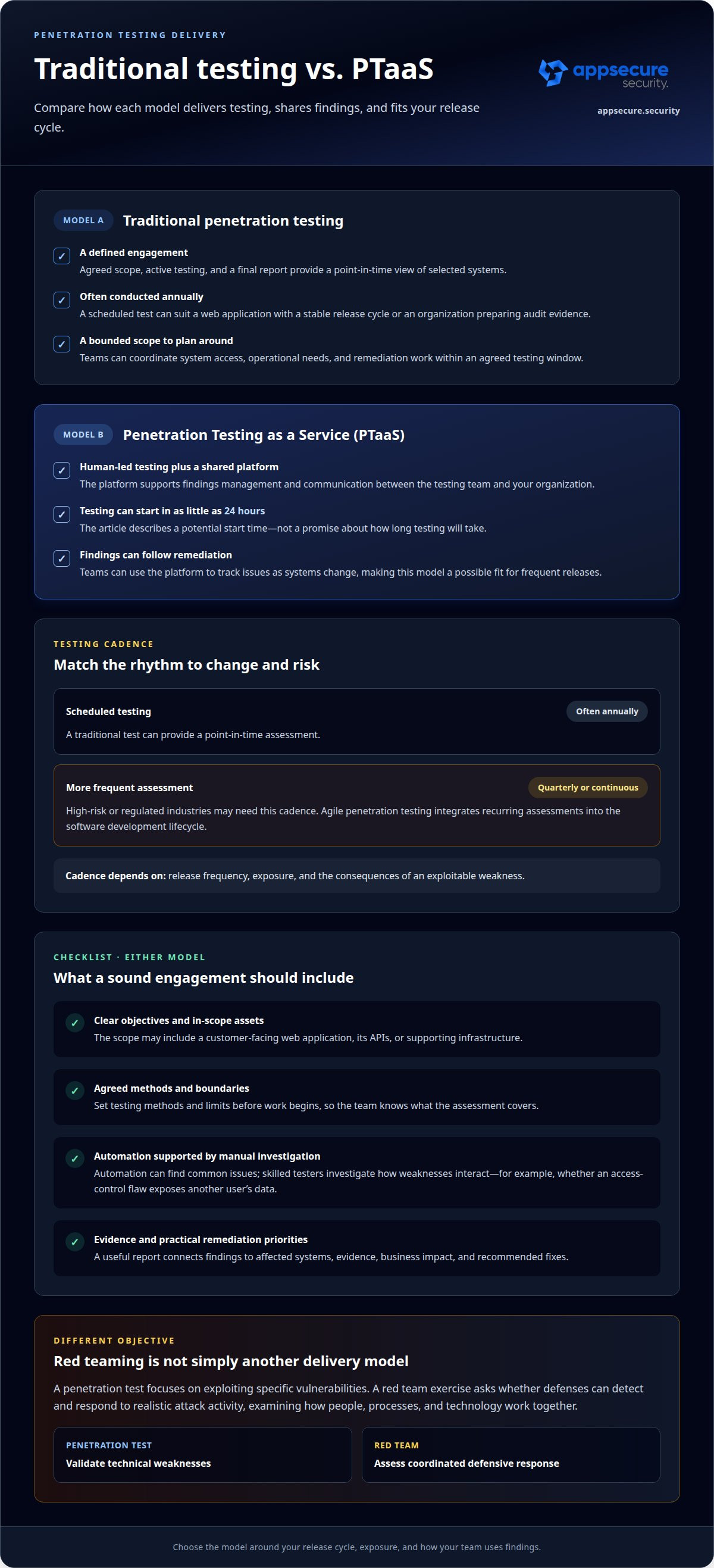
PTaaS and traditional testing differ mainly in how the work is delivered and feedback is shared. A traditional penetration test is a defined engagement with agreed scope, active testing, and a final report. PTaaS adds a platform for managing findings and collaboration, helping teams track weaknesses as systems change.
How the two approaches work
Traditional testing is often conducted annually, providing a point-in-time view of selected systems. It can suit a web application with a stable release cycle or an organization preparing evidence for an audit. A bounded scope helps teams plan testing around system access, operational needs, and remediation work.
PTaaS combines human-led testing with a shared platform for findings and communication. Testing can start in as little as 24 hours, and teams can use the platform to follow issues through remediation. That model can fit development teams that release changes regularly and need test results connected to ongoing work.
High-risk or regulated industries may need quarterly or continuous testing. Agile penetration testing integrates recurring assessments into the software development lifecycle rather than relying only on infrequent test windows. The right cadence depends on release frequency, exposure, and the consequences of an exploitable weakness.
From scope to findings
An engagement starts by setting objectives and identifying in-scope assets, such as a customer-facing web application, its APIs, or supporting infrastructure. The team then agrees on testing methods and boundaries. Testers use offensive techniques to investigate weaknesses, validate exploitable paths, and record evidence. The final report explains findings and remediation priorities.
Both models may combine automated discovery with manual investigation. Automation can identify common issues across defined assets; skilled testers examine how weaknesses interact, such as whether an access-control flaw exposes another user’s data. The method should suit the target, not substitute a scan for hands-on assessment.
Where continuous red teaming fits
Continuous red team services answer a different question: can an organization’s defenses detect and respond to realistic attack activity over time? A red team exercise examines how people, processes, and technology work together, while a penetration test focuses on exploiting specific vulnerabilities. Choose according to whether you need to validate a technical weakness or test coordinated defensive response.
Use traditional testing for a clearly bounded assessment or a scheduled compliance need. Consider PTaaS when development changes often and teams need findings integrated into their workflow. For a recurring offensive assessment, define which assets and releases matter most before setting the cadence. A focused discussion about testing scope can help translate those priorities into an engagement plan.
Choosing a penetration testing provider
Choose a provider whose technical specialties match your systems and threat model. Compare how each engagement defines scope, testing depth, evidence, and remediation priorities.
Provider Specialties and Ideal Customers
Start with the assets that matter most. A company running a customer-facing web application needs application testing expertise; an organization with complex infrastructure may need coverage across cloud environments, networks, and internal systems. Providers also vary in their experience with APIs, mobile applications, and AI systems. Match the specialty to the attack paths you need to assess.
Your organization’s needs matter, too. A startup may need a tightly scoped assessment of its core product, while a large enterprise may need coordinated testing across business units and varied environments. Compare proposed engagements by scope and methods, not firm size alone. The right team can investigate relevant vulnerabilities and explain their business impact.
Provider Comparison Criteria
Compare providers against the same criteria to make proposals meaningful. The guide assigns 20% of its provider scoring to compliance and report quality. It also recommends alignment with OWASP and NIST frameworks for comprehensive, consistent, and repeatable testing. Look for a clear description of how those frameworks shape the scope, techniques, and final deliverables.
Check whether the proposal distinguishes manual validation from automated discovery and explains how testers confirm vulnerabilities. A useful comparison covers in-scope applications and infrastructure, testing boundaries, reporting format, and retesting approach. Consider how findings reach your internal team. A report should connect technical evidence to impact and remediation, rather than present an unprioritized list of issues.
Provider Selection Factors
Base your selection on your primary threat and operational needs. For example, a business handling sensitive customer data may prioritize access-control testing, while a company with frequent releases may value repeatable testing that fits its development workflow. Before testing begins, make sure the engagement defines objectives, in-scope assets, and permitted techniques.
Review the testers’ relevant experience and each proposed team member’s role. Ask how the provider will communicate urgent findings during the engagement and deliver final results. Internal security staff can explain architecture and coordinate safe access. These details show whether the plan fits your operating environment rather than relying on a generic package.
Finding Reputable Local Providers
Proximity can help with coordination, but local presence alone does not establish testing quality. Assess local providers using the same scope and reporting criteria as remote firms. A clear proposal identifies the systems covered, testing methods, communication process, and deliverables. For an external assessment, it also defines which exposed assets are in scope.
Use a consistent comparison record to evaluate each proposal: specialty, relevant experience, framework alignment, report quality, and fit with your internal workflows. Prioritize the provider whose approach best matches your threat model and infrastructure. This keeps the decision focused on technical coverage and usable findings, not geography or presentation alone.
Cloud, web, mobile, network, and internal testing
Choose assessment coverage by mapping systems to likely attack paths. Cloud environments, customer-facing web applications, mobile apps, and internal networks each expose different weaknesses.
Cloud, Web, and Mobile Testing
Cloud testing examines configuration and access paths within the agreed environment. For example, testers can assess whether permissions allow unintended access between cloud resources. Web application testing focuses on application behavior, including authentication, authorization, and data handling. Mobile testing also examines client-side behavior and communication between an app and its services.
APIs may be part of these assessments because a mobile app can rely on API calls to retrieve or update account data. Define the scope of each component explicitly. Testing the mobile interface alone may not cover the API or cloud resources behind it. Connect findings to affected functions and document remediation steps for the responsible technical team.
IoT and internet-connected devices need a distinct scope. For a connected camera, sensor, or control device, an assessment can examine exposed interfaces, access controls, and communication with other systems. Identify device models, relevant services, and permitted testing boundaries before work begins. This helps distinguish device-level weaknesses from risks in the network or supporting cloud environment.
Internal and External Network Testing
External network testing examines systems reachable from outside the organization, such as exposed services or remote access points. It helps assess how an external threat could approach the defined perimeter. Internal network testing starts from an inside position, such as a user workstation, and examines possible paths to sensitive systems. These perspectives reveal different routes through an organization’s network.
Define the starting point and target assets for each test. An external assessment might include approved public-facing infrastructure, while an internal assessment might focus on access between user devices and sensitive servers. This distinction affects the test’s assumptions and the meaning of its findings. The report should identify the source of each observed weakness and explain its potential path through the environment.
Network scope should account for segmentation and shared services. If a business unit uses common identity systems or infrastructure, those dependencies can affect the paths testers examine. Threat intelligence can help frame relevant scenarios, but the assessment still depends on authorized assets and techniques. Keep external and internal results distinct, then prioritize remediation by exposure, reachable assets, and business impact.
For a broader cybersecurity view, connect network findings with relevant cloud, web, mobile, and IoT results. This context can show whether a weakness is isolated or part of a larger attack path. Clear asset ownership, supporting evidence, and remediation guidance make results useful across infrastructure and application teams.
Manual testing, red teaming, and attack surface management
Manual testing, red teaming, and attack surface management answer different security questions. Manual testers validate whether specific weaknesses can be exploited, while a red team examines how defenses respond to a broader attack. Attack surface management helps identify exposed assets that need attention.
Manual Testing and Attack Surface Coverage
Automated tools can identify potential weaknesses, but manual validation determines whether a finding creates a real attack path. For example, a tester may combine an access-control flaw with a weak workflow to assess whether one user can reach another user’s data. The report should explain the evidence, affected assets, and remediation priorities.
Attack surface management starts with knowing which systems are exposed and how they connect. The average organization tests about 32% of its attack surface. That figure highlights a practical scoping challenge: an assessment can only validate the systems and paths included in its scope. Map exposed applications, APIs, cloud assets, and network entry points before setting test priorities.
Penetration Testing Versus Red Teaming
A penetration test focuses on exploiting specific vulnerabilities at the network or application level. Red teaming provides a broader assessment of how an organization’s people, processes, and technology work together to defend against threats. For example, a web application test might validate an account-access flaw, while a red team exercise examines whether defenders detect and contain a simulated intrusion.
The right choice depends on the question. Use a focused penetration test to validate technical weaknesses and guide remediation. Use red teaming to examine detection, decision-making, and response across defensive teams. Organizations with a high level of security maturity should regularly perform both exercises, since neither replaces the other.
Purple Teaming and Enterprise Exercises
Purple teaming brings offensive testers and blue team defenders together for a collaborative exercise. The red team demonstrates an agreed attack technique while the blue team observes detection and response. Together, they can review alert gaps, improve playbooks, and repeat the test against the same technique. This makes the exercise useful for training, not just evaluating defenses.
Enterprise red teaming requires coordination across business units, security operations, and system owners. A simulated attack may touch identity systems, applications, or internal processes, so rules of engagement must define targets, boundaries, escalation contacts, and stop conditions. Clear objectives keep the exercise focused on defensive outcomes rather than activity for its own sake.
For a scoped red-team exercise, discuss your red teaming objectives and the defensive outcomes you need to evaluate.
AppSecure Security: Web Application Penetration Testing
AppSecure Security provides Web Application Penetration Testing to help businesses identify exploitable weaknesses in their web applications. Choose this assessment for a hands-on review of application security risks, not just automated checks. Its manual, hacker-led approach focuses on uncovering deeper technical vulnerabilities.
For systems beyond a web application, AppSecure Security also provides Mobile Application Penetration Testing and API Penetration Testing. The Agentic Penetration Testing Platform supports testing across web, mobile, API, IoT, and cloud environments. Choose the scope based on the systems and attack paths you need assessed.
Share your testing goals and systems with AppSecure Security to discuss the right assessment for your business.
Turn Your Security Priorities Into Action
The value of an assessment lies in what your team does next. Treat each finding as an input to security decisions: assign ownership, plan remediation, and use the results to shape future testing as your systems evolve. A good partner makes this process clearer, not leave your team with technical issues and no practical direction.
When evaluating penetration testing companies, focus on how their work will support your next security decision. Define the system or risk you want to address, then align the assessment with that priority. A clear starting point helps your security and engineering teams turn testing into progress.
AppSecure Security can help assess your web application, mobile application, or broader testing needs. Contact AppSecure Security to discuss your assessment and take a purposeful next step toward stronger security.
Frequently Asked Questions
Do I Need a Pen Test or a Red Team Engagement?
Choose a penetration test to validate specific technical weaknesses; choose red teaming to examine how people, processes, and technology respond to an attack. For example, test a payment web application for access-control flaws, or use a red team exercise to assess whether defenders detect and respond to a simulated intrusion. Organizations with mature security programs can use both, since each answers a different question.
How often should organizations perform penetration tests?
Most organizations should conduct penetration testing at least once a year, and after major releases, infrastructure changes, or new market launches. High-risk or regulated organizations may need quarterly or continuous testing. A team making substantial changes regularly can align assessments with its development cycle, while a major system migration—such as rolling out an all-in-one business platform like TSEA - ERPNext—is a clear reason to test outside the usual schedule.
What Is a Penetration Test?
A penetration test is an authorized security assessment that uses offensive techniques to identify and validate exploitable weaknesses in defined systems. For example, testers might examine whether a flaw in a web application lets one user access another user’s information. The engagement has agreed boundaries and produces findings that help teams understand technical risk and plan remediation.
Why is Independent Security Testing Important for Your Business?
Independent testing brings an external perspective that can uncover assumptions internal teams may overlook. A tester unfamiliar with an application’s intended behavior can investigate it as an attacker would, then document evidence for security and engineering teams. An assessment may reveal that separate, seemingly low-risk issues combine into a path to sensitive data, helping the business prioritize remediation.
What services do penetration testing companies offer?
Services can include web application, mobile application, API, cloud, and network testing, as well as vulnerability assessment and penetration testing. Some providers also conduct red team engagements or offer platforms for frequent testing. AppSecure Security provides web application, mobile application, and API penetration testing, cloud security assessments, red teaming, and an Agentic Penetration Testing Platform. Select services according to the systems and risks in scope.
How much does a penetration test cost in the United States?
Pricing depends on the engagement’s scope and is provided after a quote request. Key factors include the number and complexity of applications or systems, testing depth, required access, and reporting needs. A focused assessment of one web application differs from testing applications, APIs, cloud infrastructure, and networks together. Define the assets and objectives first so the proposed work reflects the assessment you need.
What factors affect penetration testing pricing and timelines?
Scope, system complexity, access arrangements, and testing methods shape pricing and timelines. A single web application with a defined test environment differs from interconnected applications, APIs, and cloud assets. Scheduling also depends on coordination with system owners and internal security teams. Clear objectives and asset boundaries help the testing team estimate effort and prevent delays caused by unclear scope.
How do I compare and choose a penetration testing company?
Compare providers by relevant technical expertise, proposed scope, testing methods, report quality, and how findings support remediation. Check that their experience fits your systems, such as APIs or mobile applications, and that the engagement aligns with your compliance needs. Organizations operating across India, the United States, the United Kingdom, Dubai, Canada, Singapore, France, or Italy should also account for the systems and teams involved in each market.




































































































