



A penetration test puts your systems under controlled attack to uncover exploitable weaknesses and assess how well security controls hold up. For ISO 27001 compliance pentesting, UK organisations can use the findings as evidence within their information security management system (ISMS), but a test alone does not prove compliance or secure certification. ISO/IEC 27001:2022 Annex A contains 93 reference controls.
It’s easy to assume that a penetration test report is simply a pass-or-fail document. In practice, its value depends on whether the scope is relevant, the findings are clear, and remediation is tracked through retesting. The report should help your team understand what was tested, what was found, and what action followed.
This article explains what penetration testing can contribute to an ISO 27001 programme, how to prepare audit-ready evidence, and when testing may be appropriate. It also covers reporting, remediation and retesting, so you can connect technical findings to risk management and continual improvement without mistaking a single test for the whole compliance process.
Key Takeaways
• A penetration test can provide useful security evidence, but it doesn’t prove ISO 27001 compliance on its own.
• Connect findings to relevant risks and Statement of Applicability controls so audit evidence has clear context.
• Set the test scope around your organisation’s systems, likely attack paths and security objectives.
• Turn findings into tracked remediation actions, then retest to confirm whether fixes have addressed the issues.
• Use testing as part of ongoing risk management, including after significant changes to in-scope systems.
What is ISO 27001 Penetration Testing?
ISO 27001 penetration testing is a controlled assessment that probes systems for exploitable weaknesses. It tests whether technical safeguards resist realistic attack paths, rather than simply confirming that policies exist. Within an ISO 27001 information security management system (ISMS), findings can inform risk decisions and show how security controls perform in practice. A penetration test supports the programme; it does not prove compliance by itself.
ISO 27001 certification is not mandatory by law in the UK, although contracts or industry expectations may make it commercially necessary. Separately, according to the UK Government, UK GDPR Article 32 is relevant to regular testing of the effectiveness of security measures. These are distinct considerations: certification addresses an organisation’s ISMS, while data-protection duties concern the security of personal data. A contract may also define its own testing expectations, so the applicable obligation depends on the organisation’s context.
Annex A provides reference controls for selecting and assessing security measures. ISO/IEC 27001:2022 contains 93 reference controls, grouped into organisational, people, physical and technological themes. Penetration testing is most directly useful where technical controls need validation, but technical weaknesses can expose failures in access policies or incident response. The standard identifies penetration testing as a way to verify controls and assess resilience against real-world attacks. Penetration testing may help assess whether relevant security controls are working effectively.
Testing can examine internet-facing infrastructure, a web application, or internal access paths. For example, an assessor may test whether an unauthorised user can reach sensitive records through an access-control flaw. The evidence helps teams understand the weakness, its potential impact, and the security measures involved. Automated scans can find known vulnerabilities, but may miss complex issues involving application logic, permissions, or user behaviour. Manual investigation can explore how weaknesses combine to create a viable attack path.
Choose a UK penetration-testing provider whose proposed scope matches your systems, risks and audit evidence needs. Assess whether its reporting explains findings clearly, maps them to relevant controls, and supports remediation and retesting rather than delivering scan output alone.
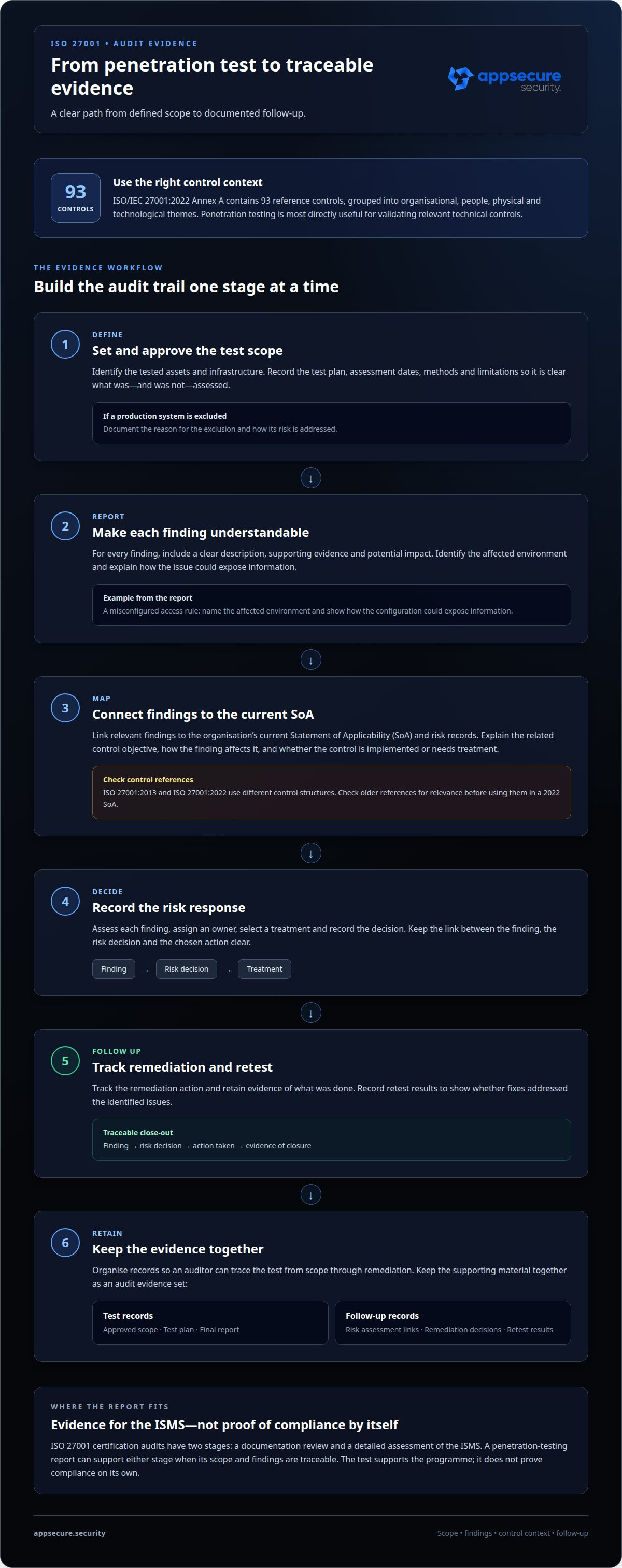
An audit-ready report connects the tested assets, methods, findings, risk decisions, and remediation records. Control mapping should use the organisation’s current Statement of Applicability, not references copied from an older control structure. This gives auditors a traceable view of what was tested, why the evidence matters, and how the ISMS responded.
Audit-ready reports and Statement of Applicability mapping
A report becomes useful audit evidence when it connects a defined test to information security risks, control decisions, and follow-up. The Statement of Applicability (SoA) provides the control context for that connection.
Reports for Certification Audits
A penetration-testing report records what was assessed, what the testing found and how the organisation responded. During certification audits, this helps demonstrate that technical evidence informs the information security management system, rather than sitting apart from it. ISO 27001 certification audits have two stages: a documentation review and a detailed assessment of the ISMS. A report can support either stage when its scope and findings are traceable.
For a Stage 2 or upcoming surveillance audit, schedule testing early enough for findings to enter the risk process. The report should identify tested assets, assessment dates, methods, limitations and technical results. Each finding needs a clear description, supporting evidence and an explanation of potential impact. For example, a misconfigured access rule should identify the affected environment and show how that configuration could expose information.
Map relevant findings to the current SoA and risk records. The mapping should explain which control objective the evidence relates to, how the finding affects that objective, and whether the control is implemented or needs treatment. ISO 27001:2013 and ISO 27001:2022 use different control structures. Therefore, older control references should not be copied into a 2022 SoA without checking their relevance. A useful mapping preserves traceability from finding to risk decision, action and evidence of closure.
Audit Evidence and Test Documentation
Audit evidence is the organised record that lets an auditor trace the test from scope through remediation. Keep the approved scope, test plan, final report, risk assessment links, remediation decisions, and retest results together. This documentation helps show why assets were selected and how the management system handled the results. It also makes external review more straightforward: each conclusion has a supporting record. For organisations operating across regulated sectors where security testing overlaps with broader regulatory expectations, implementing DORA compliance validation software can help verify technical controls and keep audit documentation aligned across frameworks.
Choose testers with demonstrable technical competence, a clear methodology, and experience relevant to your systems. A certification can support an assessment of competence, but no badge replaces a well-defined scope, defensible findings, and useful retest evidence.
If you need a report built around your audit evidence needs, discuss your testing scope and the systems it must cover.
How penetration testing supports ISO 27001’s risk-based ISMS and PDCA cycle
Penetration testing supplies technical evidence for an ISMS risk assessment. It shows how a threat could exploit weaknesses across connected systems. ISO 27001 Clause 6.1.2 requires organisations to define and apply an information security risk assessment process. Clause 8 requires risks to be assessed and treated appropriately. Testing can make those decisions more grounded in observed attack paths.
The Plan-Do-Check-Act (PDCA) cycle turns evidence into continual improvement. During planning, the organisation identifies risks, assets, and security objectives. The engagement then tests selected controls against realistic attack paths. Reports help teams check whether safeguards work as intended. Risk owners can choose corrective action, record decisions, and feed remaining exposure into the next planning cycle. A test is most useful when its findings inform those decisions, not when the report simply enters an archive.
Risk treatment should consider the affected information and the likely business impact. A flaw that exposes sensitive records may carry different consequences from a weakness on an isolated test environment. The organisation can reduce risk through a technical fix, change a process, or formally accept residual risk through its governance process. Each decision should connect the finding to the relevant risk record and accountable owner. ISO 27001 requires organisations to consider risks to confidentiality, integrity and availability.
Scope should follow the systems and attack paths that matter to the ISMS. An engagement might examine a web application, its API, cloud configuration, network infrastructure, or mobile application. These components often interact. Testing only an application’s visible interface may miss an API permission flaw or an exposed cloud resource that changes the attack path. Include internal systems when the scenario involves access through a compromised asset or rogue device. External testing assesses internet-facing infrastructure from an internet-based attacker’s perspective.
The testing perspective determines what the assessor knows at the start. In a black-box test, the assessor begins with little internal information, modelling an outside attacker’s view. A gray-box assessment provides limited knowledge or access and is often the most common perspective. A white-box test supplies detailed system information, such as architecture or source code, to support focused analysis. The right model depends on the risk question, access assumptions, and evidence needed.
For a web application, testing can examine authenticated and unauthenticated access. API testing can probe whether permissions remain effective across endpoints. Cloud assessment can focus on configurations and trust relationships, while mobile testing can examine how the application handles data and communicates with services. Define the assets, test boundaries, access model and exclusions before work begins. ISO/IEC 27001:2022 does not prescribe one universal penetration test or annual testing frequency for every organisation. The ISMS risk assessment should drive the scope and timing.
Remediation, retesting, and continual improvement
A penetration test creates value when findings lead to verified technical action. Remediation should address the weakness and the route that made exploitation possible. ISO/IEC 27001 clause 10.2 covers nonconformity and corrective action. That makes ownership, treatment decisions and follow-up essential parts of the improvement process. In an ISO 27001 compliance pentesting UK programme, each finding needs a clear route from discovery to resolution.
To prepare for a UK penetration test, define the authorised scope, nominate technical contacts, and agree how urgent findings will be escalated. Provide relevant architecture and access details, and ensure teams can respond to operational issues during the engagement. After testing, assign each finding an owner, evaluate its risk, and track remediation through retesting.
Triage
Assess exploitability, affected assets, information sensitivity and business impact.
Assign
Name an accountable owner and record the planned corrective action.
Fix
Resolve the root cause, such as excessive permissions or unsafe input handling.
Retest
Reassess the original finding and preserve evidence of the result.
Prioritisation should reflect the attack path, not just a scanner label. For example, a technical flaw that allows unauthorised access to sensitive records may need faster treatment than a lower-impact configuration issue. The risk register should capture the finding, affected asset, business consequence, treatment decision, owner and status. If remediation changes the risk assessment, update the recorded likelihood or impact rationale. Keep links between the original report, change record and retest result. This traceability keeps ISO 27001 compliance pentesting UK findings connected to decisions and corrective action.
Not every finding leads to an immediate fix. An organisation may accept a risk when decision-makers understand the exposure and document why treatment is not currently selected. Record the rationale, accountable approval, compensating controls, and review trigger. Accepting a risk is a conscious management decision, not evidence that the technical issue has disappeared. Revisit it when the affected system changes, controls weaken, or the threat landscape shifts.
Retesting checks whether a corrective action resolved the reported weakness. It should reproduce the relevant attack path, verify the change, and identify whether the fix created another issue. If an access-control repair blocks one route but leaves another endpoint exposed, the finding remains open. Reports should distinguish resolved, partially resolved, and unresolved issues, with evidence supporting each status.
Continual improvement also means looking for patterns across findings. Repeated permission errors may point to a wider access-control weakness, while recurring configuration flaws may reveal gaps in change processes. Use these patterns to refine security policies, technical controls, and future assessment scope. Automated scans can help identify known issues, but manual retesting evaluates whether fixes withstand the original attack logic. A fresh penetration test after significant changes to an application, infrastructure, or threat landscape can reveal risks introduced since the previous assessment.
What should an ISO 27001 penetration test scope and report include?
A strong scope connects the assessment to the systems and risks covered by the information security management system. It defines what testers may examine, how they may access it, and which boundaries they must respect. For example, a customer-facing web application may rely on an API, cloud services, and identity controls. Leaving a key dependency outside the scope can hide an attack path that crosses those components.
Define each in-scope asset precisely. Record application names, environments, network ranges, API endpoints, mobile platforms, and relevant cloud accounts. Separate production from staging, and state whether authenticated testing uses supplied user roles. Include each asset’s business purpose and the types of information it handles. If a payment workflow or sensitive customer record is excluded, document the boundary and rationale.
The authorisation and rules of engagement should make permitted activity clear. They identify approved targets, testing methods, escalation contacts, and actions that could affect service availability. For example, the scope can prohibit destructive tests against production while permitting controlled validation of an access-control flaw. Record third-party dependencies and exclusions so findings aren’t attributed to systems outside the agreed boundary.
Purpose and boundaries
State the assessment objectives, assets, environments and exclusions.
Access model
Describe test accounts, user roles and any initial knowledge supplied.
Operational rules
Set authorisation limits, escalation contacts and safety constraints.
Evidence handling
Define how sensitive screenshots, logs and test data are protected.
The report should let technical teams reproduce and understand each finding without exposing unnecessary sensitive data. Include an executive summary, scope, methodology, limitations, and a clear results section. For each issue, identify the affected asset, describe the vulnerability, explain the demonstrated attack path, and record its practical security impact. A screenshot or request-and-response extract can support a finding when it safely demonstrates the behaviour.
Separate confirmed vulnerabilities from observations and recommendations. Explain the conditions needed to exploit each issue, such as a particular account role or configuration. Avoid unexplained scanner output: a raw alert does not show whether an attacker can reach sensitive information. The report should connect technical evidence to business risk and relevant control objectives, helping risk owners make informed treatment decisions.
Close with prioritised actions, accountable owners where assigned, and retest status when follow-up testing has occurred. Record unresolved findings and any scope limitations that affect interpretation. This gives technical teams a workable remediation plan and audit reviewers a traceable record of the assessment’s coverage and outcome.
Need a scope and report aligned to your systems? Discuss your penetration-test scope.
AppSecure Security
AppSecure Security helps organisations turn security testing into clear technical findings that support risk decisions and remediation. Its penetration testing work can assess web applications, mobile applications and APIs, with testing focused on the systems and attack paths relevant to your ISMS. Bring AppSecure Security in when you need to define a focused assessment, investigate vulnerabilities, or validate whether remediation has addressed reported weaknesses. The aim is practical evidence your teams can use, not a substitute for the wider ISO 27001 management system or certification process.
For an assessment aligned to your systems and security objectives, contact AppSecure Security.
Make your next security decision evidence-led
The next step is to connect testing with the security decisions your organisation needs to make. Set a clear objective, choose the systems that matter to your risk profile, and ensure findings can inform practical action. Effective ISO 27001 compliance pentesting in the UK is not a document exercise. It should help your teams understand exposure and make informed choices about security improvements.
AppSecure Security provides Web Application Penetration Testing, Mobile Application Penetration Testing, and an Agentic Penetration Testing Platform. These services can help assess relevant technical environments as your testing needs develop. Start with a focused discussion about your scope, systems, and evidence objectives.
Contact AppSecure Security to discuss your testing requirements and take a confident next step towards stronger security decisions.
Frequently Asked Questions
ISO 27001 Pentesting: Is It Required in the UK?
No general UK law makes ISO 27001 certification or penetration testing mandatory for every organisation. A customer contract, supplier condition or sector-specific expectation may still make certification or testing commercially necessary. Separate those obligations: a contract may require a penetration test, while an organisation pursuing certification must operate an effective information security management system. For example, a supplier agreement might request recent security-test evidence before approving access to sensitive data.
How often should testing happen?
Set the cadence through your risk assessment, system changes and assurance needs. An annual penetration test is often used as a baseline, but it isn’t a universal ISO 27001 frequency. A major application release, infrastructure change or emerging threat may justify testing sooner. For example, a new authentication flow can create attack paths that the previous assessment never examined. Record why the chosen timing fits your risk profile.
Does ISO 27001 require penetration testing?
ISO/IEC 27001:2022 doesn’t prescribe one universal penetration test for every organisation. Testing can contribute evidence about technical security controls, but it isn’t a substitute for operating the wider management system. The appropriate assessment depends on risks, systems and control objectives. A small internal environment and a customer-facing application may need different validation methods. Document the rationale for your approach and connect testing decisions to the organisation’s risk process.
Which ISO 27001:2022 controls cover penetration testing and vulnerability management?
ISO/IEC 27001:2022 Annex A contains reference controls, but penetration testing can support control evaluation rather than map neatly to one control alone. Penetration testing can support the evaluation of relevant security controls, but its relationship to specific controls should be documented in the Statement of Applicability. Use your current Statement of Applicability to explain the relationship between a test finding and selected controls. For vulnerability management, connect identified weaknesses to risk treatment, ownership and corrective-action records.
How often should UK organizations conduct penetration tests for ISO 27001?
There’s no single frequency prescribed for every UK organisation under ISO/IEC 27001:2022. Use the risk assessment to set a defensible schedule, then revisit it after material system or threat changes. Annual testing can serve as a planning baseline, while a significant application change may warrant an earlier assessment. Keep the timing rationale in your ISMS records so management can explain how testing supports current risks and assurance objectives.
What are the UK GDPR and NCSC considerations for penetration testing?
According to the UK Government, UK GDPR Article 32 is relevant to regular testing of the effectiveness of security measures. For a test involving personal data, define authorised access, limit exposure, and handle evidence securely. NCSC-related security planning should also account for clear permission, boundaries and escalation arrangements. For example, agree how testers report a critical exposure without unnecessarily copying customer records into screenshots or working notes.
How do penetration test findings affect ISO 27001 certification audits?
Findings can give auditors evidence of how the organisation evaluates technical risks and follows through on corrective action. An unresolved issue doesn’t automatically determine a certification outcome; its context, risk treatment, and management response matter. For example, an auditor may examine whether a serious finding has an owner, a documented treatment decision, and appropriate follow-up. Clear records help show that the ISMS responds to evidence rather than treating the report as a standalone document.
What qualifications and certifications should UK penetration testers hold?
Choose testers with demonstrable technical competence, a clear methodology, and experience relevant to your systems. A certification can support an assessment of competence, but it does not replace a well-defined scope, defensible findings, and useful retest evidence.




































































































