


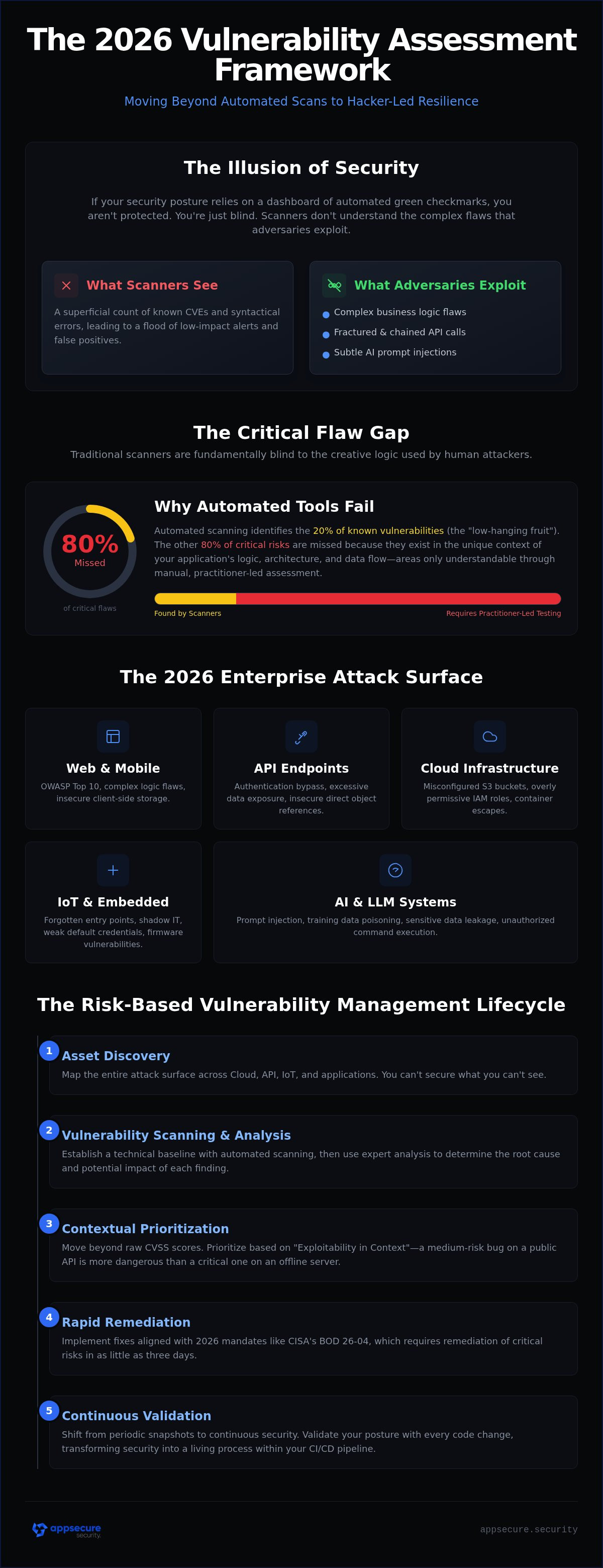
If your security posture relies on a dashboard of automated green checkmarks, you aren't protected. You're just blind. In 2026, the gap between a superficial scan and a true vulnerability assessment is where enterprises lose their data and their reputations. Scanners don't understand complex business logic. They don't see the fractured API calls or the subtle AI prompt injections that elite adversaries exploit. They just count CVEs. Meanwhile, CISA's BOD 26-04 now mandates remediation timelines as short as three days for critical risks. You don't have time to sift through thousands of false positives while real threats linger in your shadows.
It's exhausting to justify security spend when your tools produce more noise than signal. We know the frustration of chasing low-impact alerts while missing the deep technical flaws that actually matter. This guide changes that. You'll master the technical frameworks and strategic nuances required to secure your enterprise against 2026's evolving threat landscape. We'll provide a clear roadmap for continuous security, explain the critical difference between automated scanning and hacker-led assessments, and show you how to build a vulnerability management lifecycle that satisfies both the board and your engineering teams.
Key Takeaways
• Adopt a modern vulnerability assessment strategy that accounts for the surge in AI-generated code and complex logic flaws.
• Map every enterprise asset across Cloud, API, and IoT environments to eliminate blind spots in your security architecture.
• Identify why traditional scanners miss 80% of critical flaws and how manual, practitioner-led testing restores your defensive edge.
• Implement a risk-based lifecycle that aligns with 2026 mandates like CISA’s BOD 26-04 for rapid, high-impact remediation.
• Move beyond periodic snapshots to continuous security validation using agentic platforms that mirror the persistence of modern hackers.
What is a Vulnerability Assessment in 2026?
A vulnerability assessment is a systematic review of security weaknesses in an information system. In 2026, this definition has shifted from a static checklist to a dynamic offensive strategy. The explosion of AI-generated code has flooded production environments with software that is syntactically correct but logically broken. Traditional scanners can't keep up. They see the syntax; they miss the intent. A modern vulnerability assessment must bridge the gap between technical flaws and the strategic nuances of your business logic.
Understanding the boundary between a vulnerability assessment and a risk assessment is critical. Risk assessment is administrative. It calculates the theoretical impact of a breach. Vulnerability assessment is technical and practitioner-led. It identifies the specific "how" behind a potential compromise. For high-stakes environments, an Application Security Assessment serves as the definitive line of defense. It scrutinizes the custom code and complex integrations that automated tools routinely ignore.
The Core Components of a Modern Assessment
Asset discovery comes first. You can't secure what you don't see. Shadow IT and forgotten APIs are the primary entry points for modern adversaries. Once the surface is mapped, vulnerability scanning provides the technical baseline. It identifies known signatures and low-hanging fruit quickly. However, the real value lies in vulnerability analysis. This is where experts determine the root cause of identified gaps. We don't just report an open port. We explain how an attacker will chain that configuration to move laterally through your network.
The Shift from Periodic to Continuous Assessment
Annual testing is a recipe for disaster. In a world of daily deployments, a report from six months ago is ancient history. Security must live within the CI/CD pipeline. It shouldn't cause friction; it should provide guardrails. This reality has driven the evolution of Continuous Penetration Testing. It transforms the static assessment into a living process. It validates your security posture every time code changes, ensuring that new features don't introduce old, exploitable weaknesses. Point-in-time snapshots are dead. Continuous validation is the only way to maintain a fortified perimeter.
Anatomy of an Enterprise Vulnerability Framework
An enterprise vulnerability assessment must map the entire modern attack surface. This includes Web, Mobile, API, IoT, and Cloud environments. In 2026, these are not isolated silos. They are a single, sprawling landscape where a single API misconfiguration can expose your entire cloud database. The NIST AI Risk Management Framework provides the necessary structure to adapt these assessments for autonomous systems. It's no longer enough to patch a server. You must secure the decision-making logic of the AI agents operating within your network.
Prioritization is the next hurdle. Most security teams drown in CVSS scores that don't reflect reality. You need to move toward "Exploitability in Context." A medium-rated bug on a public-facing API is far more dangerous than a critical bug on an isolated, offline server. To manage this lifecycle effectively, practitioners should consult the OWASP Vulnerability Management Guide. It provides the technical foundation for risk-based remediation that actually moves the needle on security. A hacker-led approach is the gold standard for depth because it prioritizes the adversary's creative logic over automated patterns.
Application-Layer Vulnerabilities
Securing the digital interface is a moving target. The OWASP Top 10 remains the baseline, but 2026 has introduced LLM-specific risks like prompt injection and training data poisoning. Secure code reviews are your first line of defense. They catch logic flaws before they reach production. For modern tech stacks, an Ai Security Assessment is essential to validate that your LLM integrations don't leak sensitive data or execute unauthorized commands. Don't wait for a breach to discover that your AI has a back door.
Cloud and Infrastructure Gaps
Cloud security is about more than just firewall rules. Misconfigured buckets and overly permissive IAM roles are still the leading causes of enterprise breaches. Container escapes and lateral movement are the new normal. The rise of agentic systems has complicated infrastructure security further. These autonomous agents often have broad permissions that hackers can hijack to move through your environment undetected. Our Cloud Security Assessments focus on these deep architectural flaws, moving far beyond the superficial checks of traditional on-prem VA. If you're unsure where your greatest risks lie, talk to our practitioners today to build a fortified roadmap.
Vulnerability Scanning vs. Penetration Testing: Identifying the Gap
Many leaders mistake a basic scan for a complete vulnerability assessment. It's a dangerous assumption that leaves the door wide open for sophisticated attacks. Scanners are designed for breadth. They check for known signatures across thousands of assets in minutes. Penetration testing is designed for depth. It involves a human adversary actively trying to break your logic. If you rely solely on automation, you're only seeing the surface. You're missing the interconnected flaws that a practitioner identifies within minutes.
The "Scanner Blind Spot" is a documented reality. DAST and SAST tools typically miss 80% of critical logic flaws because they lack context. Consider a real-world scenario. A scanner sees an open port and marks it as a low-level finding. A hacker sees that same port, realizes it links to an unauthenticated legacy database, and builds a path to exfiltrate your entire customer list. This level of manual exploration is why a practitioner-led approach remains the gold standard for high-stakes Fintech Security Assessments.
Why Automated Scanners Fail
Automated tools are reactive by nature. They rely on databases of existing signatures. If a flaw is a zero-day or a unique logic error in your custom code, the scanner stays silent. It can't understand business context or multi-step workflows. Our 2025 Vulnerability Exposure Severity Trends report shows that the most damaging breaches stem from these "silent" flaws. Scanners can't navigate complex processes, like tricking a checkout system into accepting a negative price. They just don't think like an adversary.
When to Use Each Methodology
Use scanning for high-frequency baseline coverage. If you need to satisfy SOC2 or PCI-DSS requirements, automated scans provide the volume needed for compliance. However, compliance isn't the same as security. For actual risk reduction, the hybrid VAPT (Vulnerability Assessment and Penetration Testing) approach is essential. It combines the speed of automated checks with the surgical precision of manual testing. The cost-benefit is clear. You stop wasting time on thousands of false positives and start fixing the deep technical risks that actually matter to your board.
Implementing a Risk-Based Vulnerability Management Lifecycle
A modern vulnerability assessment is only as good as the lifecycle it feeds. Without a structured process, you're just collecting a list of problems you'll never solve. Effective vulnerability management requires a five-step discipline that turns raw data into defensive action. Scanners provide data. Workflows provide security.
First, define your scope. In 2026, asset inventory must include ephemeral cloud instances and shadow APIs that automated tools often miss. Second, deploy detection. This is where you combine agentic platforms with manual technical assessments to uncover deep logic flaws. Third, prioritize. Use risk-based scoring to filter out the noise. Don't waste engineering hours on vulnerabilities that have no path to exploitation. Fourth, remediate and validate. Closing the loop with re-testing ensures that patches actually work and haven't introduced new regressions. Finally, move to continuous monitoring. The shift toward Pentesting as a Service ensures that your security posture evolves as fast as your codebase.
The Prioritisation Matrix
Smart teams focus on the intersection of asset criticality and vulnerability severity. A critical flaw in a dev environment is a distraction. The same flaw on a production gateway is an emergency. You must also have a clear process for "Won't Fix" scenarios. If a risk is accepted, it must be documented with compensating controls, not just ignored. Integration is key. Push high-priority findings directly into developer workflows via Jira or GitHub. This eliminates the friction between security and engineering, turning security into a feature rather than a bottleneck.
Reporting for Stakeholders
Data without clarity is useless to a board. You need two types of output. Developers require granular technical details and proof-of-concept code to reproduce flaws. The C-suite needs an executive summary that translates technical risk into business impact. Focus on MTTR (Mean Time to Remediate) as your primary KPI. With CISA's BOD 26-04 mandating remediation in as little as three days for high-risk public assets, tracking this metric is a regulatory necessity. We use Case Studies to show exactly how a rigorous vulnerability assessment reduces these timelines. If your current reporting feels like a wall of text, contact our experts to see what practitioner-led clarity looks like.
The Future of Offensive Security: Agentic and Continuous
Offensive security is evolving into a state of persistent, intelligent testing. We're moving beyond static scripts toward Agentic Pentesting. These autonomous agents don't just execute commands; they emulate the creative problem-solving of a human adversary. They chain vulnerabilities, pivot through network segments, and identify complex exploit paths that traditional automation routinely misses. For the modern enterprise, this means your vulnerability assessment is no longer a point-in-time snapshot. It's a living, continuous validation of your entire digital perimeter.
The platform developed by AppSecure Security scales this practitioner-led expertise across global infrastructures. It provides the persistence of a real-world adversary without the logistical friction of manual teams for every minor code change. This is vital as we analyze 2026 ransomware targeting trends. Attackers are currently using AI to identify entry points faster than security teams can patch them. If your defense isn't equally autonomous, you're operating with an inherent disadvantage. Continuous validation ensures your posture remains fortified against rapid industry exposure.
AI-Powered Zero-Day Discovery
AI agents are now uncovering flaws that even elite human teams often overlook. By analyzing vast, multi-cloud codebases at machine speed, these tools find subtle vulnerabilities in logic and memory management. Our research into Ai Powered Zero Day Vulnerability Discovery shows how models like Claude and Mythos are redefining the offensive landscape. However, this capability carries ethical weight. Autonomous offensive tools require strict guardrails to prevent unintended operational damage. AppSecure Security uses these agents to fortify your systems, ensuring every discovery leads to a verified, actionable fix.
Adopting a Proactive Security Culture
Security shouldn't be a hurdle to deployment. It's an enabler for rapid innovation. When you know your systems are under continuous, intelligent test, you can deploy new features with absolute confidence. Offensive testing is the ultimate validation of your defensive spend. It proves that your firewalls, EDRs, and IAM policies actually hold up when under direct pressure. Move away from the check-the-box mentality. A modern vulnerability assessment is a strategic asset that protects your bottom line. To secure your enterprise against the next wave of threats, contact AppSecure Security for a hacker-led deep technical assessment today.
Securing Your Enterprise Frontier
The 2026 threat landscape demands more than just visibility; it requires active, aggressive protection. We've moved past the era where a static report provides a true sense of safety. As explored throughout this guide, the intersection of AI-generated code and complex API logic has created a playground for modern adversaries. A robust vulnerability assessment is the only way to validate that your defenses hold up under real-world pressure. It transforms security from a reactive burden into a strategic advantage for your organization.
AppSecure Security is trusted by global enterprises to deliver this level of specialized Fintech and AI expertise. We move beyond the superficial, providing deep technical manual testing that uncovers what automated tools ignore. Don't leave your infrastructure to chance while threats evolve at machine speed. Request a Hacker-Led Vulnerability Assessment from AppSecure Security today. Fortify your perimeter with practitioners who understand the adversary's mindset and can secure your future.
Frequently Asked Questions
What is the primary difference between a vulnerability scan and a vulnerability assessment?
A vulnerability scan is an automated search for known signatures, while a vulnerability assessment is a systematic review that includes manual technical analysis to determine the root cause of gaps. Scans provide high-volume data but lack the context to identify chained exploits. Assessments involve a practitioner who understands how multiple minor flaws can be combined to achieve a full system compromise. This depth is essential for securing complex enterprise infrastructures across India, the USA, and the UK.
How often should an enterprise perform a vulnerability assessment in 2026?
In 2026, the standard has shifted from annual checks to continuous security validation. Regulations like the GLBA Safeguards Rule already require assessments at least every six months, but the rise of rapid CI/CD cycles makes point-in-time testing obsolete. Organizations should integrate continuous penetration testing to validate every major deployment. For federal agencies and their partners, CISA’s BOD 26-04 mandates remediation of critical public-facing flaws in as little as three days, requiring near-constant monitoring.
Can automated tools replace manual penetration testing for compliance?
Automated tools cannot replace manual penetration testing because they are blind to business logic and zero-day flaws. While scanners help maintain a baseline for compliance standards like SOC2 or PCI-DSS, they lack the adversarial mindset needed to find deep technical risks. Most mature frameworks specifically mandate annual manual testing by a qualified practitioner. Relying solely on automation creates a false sense of security that sophisticated hackers in global markets like Dubai and Canada routinely exploit.
What are the most common vulnerabilities found in Fintech APIs?
Broken Object Level Authorization (BOLA) and unauthenticated endpoints are the most frequent risks found in Fintech APIs. Adversaries target these flaws to bypass transaction limits or harvest sensitive financial data without triggering standard alerts. We also frequently uncover mass assignment vulnerabilities where attackers modify backend properties by injecting unauthorized parameters into API calls. These logic-based flaws are rarely caught by standard scanners, requiring manual hacker-led investigation to ensure the integrity of financial transactions.
How does the NIST AI Risk Management Framework affect vulnerability management?
The NIST AI Risk Management Framework forces a shift toward securing the decision-making logic and data pipelines of autonomous systems. It expands traditional management to include risks like prompt injection, model inversion, and training data poisoning. Enterprises must now assess not just the server hosting the AI, but the integrity of the model itself. This framework is becoming a baseline for AI-driven organizations in the USA and India looking to fortify their agentic infrastructures.
What is VAPT and why is it considered the industry standard?
VAPT stands for Vulnerability Assessment and Penetration Testing, a hybrid approach that combines automated breadth with manual depth. It is the industry standard because it provides a complete view of the attack surface, from low-hanging fruit to complex logic flaws. By utilizing both methodologies, organizations can satisfy compliance requirements while simultaneously reducing actual technical risk. It ensures that every identified weakness is validated by a human practitioner before it becomes a report item.
Is a vulnerability assessment enough to pass a SOC2 or PCI-DSS audit?
A vulnerability assessment alone is typically insufficient for passing high-level audits like SOC2 or PCI-DSS. While it satisfies the requirement for finding known weaknesses, these frameworks often mandate a full penetration test to demonstrate that those weaknesses can be exploited. Auditors look for evidence of manual, hacker-led testing to verify that your defensive controls are effective against real-world attack patterns. Combining both ensures you meet the strict reporting obligations required in the UK and Canada.
What happens if a critical vulnerability is found during an assessment?
Discovery of a critical vulnerability triggers an immediate triage and reporting process. The practitioner provides a proof-of-concept to demonstrate the risk, followed by a prioritized remediation plan. In 2026, the timeline for fixing these issues is shrinking; CISA now requires federal civilian agencies to remediate high-risk public vulnerabilities within 72 hours. Once the patch is deployed, a re-test is mandatory to validate that the hole is closed and that no new regressions were introduced.



.webp)

