



A successful login doesn’t prove an API is protecting every account and resource correctly. API authentication penetration testing probes how an API verifies identity, handles tokens, and enforces permissions, including whether one user can access another user’s data. The OWASP API Security Top 10 (2023) ranks broken object level authorization as API 1 and broken authentication as API 2.
Authentication verifies who is making a request; authorization determines what that identity can do. Both can fail in ways routine checks miss, especially when access depends on tokens, user roles, or changing object IDs.
This guide explains what API authentication penetration testing examines, how testers uncover access-control flaws, and why manual testing complements automated checks. It covers probing token handling, testing account boundaries, and tracing real workflows to find weaknesses that could put sensitive data or business processes at risk. The aim is to show where access controls fail and what to address first.
Key Takeaways
• Trace how identities, tokens, and permissions behave across different requests, not just at sign-in.
• Use the OWASP API Security Top 10 to prioritize weaknesses that could expose data or enable unauthorized actions.
• Test complete business workflows for shortcuts attackers could exploit, including skipped steps and manipulated requests.
• Build an API inventory and enumerate endpoints to uncover overlooked routes and attack paths.
• Combine automated checks with manual testing to investigate complex authorization rules and business logic.
1. What Is API Penetration Testing?
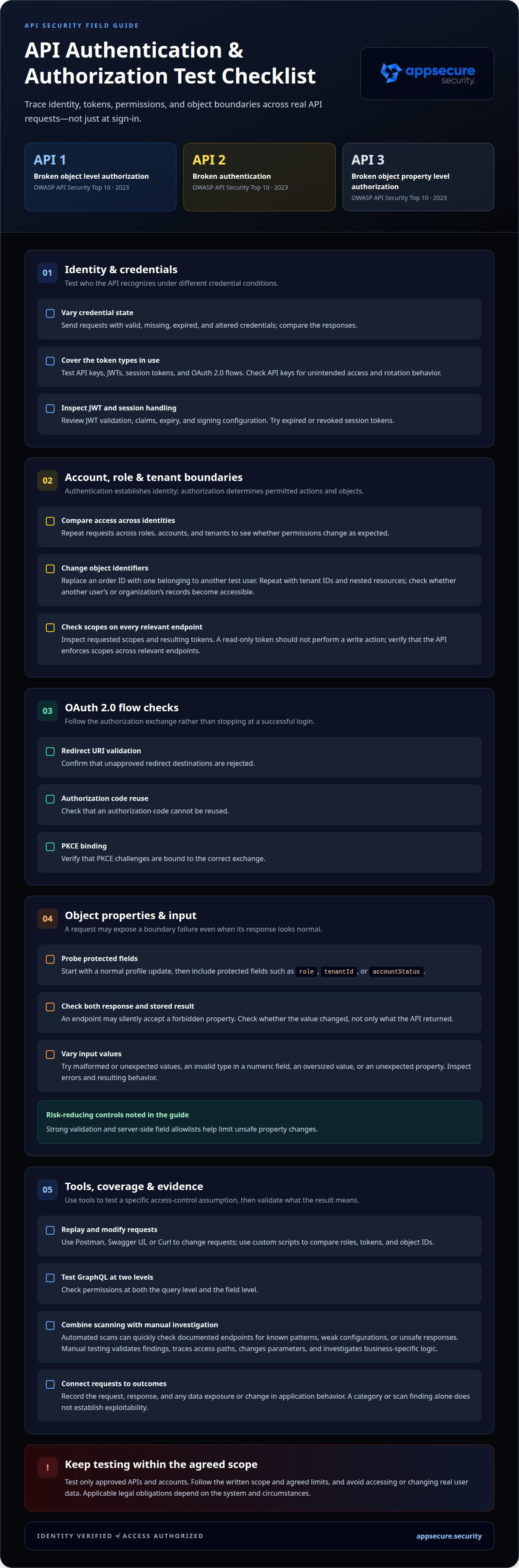
API penetration testing examines how an interface handles identity, permissions, data, and requests under attack. Authentication establishes who is making a request; authorization decides which actions and objects that identity can access. The OWASP API Security Top 10 2023 ranks broken object level authorization as API 1 and broken object property level authorization as API 3, highlighting why a valid login alone proves little.
Test authentication and authorization separately. Send requests with valid, missing, expired, and altered credentials, then compare responses across roles, accounts, and tenants. For example, replace an order’s object ID with one belonging to another test user. If the API returns that user’s order, broken object-level authorization has exposed a boundary failure. Repeat the test with tenant identifiers and nested resources to check whether one organization can access another’s records.
OAuth 2.0 testing should follow the authorization flow, not stop at successful login. Confirm that redirect URI validation rejects unapproved destinations, that authorization codes cannot be reused, and that PKCE challenges are bound to the correct exchange. Inspect requested scopes and resulting tokens: a token granted for read-only access shouldn’t perform a write action. Check whether the API enforces those scopes on every relevant endpoint.
Test object-property authorization separately. Submit a normal profile update, then include a protected field such as role, tenantId, or accountStatus. If mass assignment changes a field the user should not control, the endpoint accepts unsafe input. Strong validation and server-side field allowlists help limit this risk. Compare both the response and the stored result, because an API may silently accept a forbidden property.
In the United States, the practical legal boundary is explicit authorization and a written scope. Test only approved APIs and accounts, follow agreed limits, and avoid accessing or changing real user data. Applicable legal obligations depend on the system and circumstances.
Cover API keys, JWTs, session tokens, and OAuth 2.0 flows. Test keys for unintended access and rotation behavior; inspect JWT validation, claims, expiry, and signing configuration; then try expired or revoked session tokens. The OWASP API 2:2023 Broken Authentication category describes risks from flaws that let attackers compromise tokens or impersonate users. A focused broken authentication test can help structure these checks.
Tools support testing but do not replace reasoning. Use Postman, Swagger UI, or Curl to replay and modify requests, and custom scripts to compare roles, tokens, and object IDs. For GraphQL, test permissions at both the query and field level. API authentication penetration testing is most effective when each tool tests a specific access-control assumption.
2. What Is API Security Testing?
API security testing examines whether an application’s interfaces protect data, resources, and business functions against misuse. The OWASP API Security Top 10 (2023 edition) organizes API-specific risks to help teams prioritize reviews. It identifies broken authentication as API2:2023, alongside authorization failures, excessive data exposure, and security misconfigurations. Use the list as a risk map, then test how each concern appears in your API’s actual endpoints and workflows.
Other entries point to distinct failure modes. The OWASP list identifies unrestricted resource consumption as API 4, broken function level authorization as API 5, and unrestricted access to sensitive business flows as API 6. It also names server side request forgery as API 7 and security misconfiguration as API 8. These categories guide test cases, but a label alone doesn’t prove an endpoint is exploitable. Test specific requests, roles, and outcomes to establish the impact.
How does API authentication testing differ from general web application penetration testing? API testing focuses on endpoints, request formats, machine-to-machine exchanges, and data returned directly by the interface. General web application testing also examines user-facing pages, browser behavior, and interactions such as forms and navigation. The two overlap when a web application relies on APIs behind its interface.
An automated API security scan can quickly check documented endpoints for known patterns, weak configurations, or unsafe responses. A penetration test goes further: the tester validates findings, changes request parameters, traces access paths, and assesses whether weaknesses can be chained into meaningful impact. A scan might flag an exposed field; a tester investigates whether it enables access to restricted data. Scans broaden coverage, while manual investigation tests context and business-specific logic.
Input validation testing checks how endpoints handle malformed, unexpected, or out-of-range values. Try an invalid type in a numeric field, an oversized value, or an unexpected property, then inspect the errors and resulting behavior. Misconfiguration testing reviews deployed settings, exposed debug details, and unnecessary methods or endpoints. Connect each request to a concrete response, data exposure, or change in application behavior.
Continuous API security testing adds repeatable checks to development and build processes, helping teams catch issues as code and specifications change. It can enforce thresholds that stop insecure code from progressing, while a manual penetration test explores complex authorization paths and business logic. Use both approaches for different strengths, not as substitutes. A focused API security testing approach can align checks with documented requirements and real usage. To discuss a scoped assessment, talk through your API testing needs.
3. Business logic vulnerabilities
A business-logic vulnerability occurs when a request exploits an application’s intended rules, even if each component works correctly. Consider an ordering API: a user submits a payment step, then calls the confirmation endpoint directly. If the order is fulfilled without payment, the workflow has a security gap. Test the sequence of actions, not just each endpoint in isolation.
Map each workflow from its first request to its final state. For an approval process, record who can submit, review, and approve a transaction. Then try reversing those actions, repeating an approval, or changing the transaction’s state with an unexpected request. Compare the resulting records with the intended business rules. An exploit may rely on a valid request being used at the wrong point in the process.
Fuzzing can reveal unexpected behavior by varying request fields, formats, and sequences. For example, send an empty quantity, a negative value, an unexpected status, or repeated confirmation requests. Automated fuzzing may uncover crashes, inconsistent errors, and weak input validation, but it cannot reliably determine whether a discount, refund, or approval follows the organization’s rules. Manual testing must interpret the workflow and assess whether the outcome creates risk.
Rate limiting is part of business-logic testing when repeated requests could abuse a valuable function. Probe a password-reset flow, coupon redemption, or reservation endpoint with controlled request bursts. Check whether the API returns HTTP 429 Too Many Requests when request volume is high. Then test whether limits apply across accounts, tokens, and relevant endpoints. A limit on one route may not stop an attacker from reaching the same function through another route.
Check configuration and integration boundaries too. An API may rely on a payment processor, inventory service, or approval system, each with separate state changes. Test what happens when a response is delayed, repeated, or rejected. For example, verify that a failed payment integration does not trigger a successful order confirmation. Also check whether retries can duplicate refunds or inventory updates.
Injection testing can support this work, but the goal is to assess business impact, not merely detect suspicious input. Submit unexpected characters or values to search, pricing, and filtering fields, then check whether they change calculations or downstream actions. Pair each probe with a clear expected result. This helps distinguish harmless validation behavior from a workflow an attacker could manipulate.
Document each finding as a reproducible sequence: starting state, request order, changed values, and final outcome. Include the affected business rule and impact, such as an unpaid order being fulfilled or an approval being bypassed. Retest the same sequence after remediation. This gives the development team a precise, actionable account of the logic flaw.
4. API attack-surface discovery and endpoint enumeration
Begin an assessment by mapping the API target. Teams expose endpoints through public documentation, web application traffic, mobile clients, and service integrations. Collect OpenAPI specifications and inspect requests from normal workflows, then compare them with the inventory maintained by engineering. An undocumented route, such as an older account export endpoint, can expand the attack surface without appearing in current specifications.
Build the inventory around more than route names. Record each endpoint’s HTTP method, version, authentication requirement, accepted parameters, and data returned. For example, GET /v1/profile and PATCH /v1/profile share a path but expose different operations. Include gateway routes and GraphQL operations where applicable. This structure helps testers identify gaps, such as a write method that received less review than its read counterpart.
Reconcile documentation with live behavior in a controlled environment. Use Swagger UI to exercise documented routes, then compare those requests with traffic from the web application or mobile client. Search for versioned paths, such as /v1/ and /v2/, and note whether retired versions still respond. Check error messages and redirects for references to additional paths, but keep probing within the approved assessment scope.
Endpoint enumeration should also account for routes that vary by role or workflow. A customer account might expose profile, billing, and support operations, while an administrator uses separate management routes. Record which identities can reach each operation, then flag unexpected access or inconsistent behavior. This map connects each route to its function, data, and intended user, rather than treating every request in isolation.
Inventory quality is a security issue, not clerical overhead. The OWASP API Security Top 10 2023 identifies improper inventory management as API 9. Test whether the inventory captures legacy endpoints, deprecated versions, partner integrations, and APIs deployed in separate environments. For example, a staging route can still reveal sensitive configuration if it shares production data or credentials. Mark ownership and lifecycle status so teams can prioritize review.
Finish discovery by validating the map against actual traffic and deployment records. Group endpoints by service, version, and data sensitivity, then identify routes with unknown owners or unclear purposes. Revisit the inventory after major releases or integration changes, since new functionality can add endpoints outside the original assessment. A reliable map defines the target, reveals omissions, and directs deeper testing toward the API’s real entry points.
5. Manual API penetration testing
Manual testing investigates how APIs behave when a skilled tester looks beyond predefined checks. A scanner may flag a suspicious response; the tester traces whether it exposes sensitive records, enables unauthorized actions, or creates a practical threat. This distinction matters because API security depends on how endpoints interact, not just whether individual requests match known patterns.
Start with the API’s intended roles and workflows, then test the boundaries between them. For a horizontal privilege test, use one authorized account to request another account’s resource. For a vertical test, try a lower-privilege identity against an administrative function. Compare status codes, response fields, and state changes. A denial that still returns private data is not effective protection.
Manual analysis also probes token behavior beyond basic acceptance. Inspect JWT validation for weak signing algorithms, altered claims, and mismatches between token privileges and endpoint behavior. Test whether a revoked or expired token still reaches a sensitive operation. For OAuth 2.0, follow the authorization flow through its actual requests and verify that granted scopes constrain accessible actions.
Context distinguishes a harmless anomaly from an exploitable flaw. For example, an API may return an internal field that the interface does not display. The tester determines whether that field reveals sensitive information or supports a later attack. They can also chain findings, such as combining excessive data exposure with weak authorization to reach another user’s records.
Manual testing follows a disciplined sequence: reconnaissance, enumeration, vulnerability analysis, controlled exploitation, and reporting. Black-box testing starts without internal API knowledge; white-box testing uses code or design details; gray-box testing combines partial access with external probing. Each approach shapes what the tester can investigate. Choose a scope that reflects the available access and evidence.
Tools speed up specific tasks, but human judgment drives the test. Postman or Curl can replay requests, while custom scripts compare responses across roles and tokens. The tester then interprets differences, traces unexpected behavior, and records reproducible steps. Automated checks cover repeated patterns; manual work is crucial for complex workflows and authorization decisions shaped by business context.
A useful report connects every finding to evidence and remediation. Include the affected endpoint, test identity, request sequence, response, and resulting impact. Explain whether the issue permits unauthorized access, sensitive data exposure, or privilege escalation. Development teams can then reproduce the threat and retest the fix against the same scenario. For a hands-on review of your API interfaces, request a manual API penetration test.
AppSecure Security: Web Application Penetration Testing
AppSecure Security helps teams investigate API access risks with API Penetration Testing. Use this assessment when token checks, role boundaries, or endpoint behavior need closer scrutiny than routine scanning provides. Its manual, hacker-led approach examines how authentication and authorization work across requests, accounts, and business workflows.
For systems spanning multiple interfaces, AppSecure Security also offers Web Application Penetration Testing and Mobile Application Penetration Testing. Its Agentic Penetration Testing Platform covers API environments too. The right assessment depends on where the API is exposed and how users or connected applications interact with it. Findings help teams identify weaknesses that enable unauthorized access or expose sensitive data, then prioritize remediation.
Contact AppSecure Security to discuss API access testing for your application.
Make access control part of every release
API access risks evolve as teams add endpoints, revise permissions, and connect new services. Treat authentication testing as a recurring engineering checkpoint, not a task that ends when a report arrives. Assign owners to findings, track fixes against reproducible evidence, and revisit affected workflows when the code or access model changes.
This discipline makes API authentication penetration testing a practical input to development decisions. Teams can use findings to clarify authorization rules, strengthen review criteria, and maintain access boundaries as the application evolves. Start by defining the API scope and identifying the access paths that matter most to your business.
AppSecure Security can help assess those risks through its penetration testing services. Discuss an API security assessment and move toward clearer, more defensible access controls.
Frequently Asked Questions
What Is API Penetration Testing?
API penetration testing is a controlled examination of an API for weaknesses an attacker could exploit. It checks more than whether requests work as designed: it examines how the interface responds to deliberate misuse. For example, a tester might send unexpected parameters to a reporting endpoint, then assess whether the response reveals records or internal details beyond the caller’s intended access.
What Is API Security Testing?
API security testing checks whether an API protects its data and functions throughout development and operation. It can include specification reviews, automated checks, and hands-on testing. For example, compare an OpenAPI description with a release candidate’s actual responses. A mismatch could reveal an undocumented response field or a route that bypasses intended validation.
Can findings be mapped to the OWASP API Security Top 10?
Yes. Findings can be categorized against the OWASP API Security Top 10 (2023 edition) to give teams a consistent risk reference. A flaw involving unrestricted resource consumption, for example, can map to API 4, while an exposed administrative function may relate to broken function level authorization, API 5. Include the affected endpoint, evidence, impact, and remediation alongside the category.
Can you give an example of an API security test?
A tester can compare the fields returned by the same reporting request for different user roles. First, capture a response from a standard account. Repeat the request with an authorized administrative test account and compare the fields. If the standard account receives internal notes or hidden financial details, the test has identified a data exposure issue that needs investigation.
Do you test REST, GraphQL, and gRPC APIs?
A test plan can cover REST, GraphQL, and gRPC interfaces when they are in scope. The approach varies by protocol: REST testing examines HTTP methods and resource paths, GraphQL testing examines queries and fields, and gRPC testing examines service methods and message handling. Identify the API formats, environments, and intended access before testing to ensure the relevant interfaces are included.
How do you handle authenticated API testing?
Authenticated testing uses approved test identities to examine behavior across access levels without relying on real users’ accounts. Prepare accounts for relevant roles, document their expected permissions, and exercise representative workflows with each identity. Control credentials and distinguish test data from production data. This lets testers compare outcomes while reducing the risk of altering unrelated records.
How long does an API penetration test take?
Most API penetration testing engagements take one to three weeks of active testing. The work depends on API complexity, endpoint coverage, authentication flows, and external dependencies. A documented, focused API with test accounts is easier to assess than a changing system with multiple services and unclear ownership. Active testing is only one part of an engagement’s overall planning.
What is API authentication penetration testing?
API authentication penetration testing evaluates whether an API verifies identities correctly and handles the credentials or tokens used to access it. Testers examine how the interface responds to invalid, expired, or improperly scoped credentials, then assess whether accepted identities receive appropriate access only. The objective is to find practical weaknesses in identity verification and token handling, not simply confirm that login succeeds.




































































































