The biggest name isn’t automatically the right VAPT partner. This guide compares 10 of the top VAPT vendors in the USA, focusing on the testing, technical expertise, compliance support, and remediation guidance they offer. The right fit depends on your environment and the risks you need to uncover.
A vendor’s value isn’t measured by a scanner report alone. You need testing that goes beyond surface-level findings, evidence of exploitable weaknesses, and practical guidance your team can use to strengthen security. These differences matter whether you’re assessing a web application, mobile app, API, or cloud environment.
Use this comparison to understand how vendors differ in assessment scope, technical depth, and support after testing. The criteria can help you narrow your shortlist, from matching test scope to your attack surface to understanding how findings are prioritized and communicated. The aim is an informed decision, not a ranking based on name recognition alone.
Key Takeaways
- Match the assessment scope to the systems and attack surfaces your organization needs tested.
- Use NIST SP 800-115 as a framework for structuring VAPT testing.
- Assess whether a provider’s findings, remediation guidance, and follow-up support will help your team act on test results.
- Compare providers by their service models, relevant compliance support, and testers’ practical security expertise.
- Choose an approach that fits your environment, from focused application testing to broader, machine-scaled assessments.
Penetration testing and vulnerability assessment services
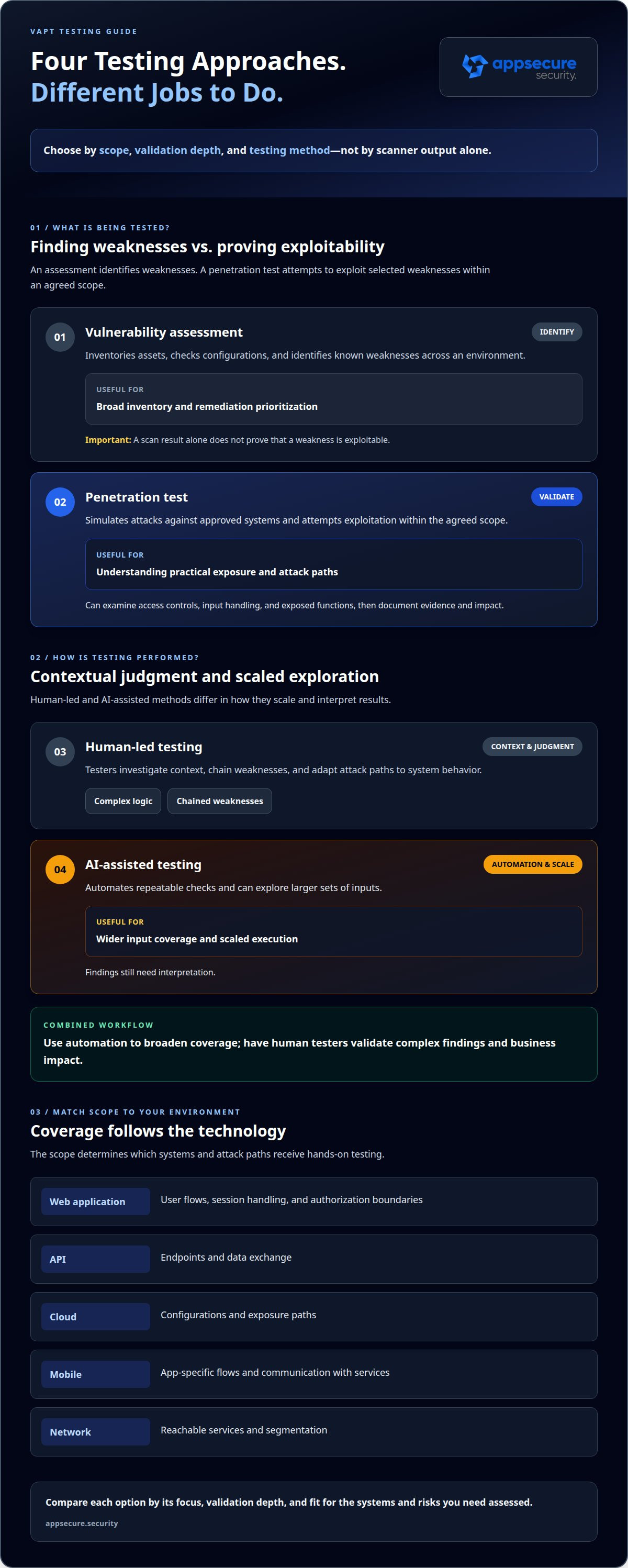
Vulnerability assessment and penetration testing answer different questions. An assessment identifies weaknesses; a penetration test attempts to exploit selected weaknesses within an agreed scope.
For VAPT testing, the National Institute of Standards and Technology recommends using NIST SP 800-115 as a framework. It helps structure technical testing and analysis, so findings connect to defined assessment activities.
Penetration Testing Services
A penetration test simulates attacks against approved systems to determine whether weaknesses can be exploited. Testers may examine access controls, input handling, and exposed functions, then document evidence and impact. Unlike vulnerability scanning, penetration testing validates whether findings could lead to meaningful access or data exposure. The scope determines which systems and attack paths receive hands-on testing.
A vulnerability assessment typically inventories assets, checks configurations, and identifies known weaknesses. It can help teams prioritize remediation across a broad environment, but a scan result alone doesn’t prove a weakness is exploitable. A penetration test adds that validation. For example, testers can examine a suspected access-control flaw to see whether one user can reach another user’s data. Beyond software scans, a broader exposure assessment can also reveal weaknesses in cloud configurations, exposed services, and the attack paths an adversary could chain together.
Human-Led and AI-Assisted Testing
Human-led testing relies on a tester’s judgment to investigate context, chain weaknesses, and adapt attack paths. AI-assisted testing can automate repeatable checks and explore larger sets of inputs. The approaches differ in how they scale and interpret results. A combined workflow can use automation to broaden coverage while human testers validate complex findings and business impact.
Web and mobile application penetration testing should reflect how each application handles identity, data, and user actions. For a web application, testers can examine session handling and authorization boundaries. Mobile testing can assess app-specific flows and how the application communicates with its services. The AI penetration testing guide explores how automated agents can support application testing.
Compare service options by scope, validation depth, and testing method. The table shows how each approach contributes to an assessment.
| Testing option | Primary focus | Validation depth | Useful for |
|---|---|---|---|
| Vulnerability assessment | Finding and grouping weaknesses | Identifies issues; may not exploit them | Broad inventory and prioritization |
| Penetration test | Attempting exploitation within scope | Tests exploitability and attack paths | Understanding practical exposure |
| Human-led testing | Contextual investigation | Adapts to system behavior | Complex logic and chained weaknesses |
| AI-assisted testing | Automated exploration and repeatable checks | Scales execution; findings need interpretation | Wider input coverage |
Choose the option whose scope and validation depth match the systems and risks you need assessed.
Reporting, remediation guidance, and post-testing support
VAPT vendors serve SaaS, fintech and BFSI, healthtech, and e-commerce organizations. Company size depends on assessment scope, technical complexity, and internal security capacity. A focused web application test may fit a smaller team, while an enterprise program may cover web, API, cloud, mobile, and network environments.
A useful report turns technical evidence into a prioritized remediation plan. Each finding should identify the affected asset, explain the weakness, describe its practical impact, and provide reproduction steps. For example, an access-control finding should show which request exposed another user’s record, not merely label the issue as high risk.
Remediation guidance should help engineering teams develop a fix while making the underlying cause clear. A useful finding can recommend validating authorization on the server, then identify affected endpoints and relevant test cases. After the fix, retesting should confirm whether the weakness is resolved and whether the change introduced a related issue. A closeout summary can track open findings and remaining exposure.
- Evidence: Record affected components, observed behavior, and reproducible steps.
- Priority: Explain impact and dependencies so teams can order fixes.
- Retest: Reproduce the original test after remediation and record the result.
Vendor models shape how findings are discovered and supported. A project-based penetration test provides a defined assessment and report. A recurring program can align testing with development changes. Crowdsourced testing and bug bounty platforms invite independent researchers to submit valid vulnerabilities under stated rules. These approaches can broaden ongoing discovery, while a scoped engagement provides coordinated testing against selected systems and defined deliverables.
Choose the model based on your release cycle and response capacity. A product team shipping frequent updates may value repeatable testing integrated into development. A company preparing for a major release may need a focused simulation of attacker behavior. In either case, define who validates submissions, handles duplicates, and routes confirmed findings to remediation owners.
Coverage should match the technology in use. Web application testing examines user flows and access controls; API testing focuses on endpoints and data exchange. Cloud assessments examine configurations and exposure paths, while mobile testing follows app-specific behavior. Network testing assesses reachable services and segmentation. Automated security tools can check repeatable patterns; manual testing investigates business logic and chained weaknesses that require context.
Before selecting a provider, map each environment to the report and follow-up your team needs. For a tailored discussion about assessment scope and reporting needs, plan your next testing step.
Provider capabilities, certifications, and compliance support
Compliance support is useful when testing evidence needs to connect to specific controls. Compare each provider’s technical capabilities, relevant credentials, and ability to map findings to your organization’s frameworks. A vulnerability report alone doesn’t demonstrate that every control is effective or establish compliance.
Credentials can help indicate a team’s training and assessment focus. CREST is one certification to consider when reviewing a VAPT team. OSCP and CEH are tester certifications identified in security-provider comparisons. For federal environments, consider whether a provider’s assessment experience fits the engagement. These names aren’t interchangeable: assess how the team’s experience aligns with your infrastructure and testing scope.
PCI DSS and ISO 27001 call for different compliance conversations. For PCI DSS, testing should connect relevant findings to the payment environment and the evidence your organization needs. For ISO 27001, discuss how assessment results support your security risk process and control evidence. A VAPT engagement can inform compliance work, but its report is not a certification or a substitute for broader control assessment. A PCI DSS penetration testing guide can help clarify how testing relates to payment security.
Ask how the provider maps each finding to your chosen control set. Useful mapping identifies the affected system, the observed weakness, its potential security impact, and the related control or evidence request. For example, a cloud configuration finding should identify the affected environment and explain what the evidence demonstrates. Reporting should distinguish verified technical findings from control interpretation, giving compliance teams a clear audit trail.
Organizations working across regions may also consider GDPR. It is an example of a regulation VAPT can help organizations address, according to the European Union. The assessment should connect technical findings to relevant data-processing risks, rather than imply that testing alone fulfills regulatory obligations. In tandem with penetration testing, specialized discovery platforms like EmberHound help pinpoint sensitive personal and payment data across environments. The same discipline applies to SOC 2 and HIPAA: define the framework, system boundary, and evidence needed before testing begins.
- Scope: Match provider capabilities to the systems and controls under review.
- Credentials: Relate CREST, OSCP, CEH, or FedRAMP 3PAO credentials to the engagement.
- Evidence: Require findings that identify assets, weaknesses, impact, and control relevance.
- Follow-through: Connect remediation records and retesting results to the same finding.
Continuous compliance work benefits from repeatable evidence. Keep the scope, findings, remediation status, and retest outcome connected so security and audit teams can follow each issue from discovery to closure.
What are the top 10 VAPT companies?
No single ranking fits every organization, so treat these names as a shortlist to compare, not a definitive order. Choosing by price or automated scanning alone can leave manual validation and context-specific attack paths unexamined.
VAPT Company Profiles and Headquarters
Use provider profiles to compare organizations consistently, not to assume a headquarters determines testing quality. A shortlist of 10 companies to research includes AppSecure Security, Bishop Fox, NetSPI, NCC Group, Coalfire, Synack, Rapid7, Trustwave, Secureworks, and Schellman. Check each company’s current scope and delivery model against your needs. Headquarters and operating locations are separate considerations from the technical work assigned to your assessment.
Provider Strengths and Service Models
Compare these providers by the questions your assessment needs to answer, not by assuming a universal ranking. Build a matrix for web application, mobile, API, cloud, and network coverage, then record each provider’s service model and reporting approach. AppSecure Security belongs in the comparison for VAPT and its Agentic Penetration Testing Platform. Tie each entry to the specific scope under consideration.
Traditional VAPT Vendor Comparisons
Traditional VAPT engagements generally focus on defined assessment scopes and deliverables. Compare that approach with recurring testing or platform-supported discovery by considering how each model fits your release process. A scanner result alone cannot show whether a finding creates a practical attack path. Assess how the proposed work combines automated checks with manual investigation and communicates validated threats to engineering teams.
US VAPT Vendor Comparisons
For US organizations, compare providers by the systems they assess and how their delivery fits your operating environment. Don’t assume a US headquarters means every tester or service operates from the same location. Record each company’s coverage, testing method, communication approach, and follow-up process. This creates a useful comparison without treating geography as a substitute for technical suitability.
Use the shortlist as a starting point, then assess all 10 providers against your priorities:
- AppSecure Security
- Bishop Fox
- NetSPI
- NCC Group
- Coalfire
- Synack
- Rapid7
- Trustwave
- Secureworks
- Schellman
Choose the provider whose defined scope, testing approach, and deliverables best fit your systems and security objectives.
India's weekly cyberattacks increased by 18% compared with the previous year. Traditional VAPT is a point-in-time engagement that can leave vulnerabilities introduced after the assessment undetected until the next cycle. Selection may also account for FedRAMP, PCI DSS, SOC 2, and HIPAA.
Certified testers and security expertise
A certification can indicate structured training, but it doesn’t prove a tester can investigate your specific attack surface. For enterprises, effective penetration testing combines technical knowledge, careful scope control, and clear evidence. Evaluate the people performing the assessment, not only the provider’s brand or toolset.
OSCP and CEH are security certifications to consider when reviewing a testing team. Ask how the assigned testers apply their skills to your systems. A web application assessment, for example, may involve investigating authorization logic, session behavior, and input validation. What matters is how testers identify, reproduce, and explain weaknesses, not simply which credentials appear in a profile.
Testers also need to distinguish a scanner alert from an exploitable flaw. A practical review follows a clear sequence: reproduce the behavior, assess its impact, identify the affected components, and document safe remediation guidance. For example, a suspected access-control issue needs validation across relevant user roles. This investigation requires context and judgment beyond automated output.
Specialization matters. Application testers need to understand user flows and business logic; API testers must examine how endpoints handle requests and authorization. Cloud and network assessments require different technical expertise. The CREST penetration testing guide can help explain how a recognized testing standard relates to provider evaluation.
During selection, connect each tester’s experience to the engagement. Ask who will perform the work, which environments they have assessed, and how they validate findings. Then review a sample report structure for reproducible evidence, impact descriptions, and remediation steps. These checks help enterprises judge whether the team can turn technical findings into decisions that security and engineering teams can act on.
- Credentials: Review relevant certifications, including OSCP and CEH.
- Hands-on approach: Look for clear methods to reproduce and validate findings.
- Technical fit: Match tester expertise to application, API, cloud, or network scope.
- Communication: Expect findings that explain impact and practical remediation.
- Team clarity: Identify who performs testing and who reviews reported evidence.
Use these criteria to distinguish documented expertise from a credential list alone. Strong testers connect technical findings to real system behavior and explain how teams can respond. To discuss an assessment aligned with your environment, start a conversation about testing scope.
AppSecure Security: VAPT services
AppSecure Security is a practical option when your team needs to uncover and validate technical weaknesses. Its VAPT work includes manual, hacker-led assessment, supported by an Agentic Penetration Testing Platform for testing across environments.
For a focused application review, Web Application Penetration Testing and Mobile Application Penetration Testing address risks specific to each application type. Choose these assessments when you need testers to investigate how flaws could affect real user flows, access, or data, then use the findings to guide remediation.
Choose the assessment scope around the systems and questions your security team needs answered. Contact AppSecure Security to discuss your VAPT needs.
Turn your shortlist into a security plan
Choosing among the top VAPT vendors in the USA is only the start. Next, connect testing to a decision your team can act on: which systems need scrutiny first, who will own remediation, and how results will inform future development. Set that direction before the engagement begins. This aligns technical testing with business priorities instead of treating the assessment as a standalone exercise.
AppSecure Security offers Web Application Penetration Testing, Mobile Application Penetration Testing, and an Agentic Penetration Testing Platform. These options can support teams assessing application exposure and planning security work across their environments. Bring your priorities and target scope into the discussion to identify the testing approach that best supports your next security decision.
Discuss your VAPT requirements with AppSecure Security. A clear next step can help your team move from identifying risk to making focused progress.
Frequently Asked Questions
1. What are the top VAPT vendors in the USA in 2026?
There is no universal ranking that establishes the best provider for every US organization. The companies named in this guide form a comparison shortlist, not a verified ranking for 2026. For a startup preparing a new product release, a focused application-testing provider may fit. A larger organization with mixed infrastructure may prioritize broader technical coverage and delivery coordination across teams.
2. Which VAPT vendors in the USA have the strongest customer reviews and independent rankings?
Review quality depends on the source, date, and type of engagement being evaluated. A useful comparison separates feedback about technical findings from comments about scheduling or communication. Check whether a review describes a similar environment, such as a SaaS product or financial application, and whether it discusses the testing work itself. Treat rankings as one input, not proof of a provider’s suitability.
3. How do leading US VAPT vendors compare by penetration testing, vulnerability assessment, and red-team services?
Compare each provider’s deliverables against your specific objective. A product team, for example, may need application findings that engineers can reproduce, while an executive security exercise may focus on organizational response. Providers also differ in whether they combine specialist-led work with a platform or offer a defined project engagement. Map each vendor’s stated services to the team that will use the results.
4. What certifications and compliance frameworks do leading US VAPT vendors support, such as SOC 2, PCI DSS, HIPAA, and FedRAMP?
Support varies by provider and engagement. SOC 2, PCI DSS, HIPAA, and FedRAMP can influence the documentation an organization needs from its security work. Treat a vendor’s framework experience as relevant context, not as a certification for your organization. For example, a payment business should identify the systems in its payment environment and the evidence its internal compliance process requires.
5. Which US VAPT vendors offer manual testing, automated scanning, and continuous penetration testing?
Delivery options differ across providers, so compare their stated methods rather than assuming every vendor offers the same mix. AppSecure Security provides manual hacker-led assessments and an Agentic Penetration Testing Platform. Its company information also describes continuous penetration testing. For a frequently updated product, consider how the testing workflow fits release changes and how findings reach the people responsible for addressing them.
6. How can a company evaluate and choose a VAPT vendor, including scope, methodology, reporting, and retesting?
Start by documenting the business event driving the assessment, such as a major release, a new integration, or a customer security review. Use that context to define the included systems, test accounts, access boundaries, and reporting audiences. Then agree on how critical findings will be communicated during the engagement and how retest outcomes will be recorded. This makes expectations clear for security and engineering teams.
7. Which VAPT vendors have US-based teams, and where do they operate?
AppSecure Security serves organizations in the USA, India, the UK, Dubai, Canada, and Singapore. Geographic service coverage and the location of a particular testing team are separate considerations. For a project involving US systems and stakeholders, define coordination, access arrangements, and communication expectations as part of the engagement scope.
8. What industries and company sizes does each top VAPT vendor serve?
VAPT vendors serve organizations in SaaS, fintech and BFSI, healthtech, and e-commerce. Company size is less important than assessment scope, technical complexity, and internal security capacity: smaller teams may need focused web application testing, while enterprise programs can cover web, API, cloud, mobile, and network environments.