The attacker may be gone, but the foothold may not be. A post-breach security assessment in the USA reconstructs how an incident unfolded, examines forensic evidence, and checks whether systems remain compromised. There is no universal standard for post-breach analysis, so the work should be tailored to the incident and the environment.
Restoring operations is an understandable first priority. But bringing systems back online before identifying lingering access, risky configurations, or malware in backups can leave the door open to another attack. Recovery decisions need evidence, not assumptions.
This article explains how post-breach analysis rebuilds an incident timeline, which logs and forensic sources can reveal attacker activity, and how an independent compromise assessment tests whether threats remain. It also covers how findings guide safer recovery and help reduce the risk of malware returning with a backup. The goal is a clear picture of what happened, what may still be exposed, and what needs to change before normal operations resume.
Key Takeaways
- Reconstruct the incident from evidence to establish how access began, what the attacker reached, and which systems may still be exposed.
- Correlate identity, infrastructure, workload, and data logs to build a timeline and trace movement across your environment.
- Use an independent compromise assessment to look for persistent access and risky configurations that routine cleanup can miss.
- Assess backup snapshots for signs of active compromise before restoring systems, especially Active Directory, to production.
- Turn forensic findings into targeted security improvements, then validate exposed applications and APIs through focused penetration testing.
What Is Post-Breach Analysis?
Post-breach analysis examines what happened, how security controls performed, and what remains exposed after an incident. It turns evidence into decisions about containment, recovery, and stronger defenses.
Digital forensics and incident response focus on investigating evidence and containing an active threat; post-breach analysis evaluates the incident and the organization’s response to guide recovery and prevent recurrence. NIST Special Publication 800-61 Revision 2 is a computer security incident handling guide dated August 2012, according to the National Institute of Standards and Technology.
Detection and Response Gaps
Detection and response gaps are failures in the tools, processes, or enforcement that should identify and stop an attacker. They matter because an alert that nobody investigates, or a policy that nobody enforces, can leave the threat active. The assessment traces missed alerts, delayed escalation, and ineffective access controls. Repeated detection failures can expose deeper trust assumptions; examining enterprise trust failures before a breach helps explain how those assumptions create openings.
Assessment Scope and Process
A post-breach security assessment defines affected systems, reconstructs attacker activity, tests for remaining access, and turns findings into recovery priorities. Federal breach response has a specific scope: OMB Memorandum M-17-12 directs federal agencies in preparing for and responding to breaches of personally identifiable information. The assessment process typically moves through evidence preservation, incident timeline reconstruction, impact analysis, compromise checks, and remediation planning. Those steps help determine what must change before systems return to normal.
Assessment Timing and Delay Risks
Begin the assessment as soon as immediate containment allows investigators to preserve evidence and examine the environment. No single timeframe applies to every incident. Urgency depends on whether an attacker still has access, which systems are affected, and whether evidence could be lost. Delaying or mishandling the work can leave an active threat undetected, obscure the attack path, or undermine recovery decisions. For a post-breach security assessment in the USA, let the incident’s scope and ongoing risk guide the sequence of work.
Ransomware preparedness involves more than restoring files. Investigators need to determine whether attacker access persists, which systems were affected, and whether a backup could carry malware back into production. A response plan should assign decision-makers, define evidence-preservation steps, and include a ransomware exercise. Those preparations help teams act on verified findings instead of treating a successful restore as proof that the threat is gone.
Training helps teams respond consistently under pressure. A tabletop exercise can guide security staff through a ransomware alert, escalation, evidence handling, and recovery decisions. The team can then identify unclear responsibilities and gaps in enforcement before a real incident tests them. Documenting the lessons gives responders concrete actions to improve, rather than leaving them to rely on memory during the next security event.
Reconstructing Incidents and Documenting Findings
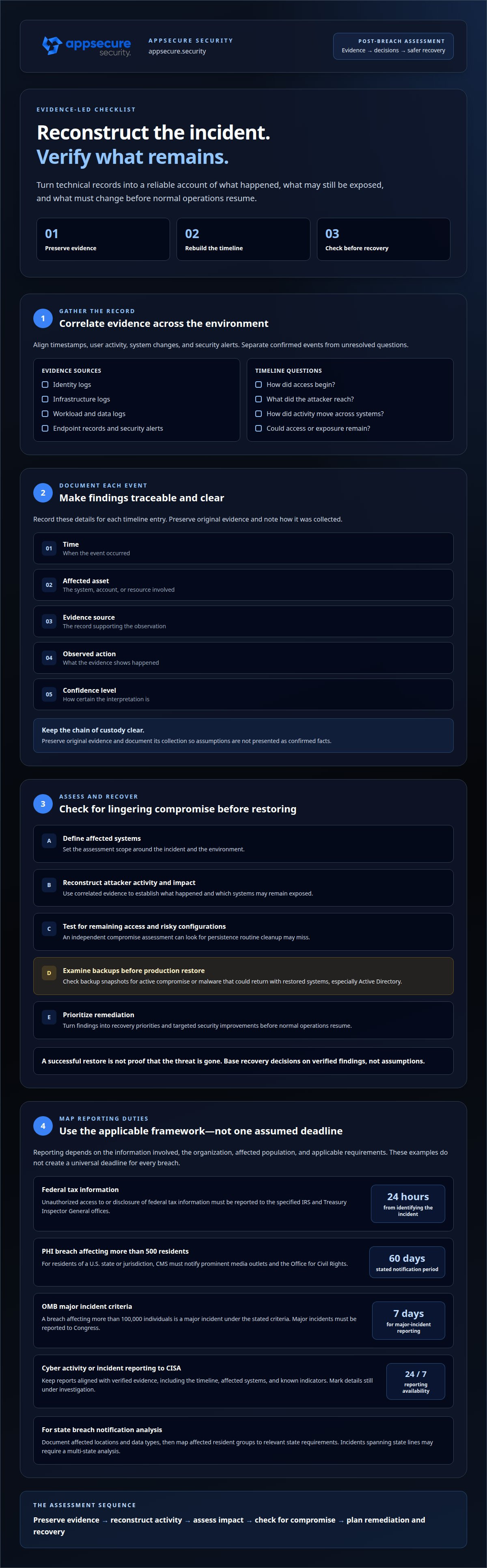
Incident reconstruction turns separate technical records into an evidence-based account of the attack. Investigators align timestamps, user activity, system changes, and security alerts to determine how access began and what happened next. The resulting timeline should distinguish confirmed events from unresolved questions. That distinction makes the report useful to leadership, response teams, and reviewers.
For each event, document the time, affected asset, evidence source, observed action, and confidence level. For example, an identity log may show an account accessing a cloud resource, while an endpoint record helps establish what happened next. Preserve original evidence and record how it was collected. A clear chain of custody supports reliable analysis and helps keep assumptions from being presented as facts.
Federal reporting duties depend on the information involved and the organization’s status. Organizations handling federal tax information must report unauthorized access to or disclosure of that information to the specified IRS and Treasury Inspector General offices within 24 hours of identifying the incident, according to the Internal Revenue Service. For a PHI breach affecting more than 500 residents of a U.S. state or jurisdiction, CMS must notify prominent media outlets and the Office for Civil Rights within 60 days.
Major-incident criteria also affect federal reporting. Under the stated OMB criteria, a breach affecting more than 100,000 individuals is a major incident, and major incidents must be reported to Congress within seven days. These thresholds are not universal deadlines for every breach. The data type, organization, affected population, and applicable reporting framework determine which channel and timing matter.
Which state breach notification laws apply? The relevant states are generally those where affected residents live, so an incident involving residents across state lines may require a multi-state analysis. Document affected locations and data types, then map each group to the applicable state requirements. Assuming one nationwide notification process may overlook differences in coverage or procedure. When identifying exposed personal data to satisfy statutory notification obligations, organizations often collaborate with legal support partners like Trustpoint.One for cyber breach response and managed review.
Cyber incident reporting is separate from notifications required by a particular legal or federal framework. Organizations can report anomalous cyber activity or incidents to CISA 24 hours a day, 7 days a week. Keep the report aligned with verified evidence: preserve the incident timeline, affected systems, and known indicators, while clearly labeling details still under investigation.
What remediation and follow-up testing should happen? Prioritize fixes tied to the attack path, such as closing exposed access, correcting affected configurations, and strengthening detection controls. Then use targeted testing of the affected systems and application paths to validate the changes. Record each finding, remediation owner, test result, and remaining risk so a successful fix is demonstrated, not assumed.
When incident findings point to weaknesses in a web application or cloud environment, discussing focused technical validation can help turn remediation priorities into evidence-based follow-up testing.
Security Logs and Forensic Data Sources
A reliable forensic timeline depends on records from identity, infrastructure, workloads, and data systems. Investigators normalize timestamps, preserve original logs, and correlate related events across sources. For example, a cloud sign-in alert becomes more useful when matched with a role change, a workload event, and access to sensitive data. This sequence can reveal the attacker’s actions, direct access paths, and possible exfiltration.
Useful evidence sources include identity-provider audit trails, Active Directory events, endpoint records, cloud control-plane activity, application logs, network telemetry, and backup histories. Each source answers a different question. Identity records show which account acted; endpoint data can reveal process execution; application records can show requests tied to an account or session. Investigators also record collection times and preserve copies so analysis does not alter original evidence.
To connect technical events, a forensic review can:
- Align timestamps across systems and note clock differences.
- Map account activity to roles, permissions, and affected resources.
- Correlate alerts with known attacker behaviors, including MITRE ATT&CK techniques when available.
- Separate confirmed malicious actions from activity that needs further analysis.
Healthcare figures show why incident scope needs careful measurement. U.S. healthcare data breaches affecting fewer than 500 individuals totaled 74,299 in 2024. That count increased by 12% from 2020 to 2024. The latest report to Congress recorded 805 healthcare data breaches in 2025. These figures describe different measures; neither alone identifies the largest incidents or proves how much data an attacker accessed.
For a large healthcare breach, investigators should establish affected systems, records, and data types from evidence rather than assume the exposed population. The same discipline matters in a smaller event: a limited number of affected people does not show whether malicious access persisted. Insider-caused incidents also require careful interpretation. Investigators can compare account permissions, access times, application activity, and approved job duties to distinguish authorized work from unusual actions. A valid login alone does not establish intent.
U.S. data breach costs depend on the incident’s consequences, including investigation, restoration, operational disruption, and required response work. A defensible assessment documents which effects stem from verified attacker activity, helping leaders prioritize remediation without treating estimates as forensic proof. Assessment pricing depends on the case and is provided after a quote request; affected environments, evidence volume, scope, and testing depth shape the work.
During a comprehensive post-breach security assessment in the USA, professionals evaluate the evidence used, the relationships among records, and the limits of what those records establish. A post-breach timeline can be reconstructed by correlating workload and cloud logs across infrastructure, identity, and data layers. When a MITRE ATT&CK technique match is available, use it to organize an alert in the timeline, not as a substitute for the underlying logs. The sequence should make clear which records support each event and where correlation remains uncertain.
Independent Post-Breach Compromise Assessments
An independent compromise assessment examines whether attacker access remains after an organization has contained an incident. It tests the environment against evidence from the breach, rather than treating restored systems or closed alerts as proof of safety. An independent review can challenge assumptions made during containment and identify blind spots in the investigation.
Scope the assessment around the incident’s attack window, affected assets, and suspected access paths. Post-breach forensics can assess an Active Directory environment for intrusions during a specified attack window. Investigators can compare account activity, replication data, configuration changes, and event logs against that period. They can then distinguish findings that indicate confirmed access from those that suggest exposure or need further investigation.
Configuration analysis can expose risks that a malware scan alone may miss. For example, post-breach analysis can uncover computers configured with unconstrained delegation, a configuration attackers may target. The assessment should identify where it exists, determine whether it connects to observed activity, and explain its effect on the environment. A finding becomes actionable when it links a specific weakness to affected systems and a clear remediation priority.
A disciplined independent review can include these checks:
- Compare known attacker indicators with endpoint, identity, and directory evidence.
- Inspect privileged accounts, authentication patterns, and permission changes.
- Review Active Directory replication and event records for activity within the attack window.
- Examine high-risk configurations, including unconstrained delegation, and map their exposure.
- Document evidence, analysis, limitations, and recommended corrective actions.
How can organizations choose a qualified post-breach security assessment firm? Select an independent team that can explain its evidence-handling process, define the assessment scope, and connect technical findings to the incident. Look for a clear method covering the relevant environment, such as Active Directory or cloud resources, and a report that separates observed facts from interpretation.
Useful reporting should identify the affected asset, the evidence supporting each finding, its potential impact, and the corrective action. For example, a report should distinguish an account that performed a verified suspicious action from one that merely had elevated permissions. That precision helps response leaders prioritize changes without treating every anomaly as confirmed compromise.
The assessment’s depth should reflect the incident evidence and systems involved. A directory-focused attack calls for analysis of identity and replication records; a cloud incident calls for review of relevant roles and resources. Independent validation can then test whether remediation addressed the identified path and whether related exposure remains. Record unresolved questions and retest results so future reviews can track what changed.
Preventing Malware Reintroduction During Recovery
Restoring from backup can reintroduce malware if the snapshot captured systems during an active attack. Post-breach forensics can help determine whether an attack was underway when a backup snapshot was taken. The snapshot’s creation time, affected workloads, and available security records all matter. Treat each recovery source as evidence to assess, not proof that the environment is clean.
Before restoring Active Directory to production, organizations should conduct post-breach forensics to reduce the risk of a follow-on attack. The analysis should examine suspicious account activity, replication data, and system changes around the incident. If evidence connects the backup or directory state to attacker activity, recovery teams can isolate the affected copy and investigate it before it reaches production.
A recovery review can assess each candidate backup through specific checks:
- Record the snapshot time and the systems or cloud entities it contains.
- Compare that time with incident records and known attacker activity.
- Examine the snapshot for indicators associated with the attack.
- Document unresolved risks and the evidence supporting recovery decisions.
Recovery should also account for dependencies. A restored application may reconnect to a compromised identity service, shared storage, or administrative account. Map those connections before bringing systems online. For cloud environments, a focused cloud security assessment can help examine configurations and access paths that affect restoration.
As organizations use more cloud workloads and connected entities, recovery teams must assess more capabilities and dependencies. A backup may include application data, configuration, scripts, and identity dependencies. Review each relevant component against the incident timeline. A restored application should not regain access through credentials or permissions that the investigation identified as exposed.
Use staged recovery to limit exposure while evidence is reviewed. Restore a selected system in an isolated environment, inspect its behavior, and validate its connections before allowing production access. Record what was examined, which indicators were found, and what remediation was completed. If malware or suspicious activity appears, stop the release and investigate the affected image or dependency.
Recovery decisions should connect forensic findings to explicit release criteria. Define which evidence supports restoration, which risks require further action, and who approves production access. This prevents pressure to resume normal operations from overriding unresolved compromise indicators. A documented decision also gives security and operations teams a shared basis for monitoring restored systems.
HIPAA's contingency plan standard, §164.308, includes requirements for a data backup plan, an emergency mode operations plan, and a disaster recovery plan. Treat each as a distinct element when planning recovery.
After a breach, organizations can scan Active Directory for risky configurations and vulnerabilities, mitigate security gaps, and restore it to a clean, malware-free environment.
To assess recovery exposure and validate critical systems, discuss a focused security assessment.
AppSecure Security
AppSecure Security is a VAPT and penetration-testing firm that helps organizations validate whether application and API weaknesses identified after a breach have been addressed. Its AI-agent platform enables faster, in-depth testing at machine scale across web applications, mobile applications, and APIs, examining exposed attack paths and testing security changes.
This is a practical next step when forensic findings identify application-layer risks or security teams need evidence that fixes withstand testing. AppSecure’s penetration testing checks whether vulnerabilities remain exploitable, complementing incident analysis without replacing forensic investigation or incident response.
Contact AppSecure Security to discuss penetration testing for your environment.
Turn Incident Findings into Stronger Defenses
A post-breach security assessment in the USA should lead to clear ownership of unresolved risks, not a report that sits unread. Assign each finding a responsible team, a remediation decision, and a way to validate the change. This turns incident evidence into a practical security roadmap and keeps recovery decisions connected to the weaknesses attackers actually exploited. For practices handling sensitive financial and client data, documenting post-incident remediation in an updated Written Information Security Plan (WISP) helps turn lessons learned into enforceable safeguards.
Where findings point to application-layer exposure, AppSecure Security offers Web Application Penetration Testing, Mobile Application Penetration Testing, and an Agentic Penetration Testing Platform. AI agents help accelerate in-depth penetration testing at machine scale, enabling teams to examine relevant environments after remediation and check whether identified weaknesses persist. This helps organizations reduce the risk of being hacked. The right focus depends on the affected application and the evidence gathered during the incident.
Use the assessment as a turning point: strengthen controls, validate critical fixes, and keep remaining risks visible to decision-makers. Contact AppSecure Security for assessment advice and take the next step toward more resilient systems.
Frequently Asked Questions
1. What should change to prevent recurrence?
Change the control that enabled the attack, then verify that the replacement works under realistic conditions. If an exposed service account enabled access, for example, review its permissions, rotate credentials, and remove unnecessary privileges. Assign an owner and a validation method to each corrective action. Update response playbooks with lessons from the incident, then run a focused exercise to test whether the right team detects and escalates a similar alert.
2. What is a post-breach security assessment?
A post-breach security assessment is an evidence-led review of an incident’s impact, security weaknesses, and recovery risks. Its scope should match the affected business services and their dependencies. For example, an incident involving a customer-facing application may require analysis of its authentication flow, connected APIs, and data stores. The assessment translates technical findings into priorities, helping security leaders decide which fixes must come before restoration or continued operation.
3. What evidence and systems should an assessment review?
Review evidence that can connect access, changes, and business impact. Alongside identity, endpoint, network, application, and backup records, examine email authentication activity, software deployment history, and relevant SaaS audit trails. For example, a new application release near the first suspicious login may reveal an exposed secret or unsafe configuration. Compare event times, affected accounts, and system changes, then preserve relevant records with collection details for later analysis.