



HIPAA requires healthcare organizations to identify, assess, and manage risks to electronic protected health information (ePHI), but it does not explicitly require penetration testing. Healthcare application security testing in the USA can support that risk assessment by uncovering exploitable weaknesses in patient apps, APIs, and connected systems.
That distinction matters. A compliance process can document risks, but offensive testing probes how weaknesses work together in practice, including whether broken access controls or business logic could expose sensitive records. The goal is not simply to find technical issues. It is to understand their potential impact and give security teams actionable evidence.
This article explains how testing applies to patient portals, telehealth platforms, EHR interfaces, and APIs; which access, integration, and business logic flaws it can uncover; and how findings can inform HIPAA risk assessments. You will also see where web application penetration testing fits and what a focused assessment can help your team understand.
Key Takeaways
• Testing patient-facing applications can reveal access-control weaknesses that routine checks may miss.
• Assess portals, telehealth features, EHR interfaces, and APIs as connected parts of the care experience.
• Use findings to inform ePHI risk assessments by documenting exploitable weaknesses and their potential impact.
• Manual testing can trace how business logic flaws and integrations combine to create attack paths.
• Scope testing around the application’s users, data flows, integrations, and security questions that matter most.
Authentication and access control vulnerabilities
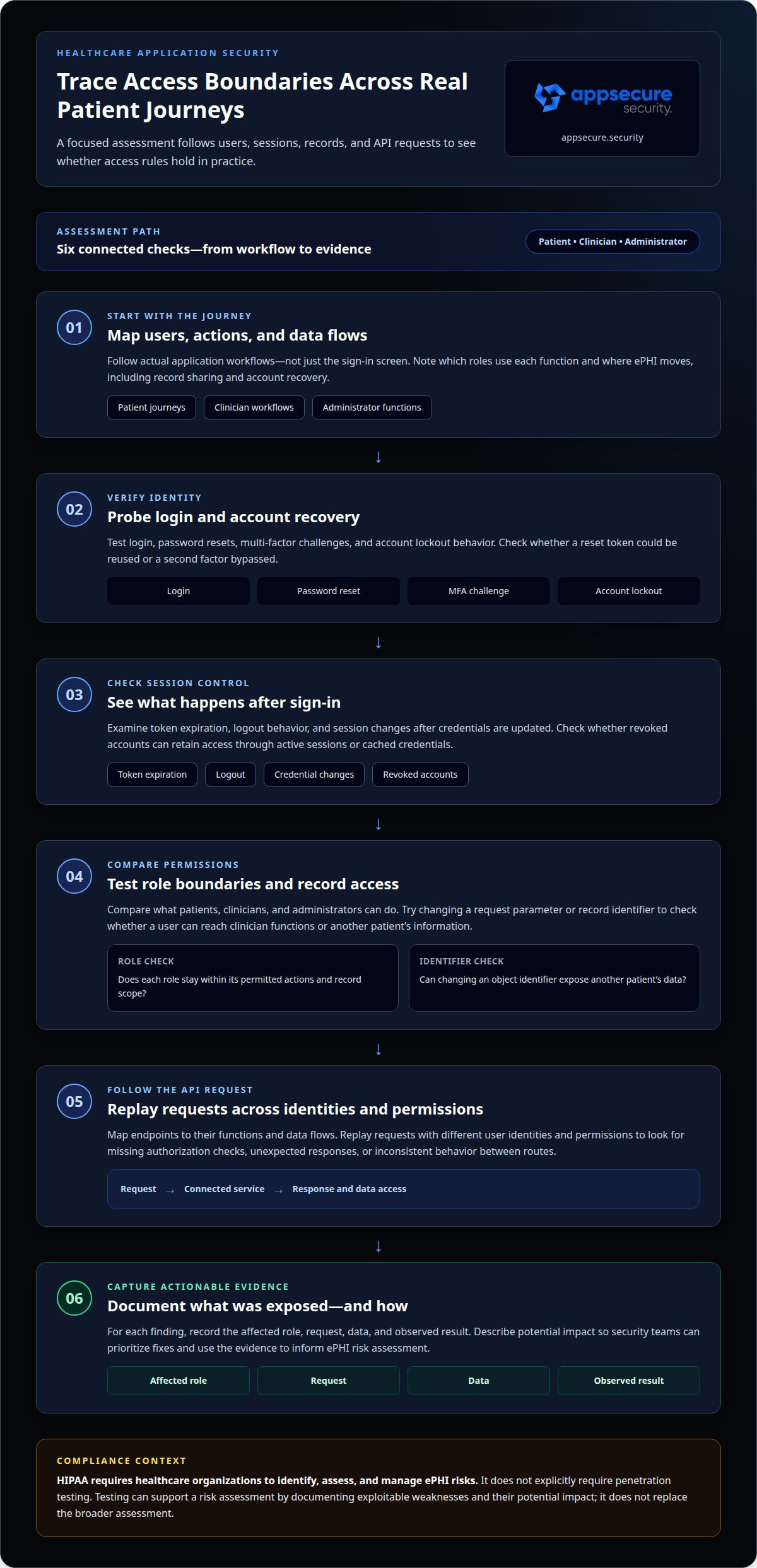
Authentication verifies who is signing in; authorization determines what that person can access. In a patient app, a weakness in either control can expose records, messages, appointment details, or account functions. A sound assessment tests both across real user journeys, not just at sign-in. For example, testers can check whether a patient can change a record identifier to retrieve another patient’s information.
FDA cybersecurity expectations depend on whether software qualifies as a medical device and on its intended use. A general appointment or wellness app is not automatically a medical device. For regulated device software, assess authentication and access controls as part of the product’s cybersecurity risks. A penetration test alone does not determine FDA status.
Account controls need testing beyond password entry. A tester can examine password resets, multi-factor authentication, session handling, and account recovery. Could an attacker reuse a reset token, bypass a second factor, or keep an old session active after a password change? Each path may create a different exposure, especially when an account can access electronic protected health information (ePHI).
Authorization flaws often emerge when an application serves patients, clinicians, and administrators. Testing should compare the actions permitted for each role. A patient should not gain clinician functions by changing a request parameter. A clinician should not access records outside their authorized scope by substituting an identifier. The test should also check whether revoked accounts retain access through active sessions or cached credentials.
Healthcare incidents show why access boundaries matter. In 2025, unauthorized access exposed the personal information of more than 5.5 million Yale New Haven Health patients. That incident doesn’t establish the cause of every exposure, but it illustrates the scale that access failures can reach. Testing helps identify whether a specific application allows unauthorized users to cross a boundary.
A focused assessment can examine these paths:
Identity
Test login, password recovery, multi-factor challenges, and account lockout behavior.
Session control
Check token expiration, logout behavior, and session changes after credential updates.
Role boundaries
Compare patient, clinician, and administrator permissions for the same function.
Record access
Change object identifiers and test whether one account can retrieve another patient’s data.
API authorization
Replay requests with different user identities and permissions to expose missing checks.
Document each finding with the affected role, request, data, and observed result. This evidence helps teams prioritize fixes based on exposure and business impact. In healthcare application security testing in the USA, access-control testing should follow the application’s actual workflows, including account recovery and record sharing, rather than treating authentication as a single checkpoint.
Patient portals, telehealth platforms, EHR interfaces, and APIs
Patient portals can give individuals online access to medical records and related services. Those portals connect patients with sensitive records and services, while telehealth platforms, electronic health record (EHR) interfaces, and APIs move information between systems. Testing must examine these connections as one application ecosystem, not as isolated screens.
Healthcare web application penetration testing simulates real-world attacks on healthcare applications, interfaces, and APIs to identify exploitable vulnerabilities. A patient might start in a portal, schedule a telehealth visit, and receive follow-up information through an EHR-connected workflow. Each transition is worth examining: what data moves, which system receives it, and whether that system handles it safely.
Patient portals often combine record viewing, appointment management, messaging, and forms. Testers can trace a workflow from the patient’s initial request through the application’s response. For example, a document download may use a separate API from the screen displaying the document. Testing both paths can reveal inconsistent validation or information exposure that a visual review would miss.
Telehealth adds functions such as visit scheduling, session access, and information exchange before or after an appointment. A test can follow the full journey, including links sent through messages and records created after a visit. The key question is whether each function enforces its intended rules, even when a user changes a request, repeats an action, or takes a different application route.
EHR interfaces and APIs warrant close attention because they carry structured requests between components. A useful test maps each endpoint to its function and data flow, then probes how the application handles unexpected inputs and responses. A request that appears harmless in a portal may trigger a more sensitive operation in a connected service. Trace the request across every handoff.
Portal
Trace record viewing, downloads, messaging, and appointment changes.
Telehealth
Examine scheduling, visit access, and related patient information flows.
EHR interface
Follow data from the patient-facing function into connected record workflows.
API
Test endpoints for validation gaps, unintended responses, and inconsistent behavior between routes.
Integration
Track what happens when one component sends incomplete, altered, or repeated information.
Testing should document the affected workflow, the system boundary, and the data involved. That lets technical teams see whether a flaw belongs to the portal, an API, or an integration between services. For teams examining connected interfaces, API security testing can help frame the risks to investigate. To discuss an assessment of patient-facing applications and their connections, contact the security team.
Penetration testing as support for HIPAA risk assessments
HIPAA’s Security Rule requires healthcare organizations to conduct periodic risk analyses of electronic protected health information (ePHI). HIPAA does not explicitly require penetration testing, but test results can provide evidence for risk assessments and audits. Include HITECH in the organization’s broader compliance mapping; testing informs technical risk, not the legal determination of which obligations apply.
How does testing support that analysis? It probes whether an attacker could exploit weaknesses affecting ePHI. A scan may flag an exposed function, while a penetration test can determine whether that function provides access to patient data or enables an unauthorized action. The evidence gives security teams a clearer basis for assessing likelihood, impact, and remediation priority.
NIST SP 800-66 Revision 2 provides guidance on implementing the HIPAA Security Rule, including risk assessment and evaluation activities. It can help structure the work around security safeguards and risk-management activities. Use it to organize assessment questions, then connect each technical finding to the systems, workflows, and ePHI involved.
HHS proposed requiring covered entities to conduct penetration testing at least once every 12 months in January 2025. The proposal described a possible testing requirement. These details describe a proposal, not a current HIPAA penetration-testing mandate. Keep that distinction clear in compliance records, alongside the separate requirement for periodic ePHI security risk analyses.
A practical assessment produces evidence that can inform risk documentation. For each verified finding, record the affected application or interface, the vulnerable condition, the access or data exposed, and the plausible impact. Include relevant remediation actions and retest results when available. This links a technical observation to the organization’s broader assessment instead of leaving it as an isolated vulnerability report.
Define scope
Identify the patient applications, APIs, EHR connections, and environments that handle ePHI.
Test realistic paths
Examine how a flaw could be reached and what an attacker could do.
Document impact
Tie each finding to affected data, users, workflows, and systems.
Prioritize remediation
Consider exploitability and potential ePHI impact when ranking issues.
Retest fixes
Verify that remediation closes the tested path and update the risk record.
Penetration testing supports, but does not replace, the organization’s HIPAA risk analysis. A test covers its defined scope and techniques; the risk analysis considers the broader environment, safeguards, and threats. Combining findings with system inventories, existing controls, and remediation decisions gives compliance and security teams a more useful record of ePHI risks.
Business logic, API, and integration vulnerabilities
Healthcare application flaws can arise when valid features are used in unintended sequences. Testing follows those sequences across application rules, APIs, and connected services.
Business Logic Vulnerabilities
A business logic vulnerability occurs when an application’s rules allow an unintended action, even though individual functions work correctly. For example, a patient might repeat a referral request or alter an appointment workflow to bypass an expected approval. These flaws matter because they can disrupt care processes or expose sensitive information without triggering a conventional technical alert. Business logic flaws are found by testing how features behave together.
API and Integration Vulnerabilities
An API or integration vulnerability occurs when connected components handle requests, data, or trust boundaries insecurely. For example, a portal may send a patient update to an EHR interface, which then forwards it to another service. A mismatch in validation or workflow assumptions can allow altered data to travel farther than intended. Testing these paths matters because a weakness in one component can affect the wider healthcare application.
Manual testing examines complete workflows rather than isolated endpoints. A tester can start with a legitimate patient action, change its order, repeat it, or submit an unexpected combination of inputs. The aim is to understand what an attacker could achieve by chaining ordinary functions and design weaknesses. One request may look safe; the sequence can expose a flaw.
Workflow order
Test whether an action can occur before its required approval or preceding step.
Repeated requests
Check whether resubmitting a form creates duplicate records or unintended changes.
Data handoffs
Trace how a value moves from a patient app through an API into an EHR workflow.
Error handling
Observe whether an unexpected response leaves a transaction incomplete or inconsistent.
Consider an appointment workflow that updates a patient record and sends a message through a connected service. Testing can check whether each step succeeds or fails consistently when a request is repeated or interrupted. If one system records the change while another rejects it, the mismatch may cause confusion or an unintended action. The assessment should capture the sequence and its impact.
For each confirmed issue, document the starting condition, requests involved, affected components, and resulting behavior. This record helps developers reproduce the flaw and identify which rule or integration needs correction. Retesting the same sequence checks whether the application blocks the unintended outcome without disrupting the intended patient workflow.
Healthcare web application penetration testing
A focused test examines a healthcare web application through realistic attack paths, not just automated alerts. Its value depends on clear scope, safe handling of test data, and findings that teams can reproduce and fix.
Testing Methods for Healthcare Applications
Penetration testing actively probes an application, while SAST reviews source code and DAST tests a running application from the outside. API testing examines endpoint behavior, including requests and responses. Combining these methods matters because a code issue, runtime weakness, or API flaw may affect the same patient workflow in different ways. For example, a portal’s record-download feature should be tested at both the interface and API layers.
Penetration Test Steps
A healthcare application penetration test moves from agreed scope to controlled testing, evidence, and remediation. A defined process helps teams focus on relevant workflows while limiting disruption to patient services. Typical stages include:
• Set scope, target environments, test accounts, and permitted actions.
• Map application functions, data flows, and external interfaces.
• Test for exploitable weaknesses using controlled requests and user journeys.
• Record evidence, affected components, and potential impact.
• Prioritize fixes, then retest the paths that were changed.
Vendor Selection and Patient Data Protection
Choose a testing team that can explain its methods, scope, evidence, and reporting in terms your security and engineering teams can use. Protect patient data by agreeing on test accounts, limiting access to necessary records, and using synthetic data where practical. For example, define how testers should handle a discovered record exposure, where evidence will be stored, and who will receive the report.
Keep testing within approved environments and document any permitted production activity in advance. These boundaries help prevent testing from disrupting appointment booking or telehealth workflows. Agree on the escalation path for a critical finding, who is authorized to receive sensitive evidence, and how data collected during testing will be handled and removed.
Healthcare Application Testing Costs
The cost depends on the engagement and is provided after a quote request. Scope, application complexity, number of interfaces, testing depth, and required environments shape the work. A single patient portal differs from a connected platform with mobile apps, APIs, and EHR integrations. Clear scope helps align the assessment with the risks the organization needs to address.
How often should testing happen? At least once a year is a common baseline for healthcare organizations. Reassess after material application changes, new integrations, or major workflow updates, as these can introduce attack paths between scheduled tests. A changed patient-registration flow, for example, may call for targeted testing before the next annual assessment.
For a scoped assessment of a healthcare web application, discuss your testing requirements with the security team.
AppSecure Security: Web Application Penetration Testing
AppSecure Security helps healthcare teams examine patient-facing applications and APIs for exploitable weaknesses through focused penetration testing. Consider an assessment when a new release, integration, or changed patient workflow needs deeper security scrutiny, or when technical findings should inform remediation priorities.
Web Application Penetration Testing assesses application behavior and connected workflows. Mobile Application Penetration Testing focuses on risks in patient apps, while API Penetration Testing examines exposed interfaces. AppSecure Security also offers an Agentic Penetration Testing Platform for testing across application environments. The right scope depends on the systems and workflows your team needs assessed.
Bring assessment findings into your remediation process, then retest to check that addressed weaknesses remain closed. To discuss healthcare application testing, contact AppSecure Security.
Turn Security Findings Into the Next Release Decision
Make the next step operational. Assign clear owners to security findings, link each issue to the affected patient workflow, and track remediation through retesting. This gives engineering and security teams a shared view of what needs to change before an application update proceeds.
For healthcare application security testing in the USA, focus the assessment on the system’s current design and use. A newly connected API, revised account flow, or changed data exchange can alter the risk picture. Treat those changes as opportunities to reassess relevant attack paths rather than relying only on an earlier report.
AppSecure Security can help teams examine healthcare applications through penetration testing. Bring your application scope, key workflows, and security priorities into the discussion to shape a practical assessment. Contact AppSecure Security to discuss your testing needs and take a clear next step toward stronger application security.
Frequently Asked Questions
How Does Offensive Testing Support HIPAA Compliance?
Offensive testing gives security teams practical evidence of whether safeguards work under realistic attack conditions. For example, if a test shows that a user can reach an ePHI function through an unintended route, the organization can document the exposure, its potential impact, and corrective action. Testing supports HIPAA risk assessment work; it does not replace the organization’s broader analysis or make compliance automatic.
What are the Key Vulnerabilities Found in Healthcare Web Applications?
Common weaknesses include excessive permissions, weak session handling, unsafe input processing, exposed configuration, and gaps between application components. For example, an export function may reveal more information than its screen preview, or a session may remain usable after an account change. Review the full user journey and the data returned by each function, not just the visible page or initial login.
What is Healthcare Web Application Penetration Testing?
Healthcare web application penetration testing is a controlled assessment that probes a healthcare application for exploitable security weaknesses. Testers examine how it responds to realistic requests and user actions, then document verified findings for remediation. For instance, a test may check whether an appointment-management function behaves safely when a request contains unexpected values or arrives in an unusual sequence.
Why Do Healthcare Organizations Need Offensive Security Now?
Healthcare teams depend on connected applications to support patient access, clinical workflows, and information exchange. Each product update or new integration can change how data moves and which functions are reachable. Offensive testing helps expose practical attack paths before teams rely on assumptions about those changes. It’s especially relevant when a release alters core workflows or introduces a connection to another system. A study of HHS breach data from 2013 to 2023 found that the share of reported PHI breaches attributed to hacking and IT incidents rose markedly over that period.
What is healthcare application security testing?
Healthcare application security testing examines software used in care delivery and administration for weaknesses that could affect confidentiality, integrity, or availability. It can include source-code review, testing a running application, and focused API assessment. The right scope reflects how the application is built and used, including its users, data flows, connected services, and functions that could affect patient care.
What types of healthcare applications need security testing, including EHRs, patient portals, and telehealth apps?
Test applications that store, display, transmit, or act on health information. This includes EHR systems, patient portals, telehealth apps, mobile health applications, scheduling tools, and APIs connecting those products. Include administrative and clinician-facing functions, not only patient screens. For example, a billing or messaging component may exchange information with a patient record even when users access it through a separate interface.
What common vulnerabilities and cyber risks affect healthcare applications?
Risks include stolen credentials, inappropriate access, exposed data, insecure integrations, and application flaws that disrupt expected workflows. A compromised account might provide access to functions beyond its intended role; a poorly handled error could reveal information or leave a transaction incomplete. Assess both direct attacks on the application and weaknesses created by its connections to identity, messaging, record, or cloud services.




































































































