A clean compliance checklist doesn’t prove defenses can withstand an attack. HIPAA doesn’t explicitly require penetration testing under the current Security Rule, but it does require periodic technical evaluations under § 164.308(a)(8) and ongoing risk analysis. For HIPAA compliance penetration testing in the USA, that distinction matters: a test is a practical way to assess whether safeguards work, not a standalone current mandate.
A proposed update would require penetration testing at least once every 12 months, or more often when the risk analysis calls for it. The current rule remains the baseline, so understanding the difference between existing obligations and proposed requirements is essential for setting a defensible testing program.
This guide explains what HIPAA requires, how proposed testing intervals compare with practical schedules, and what evidence to retain for audits and remediation tracking. It also shows how covered entities and business associates can assess systems that handle electronic protected health information, including web applications, APIs, and cloud environments.
Key Takeaways
• Distinguish the current HIPAA Security Rule’s evaluation and risk-analysis duties from the proposed penetration-testing requirement.
• Build a testing schedule around your risk analysis, system changes, and the proposed testing and scanning intervals.
• Preserve reports, technical findings, remediation records, and retest results to show how security issues were addressed.
• Define test scope around the systems and vendors that create, receive, maintain, or transmit electronic protected health information.
• Use penetration testing to uncover exploitable weaknesses and assess whether technical safeguards work beyond paper policies.
Does HIPAA require penetration testing?
No. The current HIPAA Security Rule requires periodic technical evaluations under § 164.308(a)(8), but it does not explicitly require penetration testing. The distinction matters: organizations must evaluate whether security measures work, while penetration testing is one practical way to expose weaknesses an attacker could exploit.
HIPAA does require ongoing risk analysis. The Security Management Process is cited at §164.308(a)(1), and the Risk Analysis implementation specification appears at §164.308 (a)(1)(ii). Section 164.308(a)(1)(ii)(A) requires an organization to assess risks and vulnerabilities to electronic protected health information, or ePHI. That analysis should inform security decisions as systems, threats, and business operations change.
Technical and nontechnical evaluations answer different questions. A technical evaluation tests whether documented controls work effectively in practice; a vulnerability assessment or penetration test can provide evidence. A nontechnical evaluation examines whether the organization’s security plan and procedures are adequate on paper. For example, a written access policy does not show whether a web application prevents one user from viewing another patient’s records.
Penetration testing can probe safeguards in the Security Rule’s Technical Safeguards provision, §164.312. Access controls under Section 164.312(a)(1) include unique user identification, emergency access procedures, automatic logoff, and encryption. A test can examine whether authentication boundaries hold and whether a session remains accessible after logoff should occur. Integrity controls under Section 164.312(c)(1) concern protection against improper alteration or destruction of ePHI.
Transmission security under Section 164.312(e)(1) protects ePHI in transit. Testing can inspect a web application or API for exposed data, weak transport configurations, or access paths that bypass expected controls. Audit controls under Section 164.312(b) support recording and examining system activity. A useful evaluation validates whether security events are logged and whether alerts surface suspicious access, rather than merely confirming that logging is enabled.
The current rule remains in effect while the proposed update would add a direct testing requirement: penetration testing at least once every 12 months, or more often when risk analysis calls for it. Until that proposal becomes a final requirement, the current evaluation and risk-analysis duties remain the baseline. The practical case for testing is to produce evidence about real control performance, not to treat a test as a substitute for the broader security program.
State-level requirements vary by jurisdiction. HIPAA’s federal Security Rule does not itself set a separate state penetration-testing mandate, so organizations should consider applicable state privacy and sector rules alongside their HIPAA obligations.
The average cost of HIPAA penetration testing in the United States depends on the scope and is provided after a quote request. Cost factors include the systems tested, application and API complexity, environment size, and depth of manual testing. For small to midsize organizations balancing assessment expenses with ongoing infrastructure defenses, managed IT and cybersecurity providers such as Trinity Networx, LLC offer predictable support models to maintain compliance-ready controls.
Proposed HIPAA penetration-testing and vulnerability-scanning frequencies
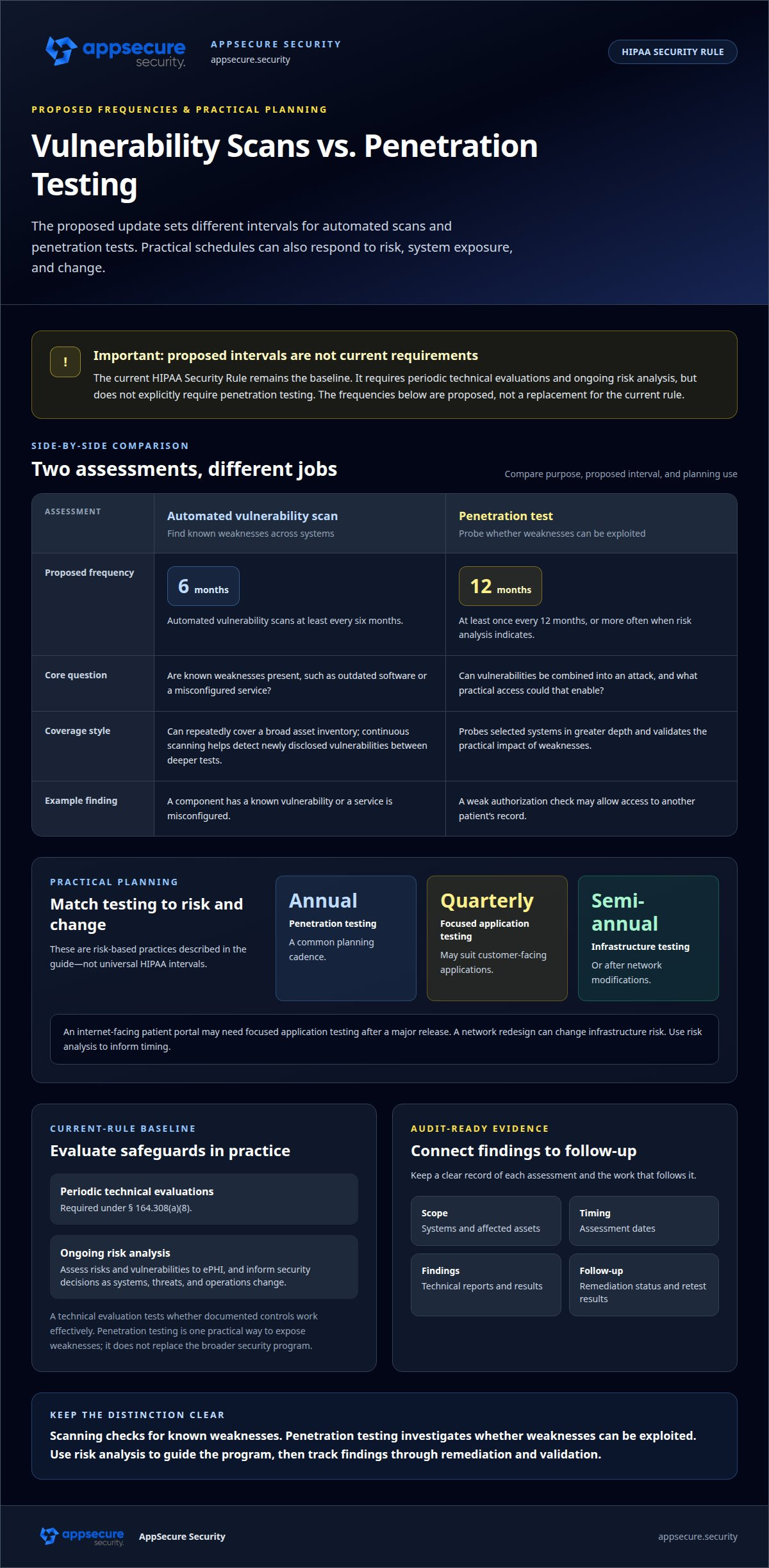
The proposed HIPAA Security Rule update separates automated vulnerability scanning from penetration testing. According to the U.S. Department of Health and Human Services, the proposal would require automated vulnerability scans at least every six months. It would also require penetration testing at least once every 12 months, with more frequent tests when risk analysis indicates they are necessary. These are proposed frequencies, not a replacement for the current rule.
For planning, match each assessment to a system’s exposure and rate of change. An internet-facing patient portal may need focused application testing after a major release, while a network redesign can change infrastructure risk. Annual penetration testing is a common planning cadence; customer-facing applications may warrant quarterly focused testing, and infrastructure testing may be scheduled semi-annually or after network modifications. These are risk-based practices, not universal HIPAA intervals.
A vulnerability scan and a penetration test answer different questions. A scan checks systems for known weaknesses, such as outdated software or a misconfigured service. A penetration test investigates whether vulnerabilities can be combined into an attack, such as exploiting a weak authorization check to access another patient’s record. Scanning can repeatedly cover a broad asset inventory; testing probes selected systems in greater depth and validates practical impact.
Healthcare web applications deserve particular attention because exposed patient portals and APIs can provide direct paths to sensitive data. A scan might flag a component with a known vulnerability; a tester can assess whether the flaw is reachable and what access it could enable. Each assessment should record its scope, dates, affected assets, findings, and remediation status. These details connect technical work to the organization’s risk analysis.
Continuous scanning helps detect newly disclosed vulnerabilities between deeper tests, but it does not replace penetration testing. A scanner generally cannot establish how an attacker might combine access-control, configuration, and application flaws. A useful cycle is to scan, prioritize findings by exploitability and ePHI exposure, apply fixes, then rescan to validate the changes. Retest critical paths with penetration testing when a fix changes authentication, authorization, or data flows.
For organizations evaluating a continuous penetration-testing program, the key is to coordinate recurring scans with focused manual testing, system releases, and remediation. The proposed six-month scan interval offers a planning reference, while risk analysis helps determine whether specific systems need closer attention. To discuss test scope and cadence for an environment, contact the security team.
Audit-ready penetration-test reporting and remediation evidence
Before testing, define the scope, systems, authorized methods, and points of contact. Provide current architecture diagrams, relevant access details, and change records so testers can examine the right environment without disrupting clinical workflows.
Testing Phases and Reports
A penetration test typically moves from scope definition and reconnaissance to controlled exploitation, analysis, and reporting. Each phase documents what was examined and how testers reached a finding. This helps healthcare teams connect technical results to affected systems and security controls.
A useful report includes an executive summary, technical findings with risk ratings, remediation steps, and evidence of exploit outcomes. For example, it might show how a role-based access flaw exposed another user’s records. The report should identify the affected application, attack path, and observed impact, rather than relying on a scanner alert alone.
Before testing, identify production boundaries, test accounts, escalation contacts, and prohibited actions. Confirming these details helps prevent unintended impact on patient care systems. A scoped test can then examine agreed assets, such as a patient portal, API, or cloud-hosted service, while keeping evidence tied to the correct environment.
Remediation Guidance and Evidence
Remediation guidance translates each confirmed weakness into a corrective action and a way to validate the fix. This matters because an audit trail should show more than a finding: it should show ownership, implementation, and retest results. Critical vulnerability patching should be prioritized within 30 days, as a recommended practice, not a universal HIPAA deadline.
For each issue, retain the original finding, risk rating, assigned owner, remediation decision, implementation evidence, and retest outcome. If a team changes an API authorization check, for example, preserve the change record and evidence that the vulnerable access path no longer works. Document accepted risks with a rationale and approval rather than marking them resolved.
Keep reports and remediation records in a controlled repository, with access limited to appropriate personnel. HIPAA documentation must be retained for six years from its creation date or the date it was last in effect, whichever is later. Include the test scope, dates, findings, and follow-up evidence in the relevant documentation set so reviewers can trace decisions over time.
Automated vulnerability scans can complement a penetration test, but they do not produce the same evidence. A scan may flag a software weakness; a penetration test report can explain whether it was exploitable and what access it enabled. Link scan results to the relevant remediation ticket, then retain a rescan or retest showing whether the fix worked.
Clear reporting also supports management decisions. A concise summary helps leaders prioritize systems that expose ePHI, while technical details help engineering teams implement precise fixes. When a penetration test identifies related control failures, group them by attack path and affected asset. This makes remediation more coherent than tracking isolated alerts without their technical context.
Penetration testing for covered entities and business associates
Testing scope should follow electronic protected health information (ePHI) across the systems that create, receive, maintain, or transmit it. For covered entities and their business associates, this means tracing data flows and the technical dependencies around them.
Covered Entity and Associate Scope
Scope defines which systems, environments, and access paths a test will examine. This matters because a patient record may pass from a provider’s application to a billing platform or cloud service. Map those flows, identify the responsible organization, and set authorized boundaries before testing begins.
A covered entity’s scope might include its patient portal, internal network, APIs, and systems used to store or transmit ePHI. A business associate’s scope may include the services and infrastructure it uses to handle that information. Business associate agreements (BAAs) help establish responsibilities and coordinate testing. Assess defenses across the relationship rather than assuming a vendor’s controls are effective.
Third-party exposure can create weaknesses beyond a healthcare organization’s direct environment. For example, a billing vendor’s API may connect to a provider’s records system. Define who owns each asset, who authorizes testing, and how findings will be shared. This coordination helps identify access paths that cross organizational boundaries without exceeding the agreed scope.
Healthcare Test Types
Internal tests examine access and movement within an organization’s network, while external tests probe internet-facing systems. Web application tests focus on user-facing functions and authorization paths; cloud tests examine hosted environments, identity controls, and data access. These approaches reveal different weaknesses, so choose based on where health information flows.
For example, an external test may assess whether exposed services provide a route into a clinical network. A web application test can examine whether one patient account can access another patient’s information. A cloud assessment can trace whether storage or identity settings expose ePHI. Internal testing can show how far an attacker could move after gaining a foothold.
Let the organization’s mission and architecture guide the testing mix. A health system with a patient portal, mobile access, and cloud-hosted records may need application and cloud coverage alongside network testing. A business associate processing claims may prioritize its processing platform and connected APIs. The aim is to test paths that could expose ePHI, not to run identical assessments across unrelated systems.
For organizations coordinating external vendor testing, a healthcare compliance testing approach should account for authorization, scope, and evidence sharing. Clear boundaries let technical teams validate controls while keeping clinical operations and third-party systems within agreed limits.
Benefits of penetration testing for HIPAA compliance
Penetration testing gives healthcare teams a practical view of cybersecurity risk. Policies describe expected protections for electronic health information; testing examines whether applications and connected systems enforce those protections against realistic attack paths.
For a HIPAA compliance penetration testing program in the USA, one key benefit is finding exploitable weaknesses before they become incidents. For example, a tester may uncover a patient portal flaw that exposes appointment details to the wrong account. This concrete evidence helps engineers understand the impact and choose a targeted fix.
Testing can also show how controls fail together. A healthcare organization might have secure authentication but weak authorization after login. A test can determine whether a user can reach records outside their role, giving security teams evidence to prioritize remediation based on potential ePHI exposure.
These findings help leadership make informed decisions about risk and investment. An assessment can reveal whether the most sensitive data paths receive appropriate attention or whether effort is concentrated on lower-impact issues. For organizations planning HIPAA compliance penetration testing in the USA, this evidence can align technical work with operational priorities.
Testing can also expose gaps in detection. A controlled attempt to access restricted records can show whether audit logs capture the activity and alerts reach the right response team. If the event goes unnoticed, the organization can improve monitoring procedures before similar activity occurs in a real attack.
For covered entities working with business associates, testing can help assess connected systems and data exchanges. A review of a claims-processing API, for instance, may reveal that its responses include more health information than the workflow requires. Addressing that exposure can strengthen security across the relationship.
The value comes from acting on results. Assign owners, implement fixes, and retest the paths that exposed weaknesses. This closes the loop between discovery and improvement, while giving decision-makers clearer evidence about the systems assessed and remaining priorities. For healthcare organizations that require ongoing assistance addressing identified vulnerabilities and securing day-to-day operations, managed IT partners like SpaceCenter Systems provide hands-on cybersecurity and infrastructure support.
Penetration testing cannot guarantee that every weakness will be found. It can provide actionable evidence about tested systems and help teams focus their next security decisions. Discuss a penetration test for your healthcare environment.
AppSecure Security
AppSecure Security helps healthcare organizations turn security questions into focused technical assessments. Its Web Application Penetration Testing, Mobile Application Penetration Testing, and API Penetration Testing examine systems that handle electronic health information. The Agentic Penetration Testing Platform supports assessment across relevant environments.
Turn to AppSecure Security when you need to test an application or API, investigate exploitable weaknesses, or understand how technical findings affect security priorities. Testing can focus on the systems and data flows your organization identifies, producing actionable remediation findings. The right assessment depends on your environment and the questions your risk analysis needs to answer.
Contact AppSecure Security to discuss your healthcare security assessment needs.
Make security decisions part of the operating rhythm
A penetration test can inform more than a technical backlog. Its findings can help security, engineering, and clinical leaders make shared decisions about priorities, ownership, and acceptable operational risk. Include these discussions in planning for application changes and security reviews so defensive decisions keep pace with evolving care systems.
For teams shaping a HIPAA compliance penetration testing program in the USA, the next step is to turn the assessment goal into a clear engagement scope. AppSecure Security offers Web Application Penetration Testing, Mobile Application Penetration Testing, and an Agentic Penetration Testing Platform to examine relevant attack surfaces and inform security decisions.
Bring your testing goals and the systems you want to assess into the discussion. Contact AppSecure Security to discuss your assessment and take a practical next step toward stronger security.
Frequently Asked Questions
How to Choose The Right HIPAA Pentesting Partner?
Choose a testing approach that matches your systems, data flows, and risk priorities. Define clear scope boundaries, practical technical findings, and remediation guidance your engineering team can act on. For example, if a patient portal uses separate APIs for appointments and records, the test should address relevant access paths rather than rely on surface-level scanning alone. Set expectations for test accounts, sensitive data handling, and communication during testing.
What is a penetration test?
A penetration test is a controlled security assessment that attempts to exploit weaknesses in specified systems. Testers use attacker techniques to determine whether a flaw could lead to unauthorized access, privilege escalation, or exposure of electronic protected health information. For example, they may test whether changing a record identifier lets one user view another patient’s data. The findings help technical teams understand exploitability and decide which fixes to prioritize.
Why Conduct Pen Testing?
Conduct penetration testing to learn how weaknesses could affect real systems, not just whether software has known vulnerabilities. A test can reveal how an attacker might combine an access-control flaw with a poorly protected API. It can also show whether security alerts capture that activity. These results help organizations target remediation, make informed risk decisions, and verify that a change closed the identified attack path.
What does HIPAA require for penetration testing?
HIPAA requires covered entities and business associates to conduct risk analysis and evaluate security measures, but the current Security Rule does not explicitly name penetration testing as a required method. A penetration test can support those activities by examining technical safeguards in practice. Treat it as evidence for the broader security program, not a substitute for risk analysis, documented policies, access controls, or ongoing evaluation.
Does the HIPAA Security Rule mandate penetration testing or vulnerability assessments?
The current HIPAA Security Rule requires periodic technical evaluations, but it does not explicitly mandate penetration testing or a particular assessment method. Vulnerability assessments and penetration tests can each provide evidence, but they answer different questions. A scan can identify known weaknesses; a penetration test investigates whether selected weaknesses can be exploited. The proposed update would set specific testing and scanning frequencies if finalized.
How should penetration testing be scoped for HIPAA-regulated systems and ePHI?
Scope testing around the systems and connections that create, receive, maintain, or transmit ePHI. Include relevant user roles, applications, APIs, cloud components, and integrations, then define authorized boundaries and excluded systems. For instance, if a patient portal sends appointment data to a separate scheduling service, document the connection and which party controls each system. Clear scope helps examine meaningful exposure without reaching unrelated environments.
What are the HIPAA requirements for penetration testing vendors and business associate agreements?
The current Security Rule does not prescribe a specific penetration-testing vendor or a standalone vendor certification for this work. The covered entity remains responsible for its HIPAA obligations, while a business associate agreement governs applicable arrangements involving protected health information. Before testing, define authorization, system boundaries, permitted data access, findings handling, and incident communication in the engagement and relevant agreements. Coordinate with affected vendors before testing connected systems.
How often should healthcare organizations conduct HIPAA penetration testing?
The current Security Rule does not set a specific penetration-testing interval. Use risk analysis, system changes, and exposure to determine a defensible schedule; annual testing is a common planning practice, with additional testing after material changes. The proposed update would require penetration testing at least once every 12 months and automated vulnerability scans at least every six months. Those proposed frequencies should not be confused with current requirements.