A checklist can prepare a penetration test, but it can’t replace a rigorous methodology. The penetration testing methodology checklist for 2026 should define the systems in scope, testing boundaries, access requirements, key contacts, compliance needs, and how findings will be remediated and retested. The methodology governs how the test is planned, conducted, and reported; NIST SP 800-115 is one reference for that process.
Preparation matters: unclear scope or access can undermine an engagement before testing begins. But readiness tasks alone do not explain how testers will investigate vulnerabilities, validate impact, or document evidence.
This checklist explains what to prepare, how a checklist differs from a methodology, and how to plan remediation, retesting, and compliance. It also covers rules of engagement and how to turn findings into practical security improvements.
Key Takeaways
- Define systems in scope, access needs, testing boundaries, and rules of engagement before expert testing begins.
- Use the checklist to confirm readiness; use the methodology to drive how testing is planned, performed, and reported.
- Prioritize findings by severity, exploitability, and business impact, then assign clear remediation owners and timelines to reduce exposure.
- Plan retesting to validate fixes, and connect findings to relevant compliance frameworks and evidence needs.
- Make penetration testing part of an ongoing security program to help defend against attackers, not a one-time snapshot.
Is a penetration testing checklist the same as a methodology?
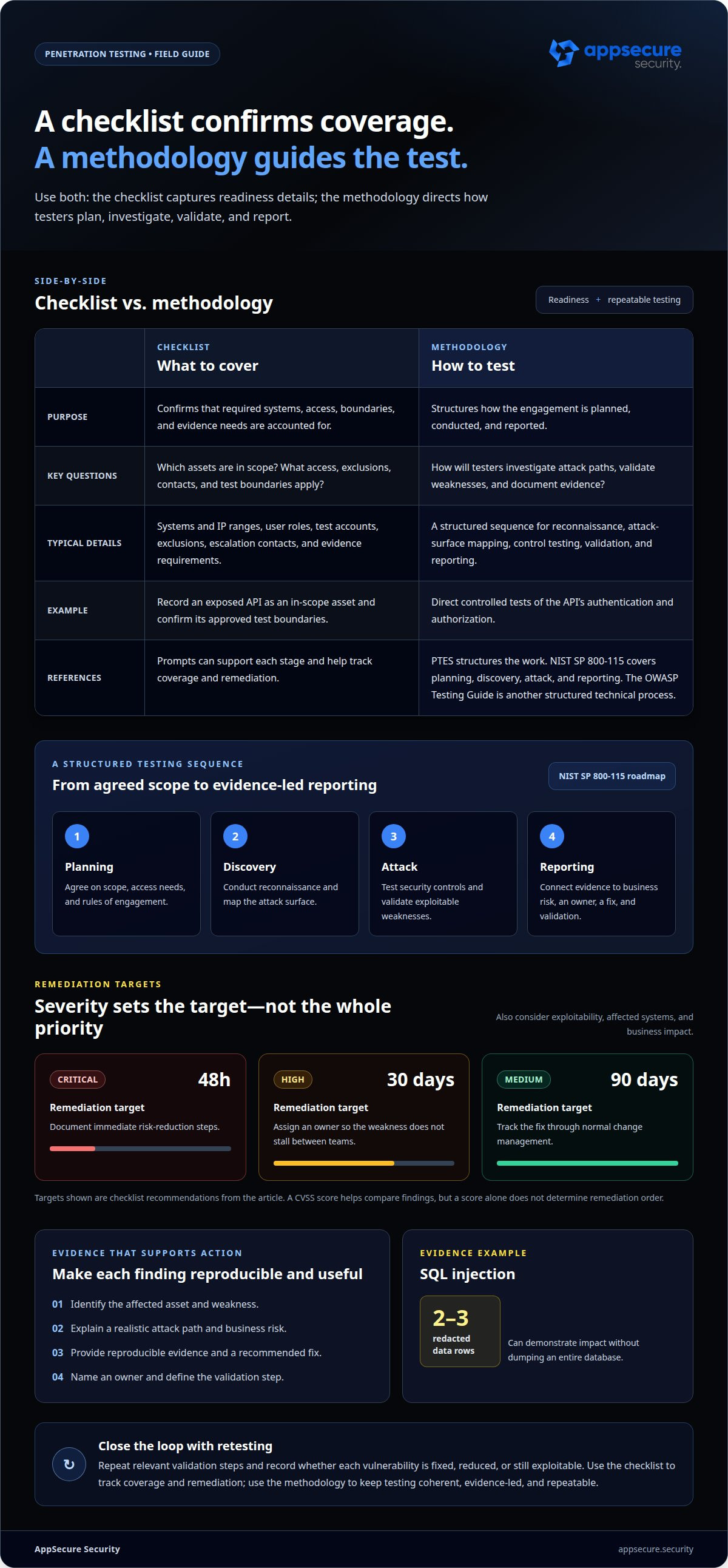
No. A checklist records what the penetration test must cover; a methodology defines how our testers conduct the engagement. That distinction matters: a completed list can confirm that an internal network, payment flow, or web application was included, but it cannot show whether testing followed a repeatable, defensible process that uncovers and validates attack paths.
Methodologies such as the Penetration Testing Execution Standard (PTES) structure the work. NIST SP 800-115 provides a roadmap covering planning, discovery, attack, and reporting. In practice, our testers first agree on scope and rules, then conduct reconnaissance, map the attack surface, test security controls, validate exploitable weaknesses, and report results. A checklist supports each stage with concrete prompts, such as confirming in-scope IP ranges and documenting approved test boundaries.
A checklist is most useful before and during testing. It can capture systems, user roles, test accounts, exclusions, escalation contacts, and evidence requirements. The methodology guides how our testers use that information to investigate potential attack paths. For example, discovery may identify an exposed API, while the methodology directs controlled tests of its authentication and authorization. The OWASP Testing Guide is another example of a structured technical process.
Reporting must connect evidence to business risk. Each finding should identify the affected asset, describe the weakness, explain a realistic attack path, and provide reproducible evidence. A critical proof of concept should show impact without exposing unnecessary sensitive data. For SQL injection, evidence can be limited to 2-3 redacted data rows rather than dumping an entire database.
Severity scoring helps teams compare findings, but a score alone doesn’t set remediation order. A CVSS score of 9.8 can indicate a serious vulnerability; exploitability, affected systems, and business impact still shape priority. Our report connects those factors to a clear owner, recommended fix, and validation step, helping organizations address weaknesses before attackers can exploit them.
- Critical: Set a 48-hour remediation target, as the checklist recommends, and document immediate risk-reduction steps.
- High: Set a 30-day target and assign an owner, so a severe weakness doesn’t stall between teams.
- Medium: Set a 90-day target and track the fix through normal change management.
Retesting closes the reporting loop: our testers repeat relevant validation steps and record whether a vulnerability is fixed, reduced, or still exploitable. A useful AI penetration testing methodology from AppSecure Security also shows why automated scale should support, not replace, consistent testing decisions. Use the checklist to track coverage and remediation, and the methodology to make testing coherent, evidence-led, and repeatable.
Pentesting as part of a continuous security program
A penetration test captures risk at a point in time. New infrastructure, application releases, cloud deployments, and AI integrations can change the attack surface after that assessment. A strong continuous security program combines ongoing validation and machine-scale testing with advanced, expert-led pentesting, helping teams reassess exposed paths as systems change and protect organizations against evolving threats. ISO 27001:2022’s continual improvement expectations also support treating test results as inputs to an ongoing security cycle.
Security testing works best when connected to the software development life cycle (SDLC). A release can change authentication, permissions, data handling, or API behavior. The program should trigger a security review when material changes affect exposed functionality, rather than relying only on a fixed calendar. Testers can examine a pre-release environment, then assess production-facing changes within agreed boundaries. Record findings in the issue-tracking process developers already use, including affected components, business impact, and validation status.
Perimeter testing examines what an external attacker can reach. Reconnaissance can reveal forgotten subdomains, exposed login interfaces, or services that remain accessible after a migration. Reviewers also check TLS/SSL configurations for weak protocols and ciphers. An exposed service can create an entry point even when internal controls are strong. Distinguish approved assets from third-party systems in the test scope to reduce the risk of unauthorized activity.
Network and cloud security testing examine how access and configuration interact. A network assessment can trace whether a compromised account reaches sensitive internal systems, while cloud testing reviews exposed services, identity permissions, and security boundaries. Connect each finding to the affected environment and access path to make remediation specific: restrict an excessive permission, close an unnecessary service, or strengthen a boundary between workloads.
For web applications, testing should assess the OWASP Top 10 vulnerability categories, including issues in authentication, access control, and input handling. An external, unauthenticated test can reveal risks visible before login; authenticated testing can examine what distinct user roles can access. API testing adds another layer by examining authorization boundaries between requests and records. These checks help identify business logic flaws that a perimeter scan may not expose.
Testing cadence should reflect exposure and change. Quarterly is a typical frequency for black-box penetration testing, bi-annually for grey-box testing, and annually for white-box testing. These are planning references, not substitutes for testing triggered by change. A major infrastructure change or application redesign can justify targeted validation between scheduled assessments. The continuous penetration testing approach connects recurring assessment with advanced pentesting as environments and attack paths evolve. For a program shaped by new releases, cloud changes, and evolving attack paths, discuss a continuous testing plan.
Remediation, retesting, and compliance
A penetration test reduces risk only when findings lead to tracked fixes and verified outcomes. Our VAPT team helps organizations turn findings into action by assigning each vulnerability an owner, a target date, and a ticket linked to the affected asset. Record the proposed fix, dependencies, and any temporary control. For example, when addressing an access-control flaw, identify the affected endpoint, role, and data before changing authorization logic.
Rigorous retesting should repeat the validation steps that exposed the original weakness. If an API returned another user’s record, test the same request with the same role boundaries after the fix. Record whether the issue is resolved, partially mitigated, or still exploitable. A code change alone is not proof: a regression, configuration gap, or alternate attack path may preserve the original impact and leave attackers an opportunity to exploit the weakness. Our validation confirms whether the demonstrated attack path is closed.
Close the engagement with a debrief that connects technical evidence to business decisions. Review critical attack paths, unresolved findings, accepted risks, and remediation ownership. Keep the original finding in the report and link it to retest evidence rather than replacing the initial result. This creates an audit trail for security teams, engineering leads, and executives who need to understand what changed and which weaknesses still require attention.
Map findings to the frameworks relevant to the organization’s obligations and assurance goals. OWASP Top 10 categories help classify application weaknesses; the OWASP Application Security Verification Standard (ASVS) provides a verification framework. Reports can also map findings to ISO 27001, PCI-DSS, or SOC 2. These mappings organize evidence; they don’t make a penetration test a certification or prove every control is effective.
- OWASP Top 10: Connect application findings to recognized vulnerability categories.
- ASVS: Link web application issues to verification requirements.
- ISO 27001 and SOC 2: Organize assessment evidence around relevant security controls.
- PCI-DSS: Relate payment-environment findings to the applicable testing scope.
For payment environments, the report should identify tested boundaries and explain how findings affect systems in scope. The PCI-DSS penetration testing guide can help teams understand how testing evidence supports this work. Keep evidence focused: include affected components, reproducible steps, impact, and remediation status, while limiting exposure of sensitive data.
Continuous validation prevents remediation from becoming a one-time exercise. Automated checks can flag recurring weaknesses, while targeted retesting confirms whether a specific fix closes the demonstrated attack path before attackers can exploit an unresolved issue. Reassess after material changes to applications, access controls, or infrastructure. Track reopened findings separately to distinguish incomplete remediation from a new vulnerability.
Maintain an attestation record stating the assessment scope, dates, methods, exclusions, findings, and retest outcomes. The responsible security owner can use it to show what was tested and what remains open. Align evidence with the relevant framework, and preserve the link between each finding, its fix, and its validation. This turns test results into usable compliance documentation and a clear remediation record.
Compliance, duration, and tester qualifications
OWASP provides application testing guidance, NIST SP 800-115 structures technical security testing, and PTES organizes penetration-test execution. OSSTMM focuses on operational security testing across people, processes, and technologies, so the frameworks differ in scope and emphasis.
Compliance planning starts by mapping assets, test boundaries, and evidence needs to applicable obligations. Consider PCI DSS, HIPAA, SOC 2, ISO 27001, and CMMC 2.0 during scoping. The required framework depends on the organization, its systems, and the data those systems handle. A control mapping helps connect each test objective to relevant evidence without treating one assessment as proof of total compliance. Include the use of AI agents for faster, in-depth testing at machine scale in the assessment plan, with clear boundaries and evidence requirements.
For U.S. organizations handling electronic protected health information (ePHI), the proposed HIPAA Security Rule changes would require covered entities and business associates to conduct penetration tests at least once every 12 months, according to the U.S. Department of Health and Human Services. Treat that proposed cadence as a planning consideration and document the applicable requirement for the organization’s assessment.
Rules of engagement should define authorized systems, testing windows, escalation contacts, and prohibited actions. They should also address compliance with the US Computer Fraud and Abuse Act (CFAA) or equivalent local laws. This matters particularly when testing shared cloud infrastructure or systems connected to third parties. Written boundaries help testers avoid disrupting services outside the agreed scope.
For 2026 planning, identify which external requirements shape testing cadence and reporting. DORA is a regulatory framework relevant to organizations’ 2026 testing cadences. NIS2 may also inform security planning for organizations within its scope; connect the assessment plan to applicable obligations rather than assuming one cadence fits every organization. Keep a record of scope, methods, exceptions, findings, remediation, and validation.
Duration depends on the target environment and scope. External penetration tests typically involve 3-5 business days of active testing, while scoping, testing, reporting, and presentation typically span 2-3 weeks. Mobile application engagements can require a different schedule based on application complexity and test coverage. Put milestones for access, testing, draft findings, and final reporting in the engagement plan.
Evaluate tester qualifications through demonstrated technical depth, a clear methodology, and evidence quality. Ask how the team uses AI agents to deliver faster, in-depth pentesting at machine scale, while maintaining manual validation, attack-path analysis, and safe proof-of-concept documentation. Reports should explain impact and reproducible steps, not just list scanner output. For AI-enabled environments, include testing boundaries for model interactions, agent permissions, and connected data flows.
Before approval, document the applicable framework, authorized scope, reporting deliverables, and retest expectations. This creates a traceable practice for compliance reviews and gives security teams a clear basis for validation after remediation.
How checklists differ from testing methodologies
A checklist answers, “What must this engagement cover?” A methodology answers, “How will testers investigate, validate, and report it?” Confusing the two creates predictable gaps: a team can tick off authentication testing without examining how one account crosses another user’s authorization boundary. The checklist tracks coverage; the methodology guides technical judgment as findings shape the next test.
Consider a web application with login, payment, and account-management functions. A checklist can name those areas, required roles, and evidence to capture. A methodology guides discovery, attack-path analysis, controlled exploitation, and reporting. If testing exposes an authorization weakness, the tester follows the evidence into related functions instead of stopping because every checklist line appears complete.
Use each tool for a different control:
- Scope check: List in-scope assets, environments, user roles, and exclusions, so testing stays within approved boundaries.
- Method selection: Choose a repeatable process, such as PTES or the OWASP Testing Guide, to structure technical work.
- Coverage check: Track authentication, access control, configuration, and exposed services, so known areas aren’t overlooked.
- Decision record: Document why an attack path was pursued or ruled out, so reporting reflects analysis, not box-ticking.
Methodologies aren’t interchangeable checklists. NIST SP 800-115 organizes testing around planning, discovery, attack, and reporting. PTES describes engagement phases, while the OWASP Testing Guide provides structured technical tests, particularly for applications. The right fit depends on the environment and objective. A network assessment and a web application assessment need different test cases, even when both use the same engagement framework.
A checklist should adapt when discovery reveals something unexpected. For example, an exposed API may connect a public application to internal records. The tester can extend the investigation, verify the authorization path, and record the impact. A rigid checklist may confirm that the API was reviewed yet miss the chained attack. A methodology provides the reasoning to follow that chain safely and consistently.
For planning, keep the checklist concise and operational. Record scope, access, rules of engagement, evidence expectations, reporting contacts, and remediation ownership. Make the methodology detailed enough to explain test sequencing, validation standards, and how results become findings. Together, they make coverage visible while preserving the depth needed to uncover weaknesses beyond obvious configuration errors.
The practical takeaway: use the checklist to prevent omissions, and the methodology to guide investigation. Plan a methodology-led penetration test when you need rigorous testing across complex environments.
AppSecure Security
AppSecure Security protects companies from attacks with focused, hands-on VAPT assessments. When you need testers to investigate a defined attack surface, validate vulnerabilities, and deliver actionable findings, we align the engagement scope with the systems and risks that matter most.
Testing can focus on web applications, mobile applications, or APIs. AppSecure’s Agentic Pentest uses AI agents to enable faster, deeper testing at machine scale across web, API, mobile, and network surfaces. Clear scope, access requirements, and remediation priorities connect testing to your security program. The right approach depends on what you need assessed and how results will support security decisions.
If you’re planning an assessment or refining its scope, contact AppSecure Security to discuss your penetration testing needs.
Turn your next assessment into a security decision
A penetration testing methodology checklist for 2026 should support a bigger goal: making security testing part of how your organization manages change. The next engagement can help clarify which risks need immediate attention, which require deeper investigation, and how testing should adapt as your systems evolve.
Before scoping the work, bring together the people responsible for security, engineering, and compliance. Align on the business processes that matter, the environments that need assessment, and how findings should inform security decisions. This helps shape an engagement around your actual exposure rather than a generic set of test activities.
AppSecure Security turns those priorities into focused penetration testing that helps protect your systems from attackers. Its services include web application and mobile application testing, supported by the Agentic Pentest platform. AI-agent-driven testing enables faster, deeper assessment at machine scale, with actionable findings for your teams.
Contact AppSecure Security to discuss your systems, objectives, and concerns, and take a clear step toward stronger protection. A well-scoped test can give your teams a stronger foundation for the security decisions ahead.
Frequently Asked Questions
1. What should I prepare before a penetration test?
Prepare a clear inventory of authorized assets, test accounts, key contacts, and operational constraints. A penetration testing methodology checklist for 2026 should also capture excluded systems, third-party dependencies, and the business functions that must stay available. For a payment workflow, identify the test environment and relevant transaction paths. Provide architecture or data-flow diagrams when available, so testers can rigorously map system relationships and uncover exploitable risks without guessing.
2. How far should post-exploitation and lateral movement testing go?
Post-exploitation testing should go only as far as the written authorization and agreed objectives allow. The tester may validate whether an exposed account can reach another approved system, but shouldn’t access unrelated data or disrupt services. Define stop conditions, escalation contacts, and evidence limits before testing. Rigorous, controlled validation helps organizations identify attack paths and address exploitable risks without exceeding approved boundaries.
3. Should you test during business hours or after hours?
Choose the testing window based on the objective, system sensitivity, and operational risk. Business-hours testing can make it easier to coordinate with application owners and observe normal workflows. After-hours testing may suit activities that could affect service availability, provided stakeholders and response contacts are available. Set the window, permitted test intensity, monitoring expectations, and stop procedure in the rules of engagement. Clear controls let pentesters validate risks rigorously while helping protect your operations.
4. What is penetration testing and why is it essential in 2026?
Penetration testing is an authorized assessment that uses controlled attack techniques to validate security weaknesses and identify exploitable risks. It helps organizations understand whether a vulnerability can affect real systems, data, or business processes, and address the risk before attackers exploit it. In 2026, changing applications, cloud infrastructure, and connected services make current validation valuable. For example, a new account-recovery flow may introduce risks that weren’t present during the previous assessment.
5. What are the standard phases of a penetration test methodology in 2026?
A common structure uses planning, discovery, attack, and reporting, as outlined in NIST SP 800-115. Planning establishes objectives and authorization; discovery identifies relevant assets; attack activities rigorously validate weaknesses within scope; reporting records evidence and impact. Some methodologies add explicit threat modeling or remediation validation. Treat the phases as a controlled workflow, then adapt the technical tests to the application, network, or cloud environment to help protect the organization from compromise.
6. What should a professional penetration test include in its pre-engagement scope, authorization, and rules of engagement, and what should clients provide?
Pre-engagement documents should name authorized assets, exclusions, testing dates, permitted techniques, data-handling limits, and escalation contacts. The client should provide an authorized decision-maker, relevant system owners, test accounts, and known dependencies. For organizations operating in India, the USA, the UK, Dubai, Canada, or Singapore, identify the jurisdictions and stakeholders involved. This establishes clear boundaries for rigorous testing that helps identify exploitable risks before testing begins.
7. What reconnaissance and asset discovery steps should professional penetration testers perform, and what information should clients provide?
Testers should map approved domains, subdomains, IP ranges, application entry points, and relevant third-party connections. Clients can provide current asset inventories, architecture diagrams, environment names, and known recent changes. For example, flagging a retired login endpoint helps distinguish an intentionally inactive asset from an overlooked exposure. Discovery should remain within the authorized scope and record newly identified assets for approval before testing them, helping prevent unapproved systems from being exposed to testing.
8. How should professional penetration testers assess vulnerabilities and prioritize findings by severity and business risk?
Testers should rigorously validate whether a suspected weakness is exploitable, identify affected systems, and document evidence without collecting unnecessary sensitive data. Prioritization should consider technical severity alongside exposure, required access, business function, and potential impact. For example, a flaw affecting a privileged payment action may need closer attention than a similar issue on a low-impact internal function. The report should explain the ranking and provide actionable remediation guidance to help organizations reduce the risk of being hacked.