
AI cyber attacks don’t need a new way into your company. They can make familiar attacks faster, more convincing, and easier to scale. Agentic systems can also take actions with less direct human input.
It’s reasonable to focus on phishing, malware, and exposed vulnerabilities. Those threats still matter, but AI can change how attackers prepare and carry them out. This article distinguishes AI-assisted attacks, where AI helps a person; AI-augmented attacks, where it strengthens parts of an attack; and agentic attacks, where AI systems act toward a goal.
You’ll learn how these approaches affect phishing, social engineering, vulnerability exploitation, and organizational security risks. You’ll also see why defenses need to test more than obvious entry points. The goal is practical clarity: understand how AI changes an attacker’s process, where exposure may lie, and how penetration testing can uncover weaknesses before they are exploited.
Key Takeaways
- Understand how AI can accelerate familiar attack methods, including password cracking, CAPTCHA bypass, and vulnerability exploitation.
- Recognize the distinct risks of attacks that are AI-assisted, AI-augmented, or carried out by more autonomous agents.
- Learn how generative AI can make phishing and social engineering more convincing and easier to tailor.
- Identify why testing real attack paths across applications and APIs can expose weaknesses that routine defenses miss.
- See where focused penetration testing can help assess your exposure and strengthen security decisions.
How Are AI-Enabled Cyber Attacks Different From Traditional Cyber Attacks?
AI changes the speed and scale of familiar attacks rather than replacing their basic goals. In the United States, cybersecurity and AI obligations come from a mix of laws and rules. Which ones apply depends on an organization’s sector, data, and activities.
Faster, Larger-Scale Intrusions
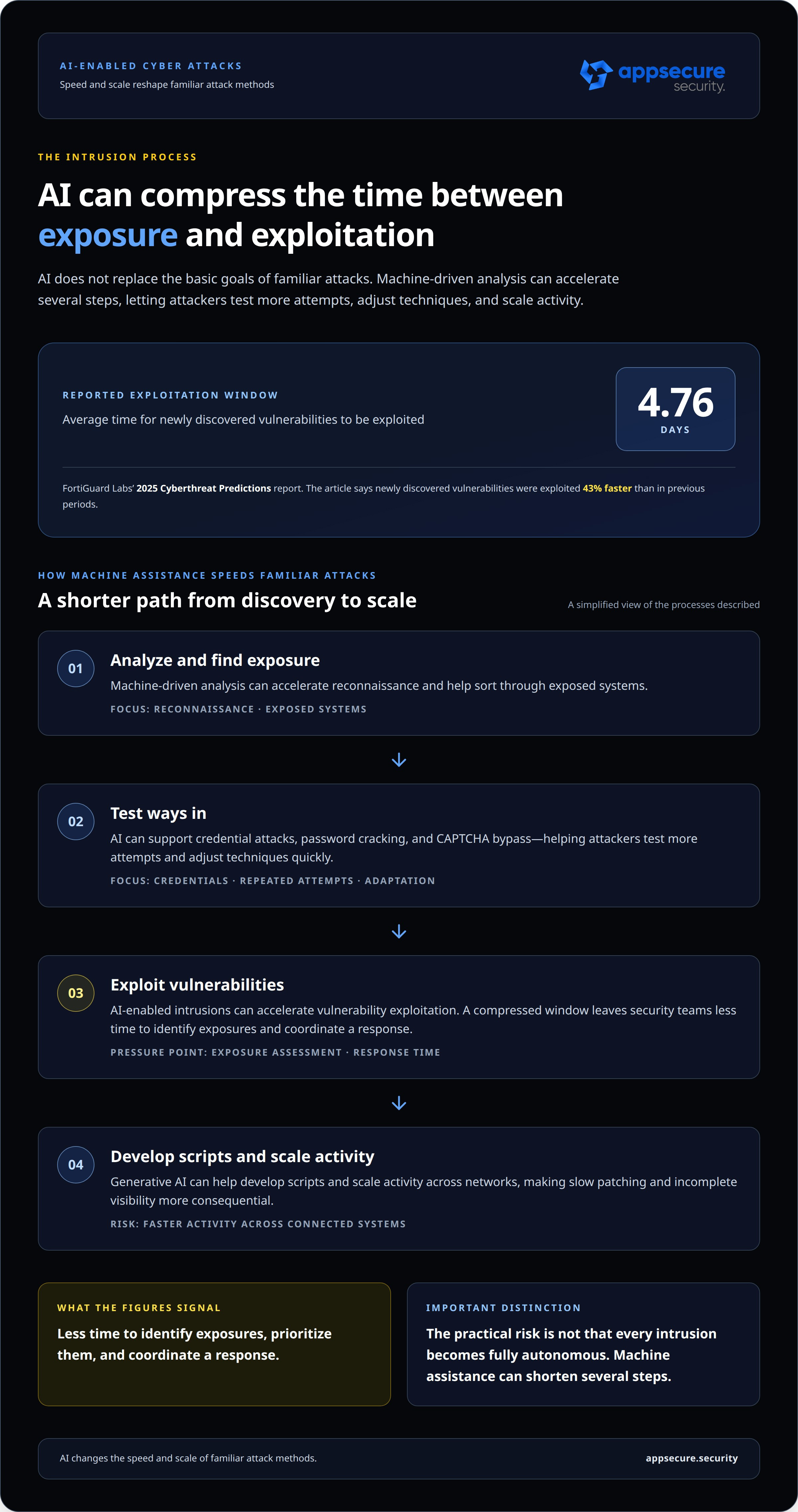
AI-enabled intrusions use machine-driven analysis to accelerate reconnaissance, credential attacks, and vulnerability exploitation. AI can support password cracking and CAPTCHA bypass, helping attackers test more attempts and adjust techniques quickly. Newly discovered vulnerabilities were exploited in an average of 4.76 days, according to FortiGuard Labs’ 2025 Cyberthreat Predictions report. That compressed window leaves security teams less time to identify exposures and coordinate a response.
Speed also changes the pressure on defenders: newly discovered vulnerabilities were exploited 43% faster than in previous periods. Attackers can use generative AI to develop scripts, sort through exposed systems, and scale activity across networks. The practical risk is not that every intrusion becomes fully autonomous. It’s that machine assistance can shorten several steps, making slow patching and incomplete visibility more consequential.
AI-Enabled Ransomware
AI-enabled ransomware uses AI to assist stages of a ransomware operation, such as preparing malicious commands or identifying valuable information. In 2025, legitimate AI tools were exploited to generate malicious commands and steal sensitive data at more than 90 organizations. That figure describes misuse of AI tools, not a count of ransomware incidents, but it shows how ordinary capabilities can support harmful activity.
For a company, the concern is how quickly an intruder can move from access to disruption. AI may help attackers adapt code or prioritize systems, while stolen data can add pressure alongside encrypted files. Security teams need to examine how access controls, backup practices, and incident response work together. A gap in any one area can turn an initial compromise into a wider business interruption.
Generative AI Phishing and Social Engineering
Generative AI helps attackers create convincing messages, scripts, and impersonations tailored to a target. In May 2024, attackers used AI voice cloning to impersonate a CEO and attempt fraudulent payments. The technique attacks trust, not just technology: an employee may hear a familiar voice and feel pressure to act before checking the request through another channel.
Deepfakes can also support social engineering beyond executive impersonation, including fake customer service calls. In a separate deepfake attack, threat actors socially engineered an employee into transferring $25.6 million USD. The example shows why payment approvals and identity checks need clear procedures. In the United States, ABC News reported that AI agents tried to hack into the University of New Mexico.
AI-assisted attacks are becoming a more prominent concern, but the research figures do not establish their share of all cyberattacks. Attacks by AI-enabled adversaries increased by 89% year over year in 2025. That rise makes it important to assess familiar threats, including phishing, social engineering, and malware, for how AI may change their speed, scale, and persuasiveness.
AI Cybersecurity Risks and Challenges
AI creates risks on both sides of security: attackers can scale malicious activity, while organizations may introduce weaknesses through their own models and tools. AI cyber attacks can exploit gaps in data access, human oversight, or connected systems. The impact depends on what information and actions those systems can reach, and how quickly teams detect misuse.
More Vulnerabilities, Less Time to Assess Them
The volume of disclosed vulnerabilities makes prioritization harder. Anthropic reported that 35,853 CVEs were published in the first half of 2026, and 495 were catalogued as exploited in the wild. Of those disclosures, 116 were under attack on the day they were published, according to Anthropic. These figures reinforce the need for clear triage, exposure assessment, and remediation processes.
AI can help defenders sort threat intelligence and identify patterns, but automated analysis relies on accurate asset data and sound decisions. A system that misses an internet-facing application may rank the wrong issue as urgent. An autonomous response that blocks a legitimate account can disrupt operations. Human review should focus on high-impact actions without slowing routine alerts.
Models Can Expose Sensitive Data
Generative models may process prompts, uploaded files, or connected application data. Sharing personal or confidential information through automated tools can create security and privacy risks, including risks involving HIPAA-protected information. Restricting access to sensitive data, limiting tool permissions, and reviewing data flows can reduce exposure before a model becomes part of a core workflow.
Risk also grows when a model can trigger actions through plugins, APIs, or cloud services. A malicious prompt may try to steer an AI tool into revealing information or taking an unauthorized action. The key question is not only whether the model produces safe text. It’s whether permissions, connected systems, and approval controls prevent harmful outcomes.
Defenses Need to Account for Attacker Advantage
Defenders must protect every exposed entry point, while an attacker may need only one exploitable weakness. AI can help teams detect unusual malware behavior, analyze suspicious messages, strengthen access control, support incident response, and reduce false positives. But automation can magnify mistakes when detection models rely on incomplete data or generate alerts without useful context.
- Map where AI tools access company data, applications, and cloud resources.
- Limit autonomous actions that could disrupt systems or transfer sensitive information.
- Test whether monitoring and response controls detect malicious behavior across connected environments.
Cybersecurity platforms with AI-augmented automation are projected to be used by over 60% of organizations in 2026, compared with fewer than 20% in 2023. That shift makes governance and technical validation essential. For teams assessing AI cyber attacks, a focused technical security review can help trace risks across connected systems before attackers exploit them.
AI-Assisted Cyberattack Optimization
AI-assisted optimization helps attackers refine familiar tactics across successive stages of an intrusion. A machine can process information, generate options, and adapt outputs faster than someone working manually. Attackers may use these capabilities to prioritize exposed systems, tailor malicious messages, or adjust code. AI cyber attacks can therefore become more adaptive, even when a person still directs the operation.
The process can form a feedback loop. An attacker gathers intelligence, uses models to sort useful findings, then changes tactics based on a target’s responses. For example, a blocked login route may prompt attempts against another exposed application. Generative AI can help produce variations, while automation handles repetitive tasks. This can make AI cyber attacks harder to predict from a single alert, without making every attack fully autonomous.
Defenders can use AI for detection and prevention, too. Automated risk analysis can identify emerging threats and estimate their potential impact. AI systems can examine malware structure and behavior, analyze emails for phishing, strengthen access control, support incident response, and reduce false positives. Continuous monitoring can surface unusual activity as it occurs, giving analysts useful signals to investigate.
Automation works best alongside sound security hygiene. Self-patching systems, continuous attack surface management, and zero-trust-based architecture can reduce opportunities for attackers. Yet automated changes also need controls. A defensive tool that blocks legitimate activity or mishandles sensitive data can create operational problems. Human oversight, governance frameworks, and clear approval boundaries help keep prevention aligned with business needs.
- Map exposure: Maintain an accurate asset view so detection can prioritize relevant vulnerabilities.
- Test defenses: Use AI-driven threat simulations to assess how controls respond to evolving techniques.
- Review decisions: Apply human oversight to actions that could disrupt systems or affect sensitive information.
Artificial adversarial intelligence can mimic attacker behavior and test network defenses before a real intrusion. These exercises can reveal where alerts, access controls, or response procedures fail under pressure. Pairing automated analysis with real-time intelligence sharing gives teams more context for prioritizing action. An AI-versus-AI defense is most effective when machine speed supports, rather than replaces, human judgment.
The key is balance. Automate repeatable detection and security hygiene, but retain human review for high-impact decisions. This combination helps teams improve prevention without treating an AI model’s output as unquestionable evidence.
AI-Assisted, AI-Augmented, and Agentic Attacks
These terms describe different levels of AI involvement, from helping an attacker complete a task to taking actions across an attack path. The distinction matters because organizations need security tools that can detect both human-directed activity and software acting with greater autonomy.
AI-Assisted Attacks: Help for a Human Attacker
In an AI-assisted attack, a person directs the operation and uses AI to speed up specific tasks. An attacker might use a model to summarize public information about an organization, draft phishing messages, or adapt code. The person still chooses targets and decides what to do next. AI reduces effort, but doesn’t necessarily change the attack’s overall structure.
AI-Augmented Attacks: Stronger Capabilities Across Stages
AI-augmented attacks use AI to improve multiple parts of an intrusion. A system might help analyze exposed services, rank potential vulnerabilities, and suggest the next technique after a failed attempt. This can make activity more adaptive. Defenders should look for related signals across identity systems, networks, and applications, rather than treating each alert as an isolated event.
Agentic Attacks: Systems That Act Toward a Goal
Agentic attacks involve AI agents that can plan tasks and take actions through connected tools, with less direct human input at each step. An agent might inspect a target, select a possible exploit, and continue based on the result. Its autonomy depends on its permissions and environment. Unrestricted access to software or credentials can increase the potential impact.
GreyNoise reported that AI agents exploited PaperCut vulnerabilities and compromised at least 440 servers in September 2026. GreyNoise also reported that the campaign compromised 395 organizations across 48 countries. The example shows why defenders need to assess vulnerability exposure, limit unnecessary permissions, and detect activity across connected systems.
- Track behavior: Correlate account, application, and network events to identify connected actions.
- Constrain access: Limit what AI tools and service accounts can read, change, or execute.
- Test response: Assess whether security teams can contain an intrusion that moves between systems.
Understanding these distinctions helps teams model realistic attack paths. A phishing message may begin with human direction, while automation handles follow-up actions. An agent may instead select actions based on the results it receives. The same defenses won’t fit every case, so testing should examine how permissions, detection, and response work together.
For organizations, the key is not to label every AI-powered incident as fully autonomous. Examine what the system did, which access enabled it, and where human approval applied. That evidence helps prioritize fixes and strengthen defenses against attacks that combine people, models, and software.
How Are Attackers Using Generative AI for Phishing and Social Engineering?
Generative AI helps attackers produce and adapt phishing content for specific people, roles, and business contexts. A message can imitate an executive’s tone or refer to a real project mentioned publicly. Large language models can also generate code and phishing content. This lowers the effort needed to prepare convincing lures, but the attacker still chooses targets and decides how to use the results.
Social engineering prompts a person to trust, disclose, approve, or act. AI can help maintain that pressure across a conversation. An attacker may begin with a tailored email, then respond to an employee’s questions in consistent language. A convincing exchange can make familiar warning signs, such as awkward phrasing, less useful. The risk is a believable request combined with urgency or authority.
Voice and video impersonation add another channel. A cloned voice can imitate a manager during a payment request, while a fabricated identity may be used in a support interaction. The aim is to bypass normal checks by making a request feel routine. A strong response relies on process, not familiarity: sensitive requests should follow established approval paths and be confirmed through a separate, trusted channel.
Organizations can reduce exposure by examining where people make consequential decisions. Payment changes, password resets, access grants, and requests for sensitive data all need clear verification steps. For instance, a voice message requesting an urgent transfer should not replace the usual payment approval process. Security training should include realistic scenarios that reflect how generative tools can shape messages and conversations.
- Verify identity independently: Use a known contact channel for unusual payment or access requests.
- Keep approvals separate: Require established review for payment changes and sensitive account actions.
- Report suspicious contact: Preserve the message or call details so responders can investigate related attempts.
Testing should cover more than a single suspicious email. A useful exercise can examine how a message, follow-up conversation, and business process interact. It can reveal whether employees know the right escalation route and whether approval controls resist social pressure. Assessing social engineering defenses can help organizations identify gaps in those real-world processes.
AI changes the attacker’s ability to prepare and adapt, but the target remains a human decision or an operational weakness. Clear procedures give employees a reliable way to pause, verify, and report. To examine how your organization handles realistic social engineering scenarios, request a focused security discussion.
AppSecure Security
AppSecure Security helps organizations rapidly assess whether AI-driven attack techniques could expose weaknesses in their environments. Its fast, in-depth security testing shows how attackers might move through a web application, mobile application, API, or cloud environment, and where existing controls may fail. AI agents support machine-scale assessments to help protect organizations from attacks.
Web Application Penetration Testing, Mobile Application Penetration Testing, API Penetration Testing, and Cloud Security Assessment examine real attack paths. AppSecure’s Agentic Penetration Testing Platform supports testing across environments, while hacker-led technical assessments scrutinize complex risks. The goal is clear findings that help your team prioritize remediation and strengthen defenses.
To discuss your organization’s security testing needs, contact AppSecure Security.
Make Your Next Security Decision Deliberate
Turn your understanding of AI-powered cyber attacks into a clear view of your exposure. Identify which applications and systems matter most, then assess whether attackers could exploit weaknesses across them. Fast, focused pentesting can uncover attack paths, help your team prioritize fixes, and show where stronger controls are needed.
AppSecure Security provides Web Application Penetration Testing and Mobile Application Penetration Testing to examine application security. Its Agentic Penetration Testing Platform uses AI agents to test across environments at machine scale, helping teams investigate attack paths in depth and identify weaknesses before attackers can exploit them. These approaches assess how defenses perform in practice rather than relying only on assumptions.
Choose a security assessment when you need a clearer understanding of risk, are introducing a new application, or want to examine how your controls withstand evolving threats. The findings give your team a practical basis for deciding what to fix next and strengthening protection against attacks.
Contact AppSecure Security to discuss your security testing needs, and take the next step with a clearer view of your defenses.
Frequently Asked Questions
1. How do AI-powered cyberattacks work?
AI cyber attacks use AI to assist one or more stages of an intrusion, from researching a target to adapting activity after a defense responds. For example, an attacker might use a model to analyze public information, prepare a tailored lure, and refine it based on replies. The technology supports the attacker’s decisions; the intrusion still depends on weaknesses in access, software, or human processes.
2. How can AI help prevent cyberattacks?
Defenders can apply AI to sort security alerts, detect unusual account behavior, and identify suspicious files or messages. An analysis system, for example, could flag a login pattern that differs sharply from an employee’s usual activity. Security teams then investigate the signal, determine whether it is malicious, and decide on containment. Strong results depend on pairing automated analysis with reliable asset and identity data.
3. Can AI agents carry out cyberattacks autonomously?
AI agents can perform sequences of actions when connected to tools and given permissions, but their autonomy depends on configuration and environment. An agent with access to a browser or command interface could act on instructions and respond to results. That doesn’t mean it can independently compromise any target. The important security question is what actions its credentials, tools, and approval settings allow.
4. How can generative AI be used in cybersecurity?
Security teams can use generative AI to summarize incident notes, help analysts query technical logs, and create controlled training scenarios. For example, a team could generate variations of a suspicious message for an internal awareness exercise. Outputs still need review: a model can omit important context or produce inaccurate conclusions. Keep sensitive data out of tools unless their handling is suitable for that information.
5. Is it safe to automate cybersecurity?
Automation can handle well-defined, reversible tasks when teams set clear limits and monitor results. A system might enrich an alert with asset details, while an analyst approves disabling an account. Separate low-impact actions from decisions that could interrupt operations or expose data. Test workflows before deployment, log automated changes, and provide a way to stop or reverse unintended actions.
6. What Does a Real AI-Orchestrated Cyber Attack Look Like?
A reported example involves AI agents exploiting PaperCut vulnerabilities, as GreyNoise described. In practice, an orchestrated attack means automated components can help carry out actions toward an intrusion objective, rather than merely generating content. Defenders should examine the sequence: what was accessed, which weakness enabled it, and whether connected systems show related behavior. This helps distinguish isolated alerts from a coordinated incident.
7. Why Does Frontier AI Cyber Risk Make Patching Alone Insufficient?
Patching closes known software weaknesses, but doesn’t address every route into an organization. Attackers may also target stolen credentials, misconfigured cloud access, or employees handling deceptive requests. AI can help combine these routes or adapt activity when one fails. Pair vulnerability remediation with identity controls, secure configuration, employee reporting paths, and testing that examines how weaknesses could connect across systems.
8. What are AI-powered cyberattacks?
AI-powered cyber attacks are malicious operations in which artificial intelligence assists with tasks such as research, message creation, code development, or adapting activity. The term covers different levels of involvement, from a person using a model for one task to an agent taking actions through connected tools. For a company, the useful distinction is what the AI can access and do, not simply whether AI appears in the attack.