AI does not make a penetration test valuable simply by making it faster. An agentic penetration testing platform can pursue a defined objective by selecting tools, taking actions, evaluating results, and choosing what to do next, with human oversight keeping testing within its authorized scope. The focus shifts from isolated findings to how weaknesses may connect.
Traditional penetration testing remains essential, but a point-in-time assessment can leave a gap as systems change. Agentic workflows can extend testing across web applications, mobile apps, APIs, IoT, and cloud environments, then map attack paths and simulate attacker behavior. Speed alone is not the goal. Useful, validated evidence is.
This article explains how agentic AI differs from traditional testing, how agents expand coverage and trace potential paths to impact, and why human validation matters before a finding becomes a security priority. You will also see what a controlled workflow involves, from setting the agent’s scope to reviewing its decisions and results.
Key Takeaways
• Human researchers confirm whether a suspected weakness is exploitable and assess its business impact before it becomes a priority.
• Continuous testing can help teams keep web applications and APIs in view as they change, rather than relying only on occasional assessments.
• AI agents can select tools, act on findings, and adapt their next steps within a defined testing objective.
• Attack-path mapping connects individual weaknesses to potential routes through an environment, helping teams understand how an attacker might move.
• Defined scope, human sign-off for high-risk actions, and review of agent decisions help keep testing controlled and its results useful.
How does human validation reduce false positives in pentesting?
Agentic pentesting systems can misread context and report false positives. They can also take risky actions if safeguards fail. A human reviewer checks whether a suspected weakness is genuinely exploitable, whether testing stayed within scope, and what the result means for the organization.
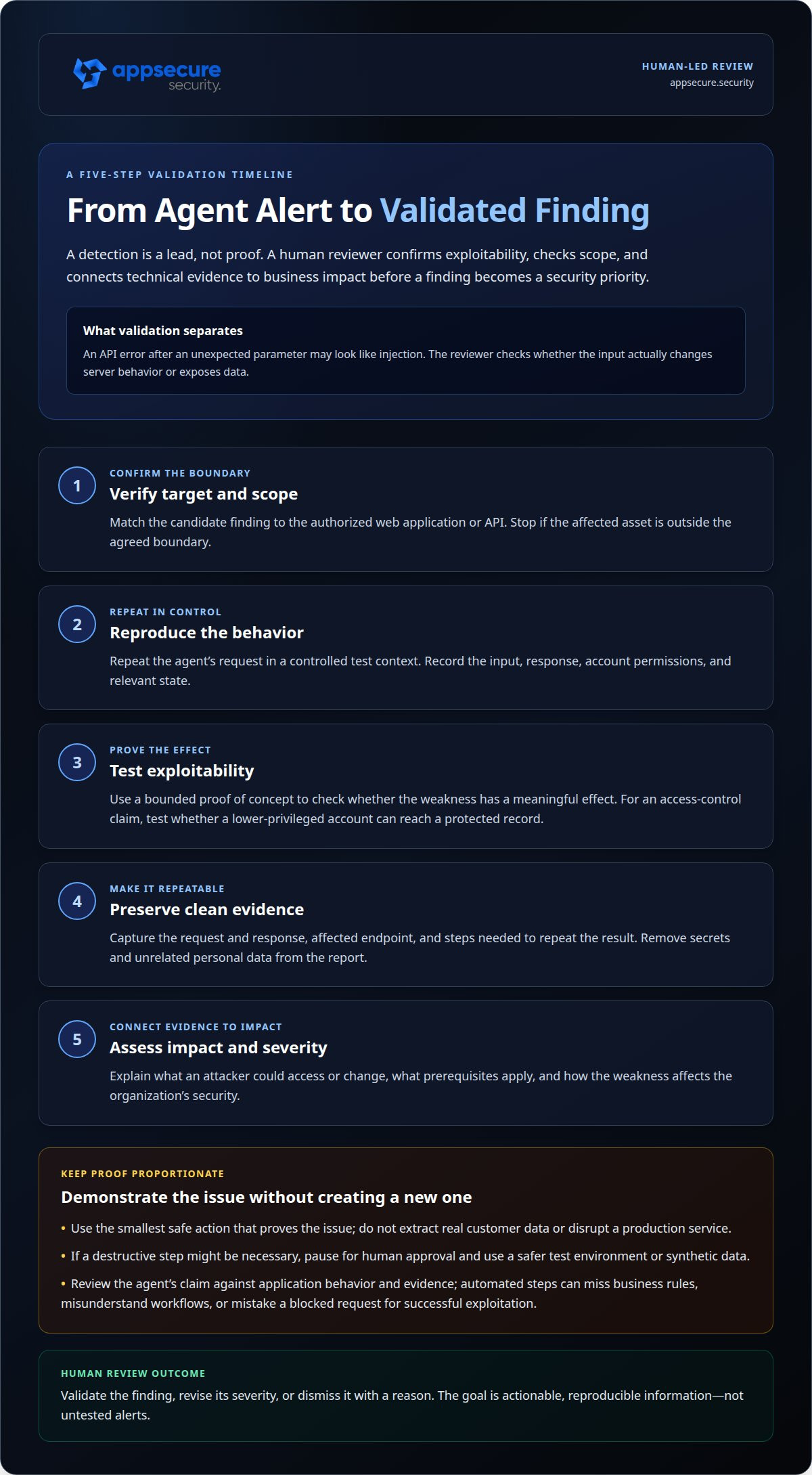
A detection is a lead, not proof. Consider an API that returns an error after receiving an unexpected parameter. An agent might flag the response as injection, but a security researcher checks whether the input changes server behavior or exposes data. That distinction separates a plausible signal from a validated finding.
Validation connects technical evidence to business impact. A weakness in a test account may not expose sensitive records, while an authorization flaw could let one customer access another customer’s information. A specialist assesses the affected asset, required access, reachable data, and realistic consequences before prioritizing remediation. The AI penetration testing methodology should make that review traceable.
For each candidate finding, human-led validation can follow these steps:
Confirm the target and scope.
Match the finding to the authorized web application or API. Stop if the affected asset falls outside the agreed boundary.
Reproduce the behavior.
Repeat the agent’s request in a controlled test context. Record the input, response, account permissions, and relevant state.
Test exploitability.
Use a bounded proof of concept to establish whether the weakness produces a meaningful effect. For an access-control claim, test whether a lower-privileged account can reach a protected record.
Preserve reproducible evidence.
Capture the request and response, affected endpoint, and steps needed to repeat the result. Remove secrets and unrelated personal data from the report.
Assess impact and severity.
Explain what an attacker could access or change, what prerequisites apply, and how the weakness affects the organization’s security.
Proof-of-concept testing must stay proportionate. A researcher should demonstrate the smallest safe action that proves the issue, not extract real customer data or disrupt a production service. If a destructive step might be necessary, pause for human approval and use a safer test environment or synthetic data. This preserves evidence without turning validation into an incident.
Human review also catches limitations an agent may miss. An automated sequence can overlook business rules, misunderstand a multi-step workflow, or mistake a blocked request for successful exploitation. Reviewers compare the agent’s claim with application behavior and evidence, then validate the finding, revise its severity, or dismiss it with a reason. The result is actionable information, not untested alerts.
How does AI expand attack surface coverage?
Traditional penetration testing is often scheduled periodically. Meanwhile, a web application may change with each release, and new API endpoints can alter its exposure. AI agents can run scoped tests continuously or after defined changes, helping security teams find vulnerabilities closer to when they enter the environment.
That cadence matters when code ships frequently but testing happens infrequently. A new checkout endpoint, authentication flow, or account-management feature can introduce a weakness between scheduled assessments. Trigger-driven testing brings those changes into scope sooner. It does not replace expert-led assessment; it helps teams focus on the parts of a web application and API that have changed.
Coverage starts with knowing what is exposed. External attack-surface discovery can identify reachable assets, such as a newly published API route or a test environment accidentally made public. An agent can then enumerate services and identify candidate weaknesses within the authorized target boundary. This gives security teams a more current view of the attack surface than a static asset inventory alone.
For APIs, testing can examine how endpoints handle authentication, authorization, input, and state. For example, an agent might compare how the same record request behaves for different roles, or test whether an endpoint accepts an unexpected parameter. In a web application, it can follow a defined user journey and assess how connected features behave. These checks broaden coverage across related entry points, while human review determines whether a suspected issue is exploitable.
CI/CD integration can link tests to meaningful events in the development process. A team might trigger a focused assessment when a pull request changes an authentication component, or when a deployment adds an API route. Test scope should match the change and its authorization. Broad, uncontrolled scans on every build can create noise, slow workflows, or probe systems that were never approved for testing.
A practical coverage model can combine several triggers:
Asset changes
Assess newly exposed services or API routes after discovery.
Application releases
Retest changed web application workflows after deployment.
Security-sensitive code
Focus checks on changes to login, access control, or data handling.
Scheduled assessments
Use broader testing to find weaknesses outside recent code changes.
Continuous testing is not simply running every test all the time. Effective coverage depends on accurate asset scope, safe test controls, and clear links between changes and test objectives. Teams planning this model can discuss continuous API and web application testing as part of a defined penetration-testing engagement.
What is agentic AI in the context of penetration testing?
In pentesting, an AI agent pursues a defined objective by choosing tools, taking actions, evaluating results, and deciding what to do next. Unlike a fixed script, it can adapt a multi-step security testing workflow without a human directing every move.
Autonomous Application and API Testing
For applications and APIs, an autonomous agent can map reachable functions, inspect responses, and test hypotheses within an authorized scope. For example, it might trace an API request from authentication through a data-access function, then explore whether changing a parameter affects access. Key evaluation points include target boundaries, permitted actions, and whether a human reviews the evidence before findings are reported.
In the United States, engagements should define written authorization, target scope, permitted techniques, and test-data handling. Compliance requirements vary according to the systems, data, contracts, and industry involved, so the engagement plan should identify applicable obligations before testing begins.
Agent Autonomy and Testing Workflows
Autonomy describes how much an agent can decide independently. A bounded workflow may allow it to perform reconnaissance, enumerate services, and generate vulnerability hypotheses, while reserving disruptive or irreversible actions for human approval. Every decision should remain within documented scope. Reviewers should also be able to inspect the agent’s actions, tools, and reasoning trail after the test.
Parallel Testing Agents
Parallel agents can examine separate authorized targets or testing tasks at the same time. One might inspect API authentication while another explores an account workflow in a web application. This can broaden assessment activity, but concurrency needs controls. Teams must manage shared test accounts, rate limits, overlapping requests, and production impact so simultaneous actions do not disrupt systems or contaminate results.
Parallel execution also increases coordination demands. Teams need clear asset ownership, distinct task boundaries, and a way to consolidate duplicate findings. Human reviewers should compare evidence across agents, resolve conflicting conclusions, and validate results before they guide remediation. More agents can increase testing activity, but they do not automatically improve accuracy or business relevance.
How much do agentic penetration testing platforms cost? Pricing depends on the assessment scope, target applications and APIs, testing depth, and human validation required; the price is provided after a quote request.
Attack-path mapping and attacker-behavior simulation
Attack-path mapping connects exposed assets, weaknesses, and access routes into a sequence. Simulating attacker behavior can reveal how separate issues might combine within an authorized attack surface.
Reconnaissance and Attack-Chain Planning
During reconnaissance, agents can enumerate authorized external assets, identify reachable services, and organize potential entry points. They can then plan a chain from an exposed service to a vulnerable application component or sensitive function. For example, a red team may examine whether a public API route could lead to an account with broader permissions. Human specialists confirm whether each link is real and within scope.
Monitoring can also prompt targeted checks when a new CVE affects an identified component. New CVEs may be exploited in about 3 days, so a prompt, scoped assessment can help teams examine exposure sooner. The agent can compare the affected technology with known assets, then test only approved targets. A manual review helps separate a relevant weakness from a false positive or an unexploitable version match.
Parallel Agents and Chained Attacks
Parallel agents can investigate different parts of an approved environment, such as an external service and an API workflow. Their results may reveal connections that an isolated test misses. One agent could identify a reachable service while another examines a related authentication path. Before treating these observations as a chain, reviewers confirm that both targets are in scope and that the evidence supports each transition.
Parallel work needs coordination. Agents should follow defined boundaries and avoid conflicting actions against shared systems. A central workflow can associate each observation with its target, test action, and result. This helps reviewers distinguish independent vulnerabilities from a credible sequence. If one agent reports an access weakness and another identifies a reachable data function, a researcher checks whether the combined path can be reproduced.
Attack-Path Visibility and Audit Logs
Audit logs show how an agent reached a proposed attack path. Useful records capture the decision, selected tool, target, action, and observed response at each step. Without that trail, reviewers may struggle to understand why an agent changed direction or linked two findings. Logs also help reproduce the sequence, identify scope violations, and explain the basis for a red-team conclusion.
Teams can use this evidence to distinguish a demonstrated route from a theoretical chain. Reviewers trace each recorded step, confirm the relevant access conditions, and assess whether the path reaches an asset that matters to the organization. They can then prioritize remediation around the actual route instead of treating every isolated alert equally. A clear record also supports incident response by showing which systems the test touched and what actions occurred.
Agentic AI penetration testing workflows
A strong workflow gives autonomous agents clear objectives, controlled access, and human oversight. Security teams should define the authorized scope before agents begin reconnaissance or testing.
Use a repeatable sequence. For example, an agent assessing an API should know which endpoints and accounts it may test, which actions need approval, and where it must stop. This makes autonomy bounded execution, not unrestricted access. Documenting the boundary also helps testers distinguish expected activity from an out-of-scope action.
Set the objective and scope.
Identify approved applications, APIs, test accounts, environments, and excluded assets. Give agents only the access needed for those tasks.
Start with structured discovery.
Agents can perform reconnaissance, enumerate services, and generate initial vulnerability hypotheses. Security teams should connect discovered assets to the authorized target list before testing continues.
Define action limits.
Specify which requests agents may send and which actions need human sign-off. Require approval before high-risk or irreversible activity, especially against production systems.
Review findings and evidence.
A tester examines the agent’s requests, responses, and reasoning. The reviewer confirms whether each finding is reproducible, relevant, and suitable for remediation.
Compare results over time.
Periodically assess agent output against human-validated findings. Differences can reveal missed issues, false positives, or drift in how the system interprets results.
Production requires tighter controls than a dedicated test environment. An agent probing a live account workflow could change data, trigger notifications, or affect customer activity. Security teams should limit test data, define stop conditions, and prevent high-impact actions without human approval. A scanner that reports a weakness without understanding its effect should not be free to escalate its own testing.
Governance must cover the agent itself. The NIST AI Risk Management Framework offers a structure organizations can use to govern AI risks. The OWASP Top 10 for Agentic Applications describes risk categories teams can address with agent boundaries, machine-readable policies, and audit trails. These controls make decisions more reviewable, especially when agents use tools across multiple steps.
A mature workflow treats speed as an advantage, not a substitute for judgment. Teams should retain logs of agent decisions and tool use, then compare those records with validated results. This creates a feedback loop: clarify scope, run limited tests, review evidence, and adjust policies when output differs from human assessment.
To put controlled agentic testing into practice, discuss your testing workflow with a security team.
AppSecure Security: Agentic Penetration testing Platform
AppSecure Security provides an AI-agent-driven Agentic Penetration Testing Platform for fast, in-depth security testing at scale. It supports assessments alongside Web Application Penetration Testing, Mobile Application Penetration Testing, and API Penetration Testing to help organizations identify risks and protect against attacks.
Use this approach when your team needs focused testing across applications or APIs, or wants to assess how agentic testing fits its security program. Define priority systems, authorized scope, and the questions your team needs answered to give the assessment a clear focus.
Contact AppSecure Security to discuss your penetration testing needs and whether an agentic penetration testing platform fits your goals.
Turn Testing Insight Into a Clear Security Plan
Choose an initial assessment objective tied to a real security decision. It might involve examining a high-priority application, exploring a critical API workflow, or assessing where agent-driven testing fits your development process. An agentic penetration testing platform is most useful when its role, target, and expected evidence are clear from the outset.
Before adopting an agentic penetration testing platform, align the testing scope with the systems your team needs to protect and the decisions findings should inform. AppSecure Security offers an Agentic Penetration Testing Platform, Web Application Penetration Testing, and Mobile Application Penetration Testing. AI agents help accelerate in-depth testing at scale, enabling teams to identify attack risks and act on findings.
Bring your priorities into the conversation. Talk with AppSecure Security about your testing scope, and take a practical next step toward stronger security.
Frequently Asked Questions
1. How does AI pentesting differ from traditional penetration testing?
The difference often lies in how assessment work is organized. A traditional engagement may rely on a tester selecting and performing checks directly; an AI-supported approach can help sort test signals and direct reviewer attention. An agentic penetration testing platform is one option for this model. Compare approaches by examining scope, evidence quality, reporting detail, and fit with your team’s release and remediation process.
2. What is AI Pentesting?
AI pentesting uses artificial intelligence to support security assessment work. Teams may use it to interpret technical data, surface patterns, or prioritize areas for investigation. For example, a security group reviewing repeated authentication failures could use AI-assisted analysis to organize related events for a tester. Its value depends on whether the resulting information is relevant, understandable, and useful within the organization’s security review process.
3. What is the difference between AI pentesting tools and Agentic pentesting tools?
AI pentesting tools can apply AI to a specific task, while agentic tools are designed around broader testing objectives. To distinguish them during evaluation, examine how each handles scope changes, approval requirements, evidence export, and access controls. Ask for a demonstration using a representative application scenario. Focus on what the security team can review and manage, not labels such as “autonomous” or “AI-powered.”
4. Can automated AI pentesting handle complex authentication like MFA or Captcha?
It depends on the authentication setup and the access available for the authorized test. Teams can plan an assessment around approved test accounts, documented MFA flows, and agreed handling of CAPTCHA challenges. For example, a test can examine session handling after a legitimate MFA login without attempting to defeat CAPTCHA. Define these conditions before testing so the assessment addresses security behavior without disrupting user access or bypassing intended controls.
5. How Should Organizations Govern Agentic Penetration Testing Delivered by a Provider?
Assign clear internal ownership before an engagement. Security can set technical priorities, application owners can identify sensitive workflows, and procurement or risk teams can review engagement terms. For organizations needing strategic guidance to align technical evaluations with enterprise risk, IT consultancies such as Unisphere Solutions can help shape security leadership and oversight. Establish how test credentials are issued and revoked, who receives escalations, and how remediation owners are assigned. A brief post-engagement review can record decisions, unresolved risks, and changes needed before the next assessment.
6. How do organizations review audit logs of what a provider’s AI agent did during a test?
Make log review part of engagement closeout. Confirm that records cover the agreed testing window and can be reconciled with internal change or incident records. Check timestamp consistency, identify the relevant test session, and note any gaps that affect interpretation. The review should also establish who may access retained records and how long they remain available under the engagement’s data-handling arrangements.
7. What is an agentic penetration testing platform?
An agentic penetration testing platform organizes AI-assisted offensive security assessments. Beyond running tests, a platform may provide a working environment where teams define engagement objectives, coordinate assessment activity, and organize results for review. During evaluation, consider whether its intended role fits your security program, reporting needs, and operating model. A platform’s name alone does not establish assessment depth or suitability.
8. How do agentic penetration testing platforms work?
At the engagement level, organizations establish the assessment brief, provide relevant target information, and agree how results will be delivered. Useful preparation can include an API specification, test-account roles, environment details, and a list of sensitive business functions. After testing, teams can map reported issues to application owners and remediation tickets. This handoff turns technical output into assigned work without assuming every observation needs the same response.