
A red team engagement should test whether your defenses hold under pressure, not just produce a list of vulnerabilities. To understand what to expect from a red team engagement, start with its objective: assess how effectively your people, processes, and security controls detect and respond to a simulated attack. A focused exercise typically lasts 1-2 weeks, a standard engagement 3-6 weeks, and an extended one 6-12 weeks or more.
It’s reasonable to want clear boundaries before testing begins. The scope, rules of engagement, approved activities, and escalation contacts help protect critical operations while allowing testers to assess realistic attack paths. The exercise is most useful when its goals align with your organization’s security priorities.
This guide explains how to define scope and rules, coordinate a red team with internal stakeholders, and assess systems and response capabilities. It also covers factors that shape the timeline, including the engagement’s objectives and the environments being tested, so you can prepare your teams and set expectations before work starts.
Key Takeaways
• Align the exercise objective with executive priorities, then define in-scope and excluded assets so the test stays focused.
• Set clear rules for permitted techniques, file access, account changes, and escalation before testing begins.
• Assess whether people and security controls can detect and respond to simulated activity across relevant environments.
• Coordinate points of contact and alert handling so the security team can investigate activity without disrupting critical operations.
• Use AppSecure Security’s application penetration testing or Agentic Penetration testing Platform for faster, deeper AI-agent testing at machine scale to help protect web applications, mobile applications, and APIs from attacks.
What Actually Drives the Length of an Engagement?
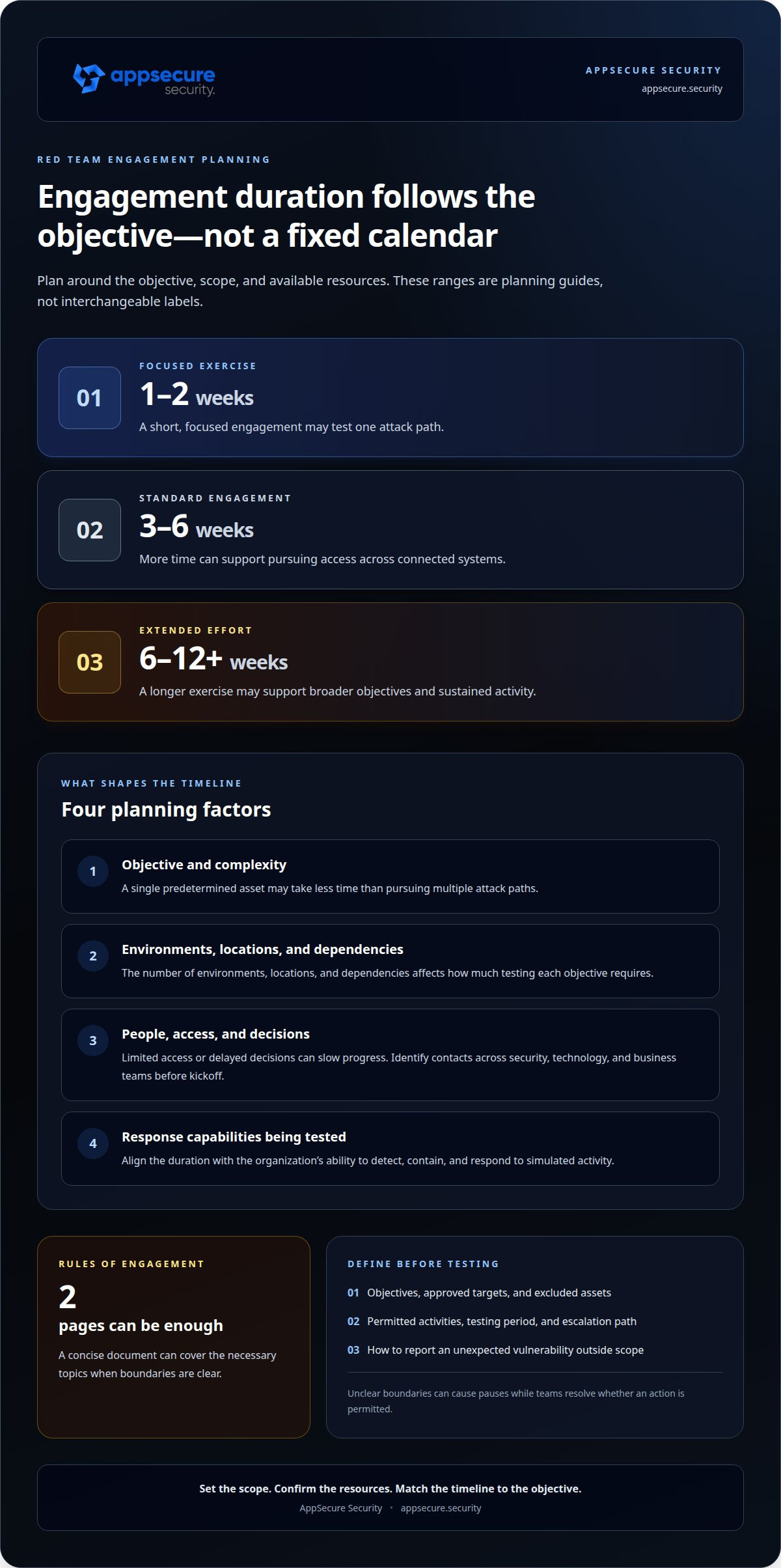
Duration follows the objective, scope, and resources, not a fixed calendar. A focused exercise may take 1-2 weeks, a standard engagement 3-6 weeks, and an extended effort 6-12 weeks or more.
•
How a Red Team Provider Aligns Executive Support and Resources
Secure executive support by linking the exercise to a strategic goal, such as testing the response to a targeted breach. Executive involvement helps resolve decisions about business risk, priorities, and acceptable disruption. Before kickoff, identify contacts who can coordinate security, technology, and business teams. Define which people and systems can support the exercise, since limited access or delayed decisions can slow progress.
•
How a Red Team Provider Sets Scope and Objectives
Define the objective first, then identify the systems and people needed to test it. A red team exercise might aim to reach an administrator account or a specific data set, rather than find every vulnerability. Specify included environments and exclusions, such as a critical application that must remain untouched. Clear boundaries keep testing focused and help the team simulate a realistic threat without going beyond approved targets.
• Match the objective’s complexity to the time available. A short, focused engagement may test one attack path, while a standard 3-6 week exercise can allow more time to pursue access across connected systems. An extended 6-12 weeks or more may support broader objectives and sustained activity. These are typical planning ranges, not interchangeable labels: the number of environments, locations, and dependencies affects how much testing each objective requires.
•
How Rules of Engagement Guide a Red Team Engagement’s Duration
Set rules of engagement that connect each objective to an approved target and activity. Document which assets are excluded, what actions testers may take, and how they should report an unexpected vulnerability outside scope. Define the testing period and escalation path, too. A concise, two-page document can cover necessary topics; unclear boundaries can cause pauses while teams resolve whether an action is permitted.
• Use the rules to establish realistic timing and decision points. Reaching a single, predetermined asset may take less time than testing multiple locations and following several attack paths. A short engagement can last 1-2 weeks; a broader standard exercise typically takes 3-6 weeks. A mature security organization may use an extended exercise lasting 6-12 weeks or more to assess deeper objectives. Align duration with scope, available resources, and the response capabilities being tested.
Who should approve the rules of engagement before testing starts?
Approval should come from leaders who understand the business impact and can authorize the planned activities. Assign clear decision-makers before testing begins.
Secure executive and operational approval.
The executive sponsor confirms that the exercise supports organizational priorities and accepts its business impact. Security leadership and the internal engagement lead translate that approval into testing boundaries. Include legal, IT, and relevant business owners when activities could affect their systems or teams. For on-site social engineering, include building owners and obtain authorization for those activities. Name a primary contact who can resolve scope questions quickly.
Approve each technique separately.
Rules of engagement should state whether phishing, social engineering, penetration testing, and vulnerability exploitation are allowed. Specify targets and safeguards for each activity. For example, phishing may be permitted for selected employees, while access to personal email remains prohibited. Decide whether testers may create accounts, change existing accounts, view files, or modify them. State whether denial-of-service testing is allowed and identify prohibited tools.
Match the method to the test objective.
A penetration test commonly focuses on finding and validating vulnerabilities through technical testing. A red team engagement uses adversary emulation based on real-world tactics, techniques, and procedures. It examines whether the organization detects and responds to simulated attack activity, not just whether an exploit works. The rules should clarify which approach is authorized, so teams know whether success means finding weaknesses or testing the response chain.
Use penetration testing to prepare.
Conduct penetration tests regularly and address their findings before moving on to a red team exercise. Fixing known vulnerabilities first helps the exercise focus on how an attacker could combine access paths and whether internal teams detect activity. For example, resolving an authentication flaw can keep the exercise from stopping at an already-known issue. Record accepted risks and outstanding remediation work, then align the red team objective with the organization’s current security maturity.
Document decision points and escalation.
Name who can pause testing if an activity threatens business operations, and who authorizes a change in approach. Clarify what testers should do if they discover an out-of-scope vulnerability or encounter sensitive data. Set an approved testing period and time zone. Before kickoff, the engagement lead can review the planned activities with approvers and settle open decisions. For help aligning the test method with your goals, discuss red team testing requirements.
Assessing systems, networks, applications, physical security, and employee awareness
Measure success against the agreed objective: whether the organization detects, contains, and responds to simulated activity. Review evidence from security controls and the response process, not just the number of vulnerabilities found.
Map testing to the agreed target.
Identify the in-scope systems, network segments, applications, IoT devices, people, and physical locations. The red team can then test relevant attack paths rather than treating every asset as an isolated target. For example, an exercise might examine how an exposed application connects to internal systems. Keep exclusions visible throughout testing to avoid crossing an approved boundary.
Assess how weaknesses combine.
Red teaming can reveal risks that single-issue testing misses by chaining vulnerabilities into a realistic route toward a defined objective. A weak credential, excessive access, and an overlooked internal connection may each seem limited on its own. Together, they could create a path to sensitive data. The assessment should record each technique, the access it enabled, and where security controls detected or missed the activity.
Include people and physical security where approved.
Employee awareness can be assessed through authorized social engineering, while physical testing can examine whether access controls and staff procedures resist an intrusion attempt. For example, testers may assess whether an employee reports a suspicious request or whether a controlled entry attempt raises an alert. Keep each activity within the approved scope and record the behavior or control observed, rather than treating one employee as the sole measure of security.
Evaluate monitoring and response evidence.
Compare red team actions with alerts, investigation records, and forensic evidence from the security team. Assess whether the organization detected the activity, investigated it, contained the simulated threat, and followed its incident response process. A missed alert, delayed escalation, or unclear handoff points to a specific control or process gap. The goal is to understand how detection and response performed against the tested techniques.
Turn findings into remediation priorities.
The final report should document the attack path, exploitation likelihood, potential impact, and practical remediation for each finding. Connect recommendations to the systems and controls involved so owners can prioritize work and track changes. Then hold a post-engagement review with relevant stakeholders. Compare the objective with actual outcomes, identify lessons, and use the evidence to strengthen security controls, monitoring, and response before the next red team exercise.
Engagement planning and communication
Typical phases include reconnaissance and planning, controlled attack activity, observation, and post-engagement analysis. Throughout these phases, teams document tactics, detection evidence, and lessons for improving controls.
•
How a Red Team Provider Maps Attacks and Plans the Campaign
Map each attack path from initial access toward the agreed objective. During reconnaissance, testers can use open-source intelligence to understand the organization’s exposed assets and likely entry points. A campaign plan then links each intended action to a target, expected outcome, and scope boundary. For example, it can distinguish an approved network range from an excluded one, helping prevent activity from reaching unauthorized systems.
Build a campaign document that guides operations.
Record objectives, in-scope assets, exclusions, planned tactics, and decision points in one usable reference. A sample rules document might permit testing 10.0.4.0/22 while excluding 192.168.1.0/24. Include a process for reporting an unexpected vulnerability outside scope. For autonomous red teaming, specify approval thresholds and scope-enforcement rules that govern the tool’s actions.
Sequence the operation around realistic dependencies.
Plan how reconnaissance, access attempts, exploitation, and objective validation connect. Identify which steps depend on earlier access, and define a safe stopping point if an action risks business disruption. The plan should also explain how testers will handle a route that differs from expectations. This keeps the campaign adaptive without treating every exploitable vulnerability as permission to expand scope.
•
How a Red Team Provider Coordinates Engagement Communication
Set communication channels and reporting triggers before activity begins. Name the engagement point of contact and define how the red team will raise urgent safety concerns or out-of-scope discoveries. If the organization informs its SOC, the team should observe activity as close to real time as alerts allow, while leaving security controls in place. Share relevant alerts or summaries with screenshots to support later comparison.
Close the loop with evidence and lessons.
After testing, compare the planned actions with the SOC’s detections, investigation notes, and forensic evidence. Map the exercise’s tactics, techniques, and procedures to the MITRE ATT&CK Framework to organize findings and assess detection coverage. Then document gaps, responsible stakeholders, and remediation priorities. A structured red team engagement can connect campaign planning with evidence-based review.
Stealth and operational security
Define how testers will conceal activity, protect evidence, and avoid disrupting critical assets. The Concept of Operations (CONOPS) translates the rules of engagement into controlled actions.
•
How a Red Team Provider Defines the Concept of Operations
Document the CONOPS as the exercise’s operational plan. It should connect the threat scenario to approved objectives, techniques, assets, and escalation contacts. Specify how testers will maintain stealth, which actions require approval, and how the team will stop or change course. For example, an engagement plan may set a defined period for maintaining persistence.
Set clear concealment boundaries.
Red teams may minimize noise and blend activity with normal user behavior to test realistic conditions. The rules of engagement must still identify prohibited actions, approved tools, and methods for reporting unexpected findings. Establish who can authorize a change in tactics. Stealth should test operational readiness, not grant permission to access excluded systems or exceed the agreed objective.
•
How a Red Team Provider Manages Operational Disruption
Agree on intervention triggers before testing begins. The engagement point of contact should consider intervening if an investigation risks rebooting critical systems, reimaging devices, or notifying senior management. The SOC should be able to investigate suspected activity, including through memory forensics, unless doing so risks business disruption. Define how testers and internal contacts will communicate when an action could affect service.
Protect investigation evidence.
Tell responders not to upload artifacts from an ongoing investigation to public sandbox sites. Attackers may monitor those services, and submitted data may become public. Instead, the SOC should follow its incident response playbook when an alert is unrelated to the exercise. If activity may be part of the test, document alerts and forensic evidence for later review with the red team.
Keep actions controlled through closeout.
If the SOC knows about the exercise, leave security controls in place and avoid actively blocking the red team. Observe activity as closely to real time as alerts allow, while using agreed escalation routes for risks to business operations. To plan a controlled, stealth-focused exercise, discuss red team engagement planning.
AppSecure Security
AppSecure Security helps organizations get ahead of attackers with faster, in-depth pentesting across critical applications. Its Web Application Penetration Testing, Mobile Application Penetration Testing, and API Penetration Testing use AI agents to test application environments at machine scale, helping teams identify technical weaknesses and reduce exposure before attacks happen.
Turn to AppSecure Security for deeper technical insight into application vulnerabilities and testing aligned with your security priorities. AI agents support broad, intensive testing, while findings inform remediation and sharpen the objectives for a red team exercise. Contact AppSecure Security to discuss your testing needs.
Turn Testing Into a Stronger Security Posture
Treat the engagement as a decision point, not a finish line. Its clearest value comes when evidence informs security priorities, remediation, and future testing. Knowing what to expect from a red team engagement helps your leadership team turn realistic attack scenarios into focused action that protects your organization from attacks.
AppSecure Security supports this work with Web Application Penetration Testing, Mobile Application Penetration Testing, and an AI-agent-powered Agentic Penetration Testing Platform. Our agents accelerate in-depth testing at machine scale, helping uncover technical exposure across relevant application environments and giving teams concrete findings to act on.
When you’re ready to shape faster, in-depth testing around your organization’s risks and objectives, contact AppSecure Security to discuss an engagement. A clear next step can turn security questions into practical progress. Your team can move forward with sharper insight and stronger defenses.
Frequently Asked Questions
1. What is a Red Team Engagement?
A red team engagement is an authorized simulation of adversary activity that examines how an organization’s defenses perform. It goes beyond checking whether individual weaknesses exist by testing how an attack path might unfold and how defenders respond. To understand what to expect from a red team engagement, consider the agreed objective, permitted activity, and evidence the exercise will produce. For example, the goal may be to test whether a security team notices suspicious access to a critical system.
2. What is a red team engagement and what are its objectives?
A red team engagement tests an organization’s ability to withstand and respond to a simulated threat. Objectives might include reaching a defined critical asset, testing alert handling, or evaluating how teams coordinate during an incident. These goals shape which systems and attack paths matter. A useful objective describes an observable outcome, such as whether defenders identify and investigate suspicious account activity, rather than simply asking testers to find vulnerabilities.
3. How long does a red team engagement usually take?
Duration depends on the exercise’s objective and scope. A short, focused engagement typically lasts 1-2 weeks; a standard engagement typically lasts 3-6 weeks; an extended engagement may last 6-12 weeks or more. A small, tightly bounded test may take less time than an exercise spanning several environments or locations. Treat these ranges as planning guidance, then align the schedule with access, approvals, and the complexity of the attack paths.
4. What should an organization prepare before a red team engagement?
Prepare an executive sponsor, a primary engagement contact, and access to the internal teams needed for coordination. Ensure the security operations team has an incident response plan and knows how to handle suspected activity. For organizations operating across India, the USA, the UK, Dubai, Canada, or Singapore, include relevant time zones and business operating windows in planning. Also identify critical services that require careful handling during testing.
5. What rules of engagement and scope are agreed on before testing?
Rules of engagement define authorized targets, testing periods, permitted techniques, exclusions, and escalation contacts. They should clarify practical decisions, such as whether testers may create accounts, access files, conduct phishing, or attempt denial-of-service activity. They also need a process for unexpected vulnerabilities outside scope. For example, if testing uncovers a path into an excluded environment, the team should know to pause and report it instead of proceeding without approval.
6. What tactics do red teams use to test people, processes, and technology?
Depending on the approved scope, a red team may use phishing, social engineering, vulnerability exploitation, or penetration testing techniques. The exercise can test whether employees report suspicious requests, security controls generate useful alerts, and responders investigate activity effectively. For example, an authorized phishing simulation can reveal whether a reporting process works as intended. Each tactic should have a clear purpose and stay within the agreed rules.
7. How does a red team engagement differ from a penetration test?
A penetration test primarily identifies and validates technical vulnerabilities in defined systems. A red team engagement uses adversary emulation to assess how well an organization detects and responds to attack activity, often examining connected technical and operational paths. The approaches answer different questions: a penetration test asks what weaknesses exist, while a red team exercise evaluates how those weaknesses could affect defenses and response. Penetration testing can help address known findings before a broader exercise.
8. What risks can a red team engagement pose to business operations?
Testing can create operational risk if an activity affects a critical service, triggers disruptive response actions, or reaches an unintended asset. Rules of engagement help control these risks by defining exclusions, stop conditions, and escalation routes. For example, teams should decide how to handle a suspected incident that could lead investigators to reboot or reimage a system. Responders should follow established incident procedures while coordinating with the designated engagement contact when appropriate.