
What makes a penetration-testing quote worth its price? Scope, testing depth, and clear deliverables matter more than a headline figure. A pentesting vendor in Singapore should explain which systems are included, how testing will be conducted, and what your team will receive.
Cost is a practical consideration, and the right engagement depends on what needs testing. A focused application assessment differs from testing APIs, mobile apps, cloud environments, or wider infrastructure. A proposal should connect its scope and methods to your risks, so you know what the work covers.
This guide explains what affects pentesting costs in Singapore, which tests vendors offer, and how to assess their credentials, findings, and proposals. It also provides focused questions for an RFP, helping you judge whether an engagement will produce actionable evidence and a clear view of exposure, rather than just a report.
Key Takeaways
- Estimate testing costs by matching the engagement scope and depth to the systems and risks being assessed.
- Choose the test type around your environment, from web applications and APIs to mobile apps, cloud, and networks.
- Assess licensing, tester experience, and credentials together rather than treating one certification as proof of quality.
- Look for findings that include clear evidence, risk context, and practical remediation guidance.
- Use focused RFP questions to define scope, reporting, data handling, and retesting expectations before work begins.
How much does penetration testing cost in Singapore?
Penetration-testing costs in Singapore depend on the systems in scope, testing depth, and reporting needs. Compare what each proposal includes, not just its headline price.
An engagement typically moves through scoping, authorisation, testing, validation, and reporting. Its timeline depends on the platforms involved, access readiness, and how quickly findings can be safely reproduced and documented.
Testing Scope and Service Types
Scope determines what the provider examines and how much hands-on testing is required. A web application test might focus on authentication and access controls; an API test examines how services handle requests and data. Network and server testing maps exposure across infrastructure, while Wi-Fi testing assesses wireless access points and connected systems. VAPT combines vulnerability assessment with penetration testing: it identifies weaknesses, then tests whether selected issues can be exploited.
- Define each web application, API, network range, server, and Wi-Fi environment in scope.
- Specify whether testing is external, internal, authenticated, or unauthenticated.
- Ask how the provider will distinguish automated checks from manual validation.
Comparing Singapore Providers
Compare at least three itemised quotes against the same asset list and test objectives. A structured provider evaluation checklist helps expose gaps between proposals. Look for named deliverables, clear exclusions, testing methods, and a defined process for communicating serious findings. A lower quote may cover fewer platforms or less manual validation, so compare scope before comparing totals.
- Check that each proposal names the systems, environments, and test boundaries.
- Compare the number and type of platforms, not just the stated duration.
- Review whether findings include evidence, risk context, and remediation guidance.
- Confirm how retesting and report handover are handled in the engagement terms.
The cost of a penetration test depends on the engagement and is provided after a quote request. Scope, application complexity, authentication paths, testing depth, access arrangements, and reporting requirements all affect the work involved. Testing one API with defined endpoints differs from assessing connected APIs, a web application, and internal servers together. Ask the provider to explain how these factors shape the proposed work.
For a useful comparison, request itemised proposals for the same scope. Separate one-time testing from recurring platform access if a proposal includes both. Identify assumptions about test accounts, environment availability, and safe testing windows. These details make cost differences easier to interpret and help avoid mismatched proposals.
VAPT findings should distinguish confirmed, exploitable weaknesses from unvalidated alerts. A proposal should explain how the provider verifies issues, records evidence, and prioritises remediation. This matters whether the engagement covers one web application or several connected platforms. Choose a scope that addresses the exposure you need assessed, rather than paying for coverage that does not match your systems.
Web, API, mobile, cloud, and network testing
Choose testing that follows real attack paths across your Singapore environment. A web application, its APIs, a mobile app, and cloud infrastructure may share authentication or data flows. Testing only one component can leave connected weaknesses undiscovered. Define the platforms and boundaries first, then align the test with the exposure you need assessed.
For web applications, testers examine access controls, authentication, session handling, and security misconfiguration. The OWASP Top 10:2025 ranks security misconfiguration as the number two web risk. API testing focuses on how endpoints enforce permissions and handle requests. Mobile app testing can assess the app’s interaction with its APIs and its handling of data. Thick-client testing adds locally installed software and its communication with backend services.
Cloud and network testing examine different layers. A cloud assessment can review configurations and access paths, while network testing evaluates reachable systems and service exposure. Active Directory testing can examine identity permissions and trust relationships. Cloud identity platforms can introduce configurations and access paths that may need assessment. A combined scope can help reveal how a weakness in one layer affects another. Context-driven testing across modern attack surfaces can help frame scope around connected systems.
Automated vulnerability scanning and manual penetration testing serve different purposes. A scanner can identify known vulnerabilities across defined assets. Manual testing investigates whether a weakness can be chained with another issue to reach sensitive data or privileged access. Effective testing uses scan results to guide validation, then documents evidence and practical remediation. Ask how the report distinguishes confirmed vulnerabilities from scanner alerts.
Authorisation comes before any test. Singapore’s Computer Misuse Act criminalises unauthorised access to computer systems and data. Written permission from the system owner is an essential legal-safety practice before penetration testing begins. If the scope includes cloud-provider or shared-hosting systems owned by a third party, obtain explicit permission for those systems too. Document approved assets, test windows, and excluded actions before testing starts.
- Set the scope for each web application, API, mobile app, cloud account, and network segment.
- Specify whether Active Directory, Microsoft Entra ID, or thick-client components are included.
- Request reports that connect reproducible evidence to risk and remediation steps.
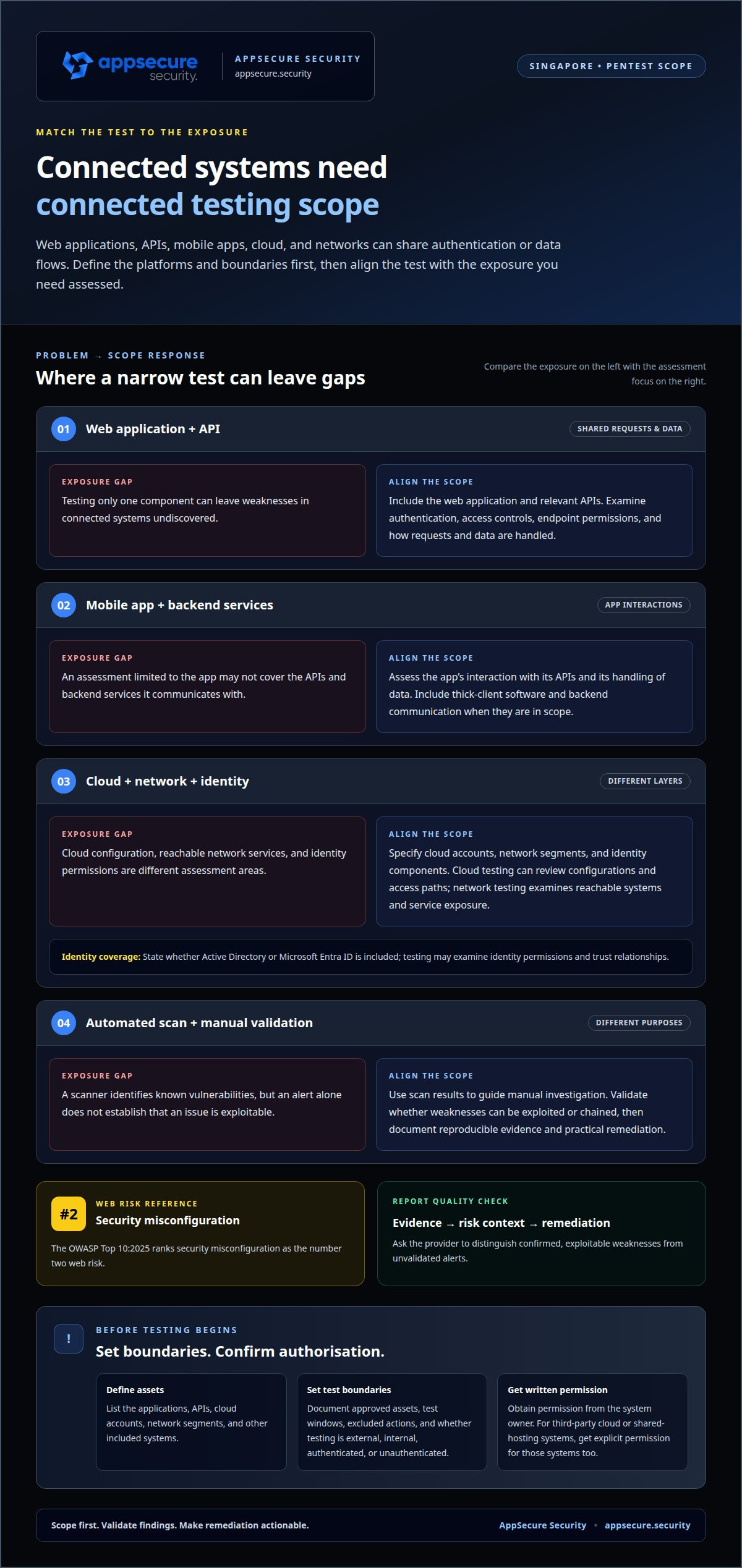
For a connected environment, discuss your testing scope before defining the engagement. Clear boundaries help focus the work on relevant platforms, authorised assets, and findings your team can act on.
CREST accreditation and tester certifications
Singapore buyers should assess provider licensing and individual tester competence separately. The Cyber Security Agency of Singapore licenses penetration-testing service providers under its cybersecurity service-provider framework. A provider-level licence does not show which tester will lead an assessment of a mobile app, web application, or infrastructure. Ask who will perform the work and about their relevant experience.
Singapore’s Cybersecurity Act 2018 has required penetration-testing service providers to hold a licence since 11 April 2022. CREST accreditation is different: it is not legally mandatory in Singapore. Banks, MAS-regulated firms, and government tenders may require CREST-accredited testers, so compliance needs can shape procurement requirements. Separate statutory licensing from a buyer’s contractual or sector-specific expectations.
Individual certifications can demonstrate technical training, but they are not interchangeable proof of test quality. Credentials named for penetration testers include OSCP, CREST, CEH, and GPEN. CREST CRT is described as a minimum certification to ask about for a penetration-testing lead. Other credentials to review include CRT, OSCP, OSCE, and CCT. Match each tester’s background to the systems being assessed.
The industry has not reached agreement on one meaningful certification framework. Treat a certificate as one signal, not a substitute for evidence of hands-on experience, clear reporting, and sound methodology. A mobile application test, for example, calls for experience with mobile-specific attack paths, while cloud identity testing requires relevant cloud security knowledge. Ask how the proposed team’s skills match the scope.
- Confirm the provider holds the Singapore licence required for penetration-testing services.
- Identify the engagement lead and the testers assigned to each platform.
- Match credentials and practical experience to the systems in scope.
- Check whether your tender, regulator, or internal compliance policy requires CREST accreditation.
For financial services, procurement requirements may add another layer. A Singapore financial institution should distinguish its own compliance criteria from general credentials and provider licensing. A financial-services testing evaluation can help frame questions about sector expectations and engagement fit. Apply those requirements to the actual scope, such as APIs, mobile applications, or cloud environments.
Ask for clear evidence of the provider’s licence, the lead tester’s credentials, and each assigned tester’s role. Then assess whether the team can explain its approach and connect technical findings to business risk. This provides a stronger basis for selection than a certification badge alone.
Risk-rated findings, evidence, and remediation recommendations
A useful penetration-testing report turns technical evidence into decisions. Each finding should identify the affected asset, explain the weakness, and show how an attacker could exploit it. For a web application, that might mean documenting an access-control flaw, the affected endpoint, and the conditions needed to access another user’s data. Clear evidence helps teams reproduce the issue without relying on vague labels.
Risk ratings help prioritise remediation, but a severity label alone is not enough. The report should explain the potential impact, exposure, and practical context behind each rating. A critical issue on an internet-facing system may need faster attention than a low-impact weakness in a restricted test environment. Ask the licensed provider to distinguish confirmed, reproducible vulnerabilities from observations that need further validation.
Useful remediation guidance names the affected component and describes a practical fix. For example, a report might recommend enforcing server-side authorisation checks instead of relying on a client-side control. It should also explain how the change addresses the exploit path and whether other endpoints share the weakness. This gives developers a clear action and helps security teams track ownership and closure.
- Record the affected asset, evidence, business impact, and remediation owner.
- Prioritise findings by severity and exposure, not by label alone.
- Connect each fix to the weakness it removes and the exploit it blocks.
- Retest resolved issues and document whether the original attack path still works.
Retesting closes the loop. Singapore pentest engagement terms should include one free retest within 60 days. The retest should confirm whether the specific fix blocks the demonstrated exploit, not merely whether a configuration changed. Critical findings should be reported within 24 hours, so teams can respond while testing continues. Agree on escalation contacts and reporting channels before assessment begins.
Audit reporting also needs to fit the organisation’s obligations. PCI DSS v4.0.1 requirement 11.4 calls for internal and external penetration testing at least once every 12 months and after significant changes. A report should identify the tested scope and findings clearly enough to support audit records. For remediation tracking, teams can map findings to tickets, assign owners, and record retest outcomes.
For CI/CD environments, connect findings to the development workflow without overwhelming teams with duplicate alerts. Assign a validated issue to the relevant application team with evidence, severity, and a fix recommendation. Track whether the code change resolves the root cause, then record the retest result in the report. This creates a traceable path from assessment to remediation and helps prevent the same weakness from resurfacing in later releases.
RFP questions for pentest vendors
A strong RFP makes scope, safeguards, methods, and deliverables explicit. Ask every provider the same questions so proposals reveal meaningful differences.
Vendor Risks and Hiring Considerations
Hiring risks include unclear scope, unsafe testing, weak data controls, and reports based mainly on automated alerts. Ask how manual testing validates vulnerabilities, how the team limits operational impact, and how it escalates a critical finding. Risks when hiring a pentesting vendor include testing beyond authorised assets, sensitive data exposure, shallow testing, and unclear remediation responsibilities.
Set boundaries in the engagement plan. Name in-scope systems, exclusions, test windows, escalation contacts, and actions that require approval. For third-party cloud or shared-hosting systems, ensure the required permission is in place before testing. State how personal or sensitive data will be protected under Singapore’s PDPA and returned or destroyed after the engagement.
- Ask which methodology guides testing and where manual validation supplements automated vulnerability assessment.
- Define how critical findings are escalated, including reporting within 24 hours.
- Set retesting terms, including one retest within 60-90 days.
- Clarify whether testing can begin within your required project window; some providers require a 4-6 week wait.
Credentials and References
To verify a Singapore pentesting vendor’s credentials and references, confirm provider licensing with the Cyber Security Agency of Singapore, then review the assigned testers’ credentials and relevant experience. Ask for references from engagements involving comparable systems, such as APIs or mobile applications, and request a redacted report sample to assess evidence quality.
Make the RFP identify the engagement lead and the people performing the work. Ask whether proposed staff may be substituted and how the replacements’ experience will be assessed. Request a clear explanation of methodology, coverage, and reporting. A certification alone cannot show how testers validate an exploit or communicate remediation to developers.
- Confirm the Singapore provider licence and the named lead tester’s role.
- Match tester experience to the systems and platforms in scope.
- Review sample findings for reproducible evidence and actionable remediation.
- Ask references about communication, scope control, and report usefulness.
Put answers into a comparison matrix covering scope, manual effort, data handling, escalation, timelines, and retesting. This keeps selection focused on execution rather than polished sales language. A proposal, for example, should state how a critical issue reaches your security team and who owns follow-up. Clear RFP terms reduce ambiguity before testing starts and make final reports easier to use.
Define your scope and procurement questions with AppSecure Security.
AppSecure Security
AppSecure Security helps companies in Singapore turn pentesting requirements into focused assessments of real attack surfaces. Its penetration testing services align web application, mobile app, and API assessments with your defined scope and security priorities. The Agentic Penetration Testing Platform uses AI agents to test across platforms faster and in greater depth, at machine scale.
Use this next step when shaping an RFP, deciding which systems to test, or seeking clearer remediation evidence. Share the systems in scope, testing objectives, and reporting needs to frame the discussion. The right engagement should match the exposure you need assessed, not add unrelated work.
Contact AppSecure Security to discuss your pentesting requirements.
Turn your next assessment into a stronger security decision
Choosing a pentesting vendor in Singapore is an opportunity to make security testing part of how your systems evolve, not just a procurement task. Set a clear objective for the next engagement, such as testing a major release or examining a newly connected platform. Make sure the results can guide decisions across security, engineering, and leadership.
AppSecure Security supports this work through Web Application Penetration Testing, Mobile Application Penetration Testing, and its Agentic Penetration Testing Platform. The platform uses AI agents to accelerate in-depth pentesting at machine scale, helping teams uncover risks faster. The right fit depends on the systems you need assessed and the outcomes your team needs. A focused discussion can define the engagement around those priorities.
Contact AppSecure Security to discuss your penetration-testing needs and plan a practical next step. Stronger security starts with clear scope, sharp testing, and action your team can carry forward.
Frequently Asked Questions
1. Is it necessary to perform a pentest regularly?
Yes. Regular testing helps identify weaknesses introduced by new features, integrations, and infrastructure changes. Annual testing is a practical baseline for external-facing assets, with additional assessments after significant system changes. For example, a company launching a new customer portal should assess its changed attack surface rather than rely only on an older report. A recurring schedule also helps teams track whether security improvements remain effective.
2. What penetration testing services do vendors in Singapore offer?
Providers in Singapore may offer web application, API, mobile application, cloud, and network penetration testing, as well as broader VAPT engagements. AppSecure Security offers web application, mobile application, and API testing, alongside its Agentic Penetration Testing Platform. Choose a service that matches the environment: a mobile release may need app testing, while a new cloud deployment may call for a focused cloud security assessment.
3. Which Singapore pentesting vendors are CREST-accredited or have recognized certifications?
AppSecure Security is CREST-accredited. For any engagement, distinguish provider accreditation from individual tester credentials, as they describe different qualifications. Recognized tester certifications include CREST CRT, OSCP, OSCE, CCT, CEH, and GPEN. Match the lead tester’s experience to the assets being assessed, such as mobile apps or APIs. This gives procurement teams a clearer view of who will conduct the work and which skills apply.
4. How do the top penetration testing providers in Singapore compare?
Compare providers by testing approach, coverage, assigned expertise, reporting, and follow-up, not rankings alone. One proposal may focus on automated scanning, while another includes manual validation of business logic. Check whether each deliverable helps engineering teams reproduce issues and plan fixes. Keep objectives and asset scope consistent across proposals, then assess which approach best fits your systems, internal resources, and compliance needs.
5. What is the typical cost of penetration testing in Singapore?
There is no single typical cost for every Singapore engagement. A focused test of one application differs from an assessment involving several platforms, user roles, or connected environments. Request a scope-based quotation that spells out the assets, testing depth, deliverables, and retesting terms. This makes the proposed work easier to assess against your needs, rather than treating a broad market estimate as a quote for your engagement.
6. What factors affect pentesting prices in Singapore?
Price is shaped by scope, system complexity, testing depth, access requirements, and reporting needs. Authenticated testing across multiple user roles, for example, takes a different level of effort from reviewing a single unauthenticated entry point. Connected APIs, cloud environments, or separate staging and production platforms can also affect the work involved. A proposal should explain how these factors shape the engagement, so your team can adjust scope deliberately.
7. How can a business choose a penetration testing vendor in Singapore?
A pentesting vendor in Singapore should have the required provider licence, relevant testing experience, and a clear engagement plan. Define what the assessment must cover, then compare how each proposal addresses those needs. Review tester roles, data handling, escalation, reporting, and retest arrangements. A sample finding can show whether its evidence and remediation guidance are clear to security staff and developers.
8. What types of penetration tests should Singapore businesses consider?
Choose test types based on the systems your business operates and the risks you need to examine. Common options include web application, API, mobile, cloud, and network testing. A company releasing a mobile app that exchanges data with an API may need both components assessed, since a weakness can cross system boundaries. VAPT can combine vulnerability identification with validation of whether selected weaknesses create practical exposure.