A yearly penetration test is a practical baseline, not a rule for every environment. The answer to how often to do penetration testing depends on your exposure, industry, and how quickly your systems change. Major releases, infrastructure changes, or a security breach can all call for testing outside the regular schedule.
A clear interval is useful, but testing too rarely can leave new attack paths undiscovered, while testing more often than your team can act on findings can waste effort. Set the schedule to match both the pace of change and your capacity to remediate issues.
This guide explains how risk and industry shape testing frequency, when to schedule an additional test, and how to use the findings. It also covers how annual, semi-annual, and quarterly schedules fit different environments, and why testing creates value only when results lead to focused remediation and retesting.
Key Takeaways
- Use annual testing as a starting point, then adjust the schedule to match your exposure, system complexity, and pace of change.
- Schedule additional testing after a breach or major change to check whether new attack paths have emerged.
- High-risk organizations may need quarterly or biannual testing to keep pace with threats and evolving systems.
- Turn findings into prioritized remediation work, then retest affected areas to assess whether the issues were addressed.
- Match the test scope to the systems that matter most, including web applications, mobile applications, and APIs.
1. How Often Should You Do Penetration Testing?
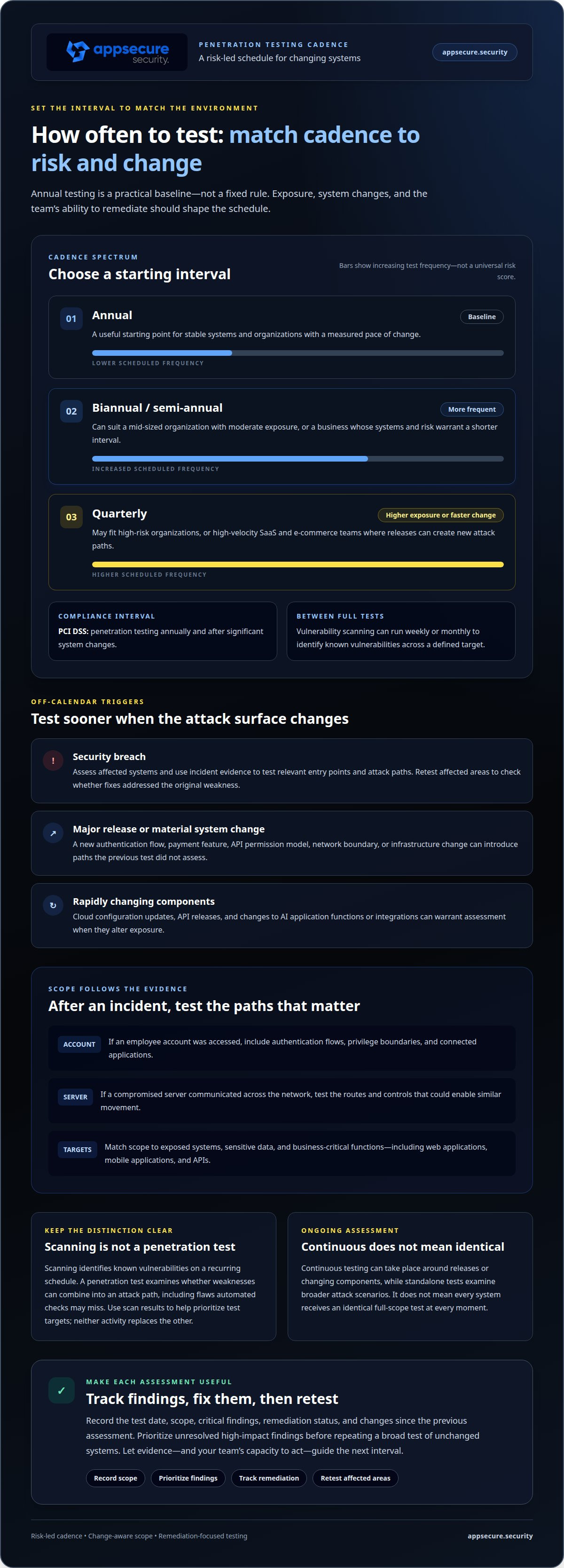
For many organizations, a penetration test once a year is a useful baseline, not a fixed schedule for every environment. A breach, major release, or material change can create new attack paths before the next annual assessment. After a security incident, test the affected systems to assess whether the entry points were identified and fixed. The incident is a reason to reassess timing, not simply wait for the next scheduled test.
After an incident, connect the test scope to evidence gathered during the response. If attackers accessed an employee account, include authentication flows, privilege boundaries, and connected applications. If a compromised server communicated across the network, test the routes and controls that could enable similar movement. The test should safely seek to reproduce relevant attack paths, document findings, and give remediation teams clear technical details. Retesting affected areas can show whether the fixes addressed the original weakness.
Client requirements can also shape a proactive schedule. A customer security review or contract may specify an assessment scope or interval. Map each commitment to the relevant environment, such as a web application that processes customer information or an API that exchanges records. Under GDPR, organizations determine when to test based on risk and implement appropriate security measures, according to the European Union. Use this risk-based approach to connect testing frequency with exposure, system changes, and the consequences of a compromise.
Organization size alone does not determine the interval. A small company with a public-facing application and frequent releases may face different exposure from a larger organization with stable, segmented systems. Security maturity matters too. Teams that track assets, remediate findings, and retest fixes can use assessment results to guide the next scope. If earlier reports still contain unresolved high-impact findings, prioritize remediation before scheduling another broad test of unchanged systems.
Cloud, API, and AI deployments introduce components that may change on different schedules. A cloud configuration update can expose a new path between services; an API release can alter authorization behavior. AI applications add model and agent interactions that deserve assessment when their functions or integrations change. A cloud penetration test can assess cloud-specific exposure alongside application and network pathways, rather than treating the environment as a static asset.
To track security posture over time, record the test date, scope, critical findings, remediation status, and changes since the previous assessment. Compare recurring weaknesses across reports. For example, repeated access-control findings may indicate that a specific review should happen before releases. This record helps teams decide whether to retain an annual baseline, test sooner after a change, or increase coverage where risk has grown. Let evidence and the organization’s ability to act on results guide the schedule.
2. Pentest Frequency: How Often Should You Conduct Penetration Tests?
A penetration test once a year is a common baseline for organizations with stable systems. Businesses are also advised to test one to two times per year, adjusting frequency to risk, change, and remediation capacity. A mid-sized organization with moderate exposure may choose biannual testing, while a small business with a stable environment may use annual testing alongside other security measures. These intervals are starting points for planning, not substitutes for assessing what has changed.
Vulnerability scanning and penetration testing serve different purposes, so their schedules need not match. Scanning can run weekly or monthly to identify known vulnerabilities across a defined target. A penetration test examines whether weaknesses can combine into an attack path, including flaws automated checks may miss. Use scan results to prioritize targets, then set the test scope around exposed systems, sensitive data, and business-critical functions. Neither activity replaces the other.
Release velocity affects the value of a fixed calendar. A high-velocity SaaS or e-commerce team may need testing quarterly or after every major release. A new authentication flow, payment feature, or API permission model can create attack paths that an earlier test did not assess. For teams using agile or DevOps, security testing can fit into CI/CD workflows, while standalone penetration tests provide a deeper adversarial assessment. Smaller projects can schedule a test at the end of development.
What is the difference between penetration testing frequency and continuous penetration testing? Frequency describes the interval between planned tests, such as annual or quarterly assessments. Continuous testing means security assessment takes place on an ongoing basis, often around releases or changing components, while standalone tests still examine broader attack scenarios. It does not mean every system receives an identical, full-scope test at every moment.
Frequency matters because a report reflects the systems and conditions assessed at that time. A new release, changed network boundary, or unresolved finding can make an old result less useful for current decisions. PCI DSS requires penetration tests annually and after significant system changes. For other environments, prioritize timing by exposure, system changes, and the potential impact of an attack. Keep vulnerability scanning active between tests to identify new weaknesses for triage.
Build a schedule that links each test to an explicit trigger: the annual review, a major release, or a change that affects a critical target. Record findings, owners, remediation status, and retest outcomes. That history helps distinguish recurring weaknesses from newly introduced vulnerabilities and supports more focused scope decisions. If releases outpace the assessment calendar, discuss a testing schedule that fits the pace of change and the systems you need assessed.
3. Quarterly or Biannual Testing for High-Risk Sectors
Quarterly or biannual testing can suit organizations facing high exposure, handling sensitive data, or managing complex infrastructure. Finance, healthcare, and e-commerce environments often combine valuable records with public-facing systems and demanding service expectations. One test schedule may not cover every system equally. A bank’s customer portal, payment APIs, and internal network can present different attack paths and business impacts. Scope each assessment around the assets most likely to affect customers, operations, or critical data.
Risk-based cadence depends on more than an industry label. A healthcare organization with stable systems and a focused environment may prioritize key applications and repeat testing after meaningful changes. A financial organization with frequent platform development may need broader, more frequent assessments. Quarterly testing is a practical option for high-risk environments; biannual testing may suit organizations with fewer changes or narrower exposure. Reassess the cadence when threats, system complexity, or unresolved findings change.
Test before attack risk increases, not only after a fixed calendar date. A new product release, expanded customer portal, or major development milestone can change exposure. For example, an e-commerce platform adding payment features should assess the affected application and data flows before launch. A planned merger can also introduce new networks, identities, and integrations. Scheduling around these events helps identify weaknesses while teams can still address them before operations depend on the changed environment.
PCI DSS requires penetration tests annually and after significant system changes. HIPAA does not specifically mandate annual penetration testing; its Security Rule calls for regular technical and non-technical evaluations, which may include penetration testing. SOC 2 requires general policies for securing systems and data, but does not specifically mandate penetration tests. For PCI DSS scope and test planning, a PCI DSS penetration testing guide can help clarify relevant assessment considerations.
Budget decisions should prioritize risk reduction, not test volume. Start with systems that process sensitive records, enable access to other environments, or support essential services. Then consider coverage depth and your team’s ability to remediate findings. If critical issues from an earlier assessment remain unresolved, remediation may deliver more value than repeating an unchanged scope. A smaller, targeted test can address a changed component, while broader testing can cover interconnected systems when architecture changes.
Track each quarterly or half-yearly assessment in a clear record of scope, date, findings, owners, remediation status, and retest outcomes. Compare those results with development releases and infrastructure changes. If the same access-control weakness appears in separate applications, strengthen the review process across those systems. If a major change creates new attack paths, move the next test forward. This evidence-based cadence helps maintain a current security posture without treating every organization’s threats and systems as identical.
4. What Happens After a Penetration Test Is Completed?
A completed penetration test is a decision point, not a finish line. Review each finding alongside the affected asset, evidence, potential impact, and recommended remediation. Assign an owner and track the fix through implementation. For example, an access-control weakness in a customer application needs a different response from an exposed management interface. Once a fix is implemented, retest the affected path to assess whether the original attack route is closed.
Major infrastructure changes can invalidate assumptions in an earlier assessment. After a server migration, test the new server configuration once it is implemented. Testing a configuration that will soon be retired provides less useful evidence. An operating-system migration, new firewall, or authentication change can alter trust boundaries and access paths. Include the changed components and their connections in scope, then assess whether the update introduced weaknesses across the network.
Application releases need a scope that reflects the size of the change. A platform overhaul or new module can affect authentication, data flows, and permissions, making a full penetration test appropriate. A minor feature update may call for targeted testing of changed components and connected functions. For example, assess a new account-recovery flow alongside its identity checks and session handling, not as an isolated screen.
Policy changes can also alter technical controls. A revised access policy may change who can reach an application, which roles can approve transactions, or how authentication works. Conduct testing after those rules are implemented, especially when a policy affects privileged accounts or external access. A test can examine whether configured controls enforce the intended boundaries. If another area is being remediated, testing a separate target can proceed independently.
Some events call for testing outside the release calendar. Schedule an assessment after a breach to check whether the identified entry points were located and fixed. New threats can also change which exposed systems deserve attention. Before a merger, assess planned integration paths, identity arrangements, and connected infrastructure. After a major software deployment or network redesign, test the live configuration rather than relying on results from the previous architecture.
Close the loop after the report. Prioritize findings by risk and business impact, implement fixes, and retain evidence of retesting. Address lower-priority issues and recheck problem areas in the following months. A useful record connects each finding to its owner, fix, retest outcome, and related change. This history helps teams identify whether a recurring weakness follows a particular release, configuration, or access policy, and whether the next test should target it.
5. Annual, Semi-Annual, and Quarterly Schedules
Choose a calendar that connects each assessment to a defined scope and decision. For small and medium-sized enterprises with stable infrastructure, annual testing is suggested at minimum. Smaller organizations with systems that change little may find annual or biannual testing adequate. Use the annual review to assess core exposure, then add tests when changes make the previous scope outdated. A fixed date helps with planning, but it should not prevent event-driven testing.
An annual schedule can work for a stable environment when teams also track vulnerabilities and remediate findings between assessments. Map the external attack surface, such as public-facing applications, separately from internal systems employees can access. These scopes expose different routes and controls. For example, an external test may assess authentication on a customer portal, while an internal assessment examines whether access boundaries limit movement between systems.
Semi-annual testing creates another checkpoint within the year. It can suit an organization that needs a mid-cycle assessment but does not face the change rate or complexity associated with quarterly work. Split the scope by business priority: assess a customer-facing application in one cycle, then focus on internal access paths in the next. Review the findings before setting the second scope, so the test can examine remediation or newly changed components.
Quarterly testing can help complex environments reassess exposure more frequently. Rather than repeat the same broad scope every quarter, rotate focus across critical applications, network boundaries, and infrastructure. For example, one cycle could assess identity controls, while another examines changed APIs. Keep a record of what each test covered. This prevents gaps hidden by frequent testing and helps security teams see whether findings persist across different parts of the environment.
Annual external and internal testing should be treated as distinct assessment scopes, not interchangeable labels. External testing examines systems reachable from public networks; internal testing focuses on systems accessible within the organization. The right balance depends on architecture, sensitive data, and how access is granted. A documented scope should identify the assets, test boundaries, and relevant changes since the previous assessment. This makes results comparable and helps teams strengthen controls where exposure has shifted.
Use a simple schedule record with the planned test date, scope, owner, findings, remediation status, and retest outcome. At each planning checkpoint, compare the schedule with releases, infrastructure work, and unresolved risks. If a major change lands between annual reviews, add a targeted assessment instead of waiting for the next calendar slot. To plan a cadence around your systems and exposure, discuss your penetration-testing schedule.
AppSecure Security
AppSecure Security helps organizations turn risk, system changes, and remediation capacity into a focused penetration-testing schedule that protects against attacks. Its testing covers web application, mobile application, and API security, while its Agentic Penetration Testing Platform uses AI agents to test changing environments faster and at scale. This enables deeper testing as release pace increases, when a major change needs assessment, or when clear findings are needed to guide remediation. The right scope targets the systems and attack paths that matter to your organization, not simply an old test plan. Share your priorities and testing needs to start a focused discussion. Contact AppSecure Security.
Make Your Next Security Decision Count
Deciding how often to do penetration testing is an ongoing security decision, not a calendar task to set and forget. Give the schedule a clear owner and connect it to your release and change-planning process. This way, a new feature or infrastructure shift prompts a timely review instead of waiting for the next routine assessment. The goal is to keep testing relevant to the systems your business depends on.
AppSecure Security provides web application and mobile application assessments, as well as its Agentic Penetration Testing Platform, which uses AI agents to test at speed and scale and help protect organizations from attacks. Use a scoping discussion to identify the systems in scope, the changes that could alter exposure, and how findings will feed into remediation. A focused plan gives your security team a practical path from assessment to action.
Contact AppSecure Security to discuss a penetration-testing plan for your environment. Take the next step with a schedule built around your security priorities.
Frequently Asked Questions
What Happens After a Penetration Test Is Completed?
Review the report, assign owners to findings, and prioritize fixes by risk and business impact. The remediation plan should identify affected components, accountable teams, and evidence needed to confirm a fix. For example, an authorization flaw may require both a code change and a review of related roles. After implementation, retest the affected path and record whether the original issue remains, has been fixed, or needs further work.
What Determines How Often You Should Perform a Penetration Test?
Set frequency according to exposure, system complexity, release pace, data sensitivity, and the status of earlier findings. A stable internal tool has a different risk profile from a public application handling customer transactions. Team capacity matters too: testing delivers actionable value when the organization can prioritize remediation. For a business operating across India, the USA, the UK, Dubai, Canada, or Singapore, assess each environment’s systems and changes rather than assuming one schedule fits all.
When Is the Right Time to Perform a Pentest?
Schedule a test before a major product release, after an important infrastructure change, or following a security incident. Testing after implementation lets the assessment examine the configuration users will actually encounter. For smaller development projects, testing near completion can reveal weaknesses before launch. If a major migration is planned, assess the new environment after deployment rather than spending effort on a configuration that is about to be retired.
How Often Should Organizations Perform Penetration Testing?
Many organizations use an annual test as a baseline, while higher-risk or rapidly changing environments may test more frequently. A mid-sized organization with moderate exposure might plan a test twice a year; complex systems may need quarterly or continuous approaches. Divide coverage by asset and purpose. For example, test a changed customer-facing application in one cycle and a critical internal access path in another.
What Factors Determine Penetration Testing Frequency?
Organizations deciding how often to do penetration testing should weigh the likelihood and impact of attack, system changes, and unresolved findings. Include customer-facing applications, APIs, cloud configurations, and critical internal systems in the risk review. Also account for contractual or assessment expectations that apply to your organization. A new authentication provider, for instance, changes the trust model and can make an earlier test scope incomplete.
Do Regulations Require Annual Penetration Testing?
Not universally. PCI DSS requires penetration tests annually and after significant system changes. HIPAA calls for regular technical and non-technical evaluations under 45 CFR §164.308(a)(8), which may include penetration testing, but does not specifically mandate annual tests. SOC 2 requires general policies for securing systems and data, not penetration testing specifically. Organizations should distinguish a stated testing requirement from broader security assessment expectations.