


VAPT (Vulnerability Assessment and Penetration Testing) is a cybersecurity testing process that identifies, analyzes, and validates exploitable security weaknesses in applications, networks, cloud environments, and IT infrastructure. Vulnerability Assessment detects potential vulnerabilities, while Penetration Testing simulates real-world attacks to verify whether those weaknesses can be exploited by attackers. For Singapore organizations, VAPT helps reduce breach risk, validate security controls, and support compliance with MAS TRM guidelines, PDPA obligations, and CSA security standards.
Singapore organizations implement security controls, but rarely validate whether those controls actually work. Firewalls get deployed, encryption gets enabled, and passwords get enforced. Singapore faces the world's highest third-party breach rate at 71.4%, often from unpatched vendor vulnerabilities. The gap between implemented security and validated security creates exploitable weaknesses that attackers consistently target.
This guide explains what VAPT is, why Singapore companies need it, how the process works, pricing considerations, and provider selection criteria.
What Is VAPT?
VAPT combines two complementary security testing approaches: Vulnerability Assessment and Penetration Testing. Together, they provide a comprehensive security evaluation that identifies weaknesses and proves they're exploitable.
Vulnerability Assessment: Finding Security Weaknesses
Vulnerability assessment systematically identifies security flaws in systems, networks, and applications. The process scans infrastructure and applications looking for known vulnerabilities, misconfigurations, outdated software, and security gaps.
Automated vulnerability scanning tools examine systems against databases of known vulnerabilities. The scanners check for missing security patches, weak configurations, default credentials, and common security issues. They generate reports listing discovered vulnerabilities with severity ratings.
The vulnerability assessment process includes:
Asset discovery: Identifying all systems, applications, and network devices in scope. This creates an inventory of what needs protection.
Vulnerability scanning: Running automated tools that check for known security issues. Common tools include Nessus, Qualys, and OpenVAS.
Vulnerability analysis: Reviewing scan results to understand which findings represent genuine risks versus false positives.
Risk classification: Rating vulnerabilities by severity based on potential business impact, exploitability, and affected asset criticality.
Reporting: Documenting discovered vulnerabilities with remediation recommendations prioritized by risk.
Vulnerability assessment answers the question: "What security weaknesses exist in our environment?"
Penetration Testing: Proving Vulnerabilities Are Exploitable
Penetration testing goes beyond identification. It actively exploits vulnerabilities to demonstrate what attackers could actually achieve. Skilled security testers use the same techniques as real attackers to breach systems.
Penetration testing simulates real-world attacks:
Reconnaissance: Gathering information about target systems using publicly available data, network scanning, and service enumeration.
Vulnerability exploitation: Attempting to exploit discovered vulnerabilities to gain unauthorized access, escalate privileges, or extract sensitive data.
Post-exploitation: After initial compromise, attempting lateral movement to access additional systems, elevate privileges, and demonstrate business impact.
Reporting: Documenting successful exploits, compromised systems, accessed data, and attack paths used to achieve objectives.
Penetration testing answers: "Can attackers actually exploit these weaknesses, and what damage could they do?"
Why VAPT Combines Both Approaches
Vulnerability assessment finds many issues quickly through automated scanning. Penetration testing proves which issues pose genuine risk through manual exploitation. Together they provide comprehensive security validation.
Vulnerability assessment without penetration testing generates long lists of potential issues without proving impact. Organizations know vulnerabilities exist but not whether they're exploitable or what damage exploitation enables.
Penetration testing without vulnerability assessment might miss issues because testers focus on exploiting specific vulnerabilities rather than comprehensively scanning everything.
VAPT delivers both breadth and depth. Automated vulnerability assessment finds the issues. Manual penetration testing proves which ones matter.
Organizations implementing application security assessment programs recognize that VAPT provides the foundation for comprehensive security validation across infrastructure and applications.
Types of VAPT Services in Singapore
Singapore organizations procure various VAPT service types depending on their technology stack and security requirements.
Network VAPT
Network VAPT assesses security of network infrastructure: routers, switches, firewalls, VPNs, wireless access points, and network segmentation. This testing identifies misconfigurations, weak access controls, unpatched network devices, and network-based attack paths.
Internal network VAPT simulates attacks from inside the corporate network. It tests what attackers could achieve after initial compromise or what malicious insiders could do. Common findings include weak Active Directory security, inadequate network segmentation, privilege escalation paths, and unencrypted internal communications.
External network VAPT tests internet-facing infrastructure from an attacker's perspective. It identifies exposed services, vulnerable perimeter defenses, and ways attackers could breach the network from outside. This testing type is most common for regulatory compliance.
Wireless network VAPT specifically examines WiFi security. Testing includes checking encryption strength, authentication mechanisms, rogue access point detection, and whether attackers can access internal networks through wireless compromise.
Web Application VAPT
Web application VAPT identifies security flaws in web-based applications, including customer portals, e-commerce platforms, SaaS applications, and internal web tools. Testing follows OWASP Top 10 methodology covering injection attacks, broken authentication, sensitive data exposure, and other web-specific vulnerabilities.
This testing type is critical for Singapore businesses with customer-facing applications. SQL injection vulnerabilities could expose entire customer databases, leading to PDPA breaches with significant penalties.
Common web application vulnerabilities discovered include SQL injection allowing database access, cross-site scripting enabling session hijacking, broken access controls letting users access unauthorized data, insecure file uploads allowing malicious code execution, and business logic flaws bypassing intended workflows.
API VAPT
API VAPT examines REST APIs, GraphQL endpoints, SOAP services, and microservices architectures. As Singapore's digital economy emphasizes API-first development, API security becomes increasingly critical.
API-specific vulnerabilities differ from web application issues. Testing focuses on authentication mechanisms, authorization flaws, rate limiting, data exposure through API responses, and API-specific injection attacks.
Singapore fintech companies, e-commerce platforms, and SaaS providers particularly need API VAPT as their business models depend on secure API integrations with partners and customers.
Mobile Application VAPT
Mobile application VAPT assesses iOS and Android applications for security flaws. Testing examines insecure data storage on devices, weak authentication, inadequate encryption, API security, and reverse engineering resistance.
Singapore's mobile-first population means businesses deploy mobile apps for everything from banking to food delivery. Mobile app security failures expose user data and enable account takeovers, making this testing critical for consumer-facing applications.
Cloud Infrastructure VAPT
Cloud infrastructure VAPT examines AWS, Azure, Google Cloud, and other cloud environments for security misconfigurations and vulnerabilities. As Singapore organizations migrate to cloud, this testing type grows in importance.
Cloud VAPT focuses on IAM misconfigurations, storage bucket security, serverless vulnerabilities, container security, and cloud-specific attack vectors. Many data breaches result from cloud misconfigurations rather than sophisticated attacks, making cloud VAPT essential for organizations adopting cloud infrastructure.
Organizations conducting web application penetration testing should extend testing to associated APIs, mobile apps, and cloud infrastructure for comprehensive application security validation.
Why Singapore Companies Need VAPT
Singapore organizations face multiple drivers creating urgent need for VAPT services.
Regulatory Compliance Requirements
Singapore's regulatory landscape increasingly mandates security testing:
MAS Technology Risk Management (TRM) Guidelines require financial institutions to conduct "regular penetration testing" of critical systems. Banks, insurance companies, payment processors, and fintech firms must demonstrate ongoing security validation through VAPT. MAS reviews penetration testing reports during audits, making VAPT a compliance necessity for financial sector organizations.
Personal Data Protection Act (PDPA) requires organizations to implement "reasonable security arrangements" to protect personal data. While PDPA doesn't explicitly mandate VAPT, the Personal Data Protection Commission increasingly expects organizations to validate security controls. VAPT demonstrates reasonable security diligence when handling personal data.
Cyber Security Agency (CSA) Cybersecurity Code of Practice recommends regular security assessments for organizations storing personal data. CSA certification programs require penetration testing as part of baseline security requirements.
Industry-specific regulations in healthcare, telecommunications, and critical infrastructure often mandate security testing. Organizations in these sectors need VAPT to satisfy regulatory obligations and pass audits.
Compliance-driven VAPT satisfies regulatory requirements, provides documentation for auditors, and demonstrates due diligence in security management.
Preventing Data Breaches
Singapore data breaches create a significant business impact. Financial costs include incident response, forensic investigation, customer notification, credit monitoring services, regulatory fines, and legal expenses. Average breach costs reach SGD 4.5 to 5.5 million based on industry estimates.
Reputational damage affects customer trust, brand value, and competitive position. Organizations suffering breaches face customer churn, negative media coverage, and difficulty winning new business.
Regulatory penalties from PDPC can reach SGD 1 million for PDPA violations. MAS can impose significant penalties on financial institutions for security failures.
Business disruption occurs as systems go offline for remediation, operations halt, and productivity suffers during incident response.
VAPT prevents breaches by discovering vulnerabilities before attackers exploit them. Remediating issues identified through VAPT costs far less than responding to actual breaches.
Customer and Partner Requirements
Singapore's business ecosystem increasingly demands security validation. Enterprise customers require vendor security assessments before engagement. Many procurement processes mandate recent VAPT reports as condition for contract award.
Banking partners need security validation before integrating payment processing or financial services. Financial institutions require partner VAPT reports to satisfy their own regulatory obligations.
Insurance requirements drive VAPT adoption as cyber insurance providers demand security testing for coverage eligibility. Premiums reflect security posture, with regular VAPT qualifying for better rates.
Board and investor expectations create pressure as stakeholders demand evidence of security diligence. VAPT reports demonstrate that management takes security seriously and validates security investment effectiveness.
Organizations implementing continuous penetration testing can provide customers and partners with ongoing security validation rather than point-in-time assessments.
Identifying Unknown Vulnerabilities
Organizations often don't know their security posture until tested. Shadow IT creates undocumented systems with unknown security status. VAPT discovers forgotten servers, abandoned applications, and unmanaged infrastructure.
Configuration drift occurs as systems deviate from secure baselines over time. VAPT identifies misconfigurations that accumulate through changes and updates.
New vulnerabilities emerge constantly as researchers discover security flaws in software and platforms. VAPT validates whether systems are vulnerable to newly disclosed issues.
Complex attack paths that seem secure individually become exploitable when chained together. VAPT reveals how attackers could combine multiple small issues to achieve compromise.
Business logic flaws that automated scanners miss require manual testing to discover. VAPT identifies workflow bypasses and authorization issues that enable business impact.
Validating Security Controls
Security investments require validation to ensure they actually provide protection. VAPT tests whether network segmentation actually prevents lateral movement, whether security monitoring detects attacks, whether systems are actually patched despite patch deployment processes, whether access controls prevent unauthorized access, and whether sensitive data is actually encrypted with correct implementation.
Organizations conducting offensive security testing gain comprehensive validation that security controls function as intended under realistic attack scenarios.
The VAPT Process: How It Works
Understanding the VAPT process helps organizations prepare for assessments and interpret results.
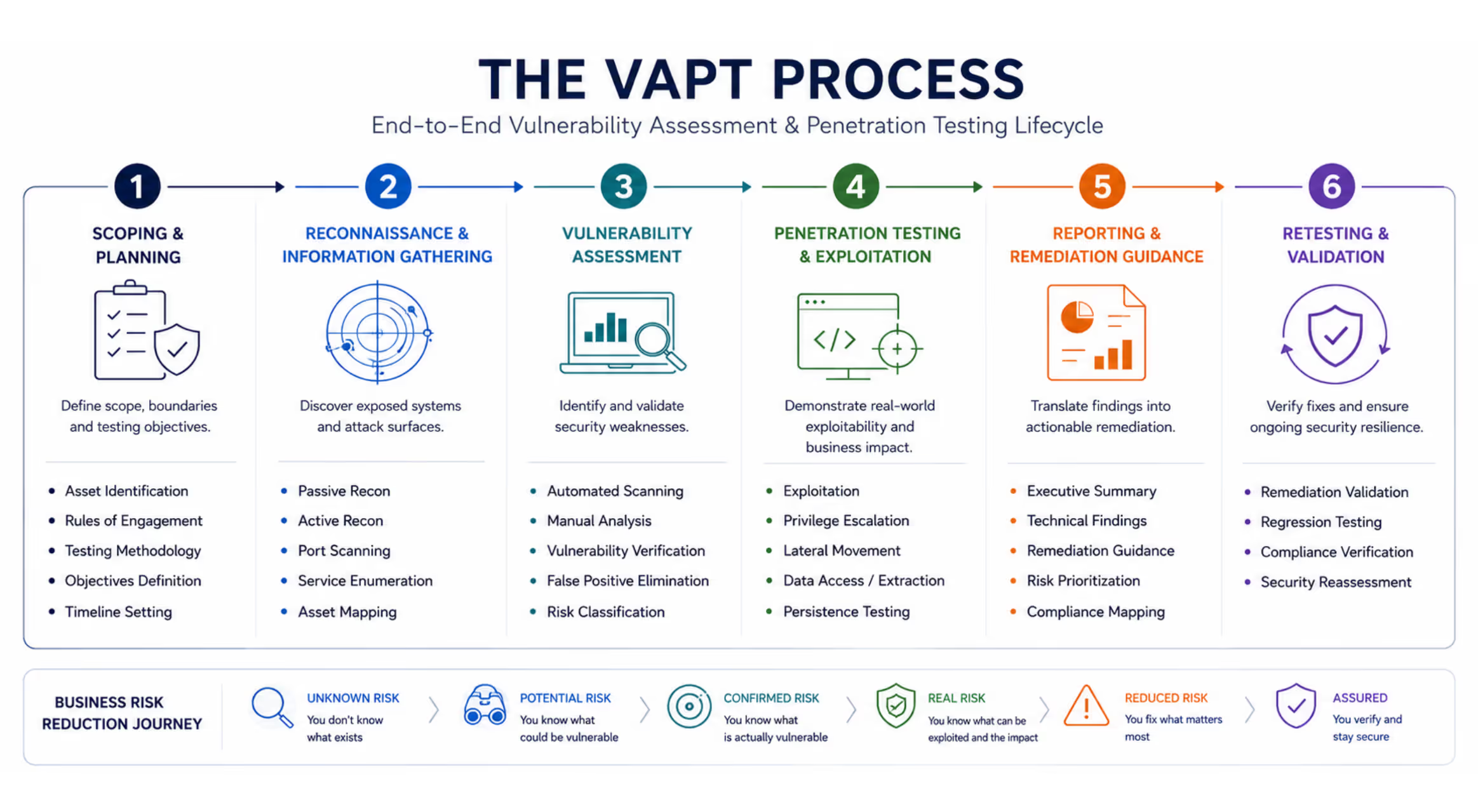
Phase 1: Scoping and Planning
Successful VAPT begins with clear scope definition. Asset identification documents what systems, applications, and networks require testing, including IP addresses, URLs, application credentials, and network diagrams.
Testing objectives define what the organization wants to achieve. Compliance-focused testing differs from comprehensive security validation.
Rules of engagement establish boundaries, timing constraints, emergency contacts, and safe harbor provisions. This protects production systems while enabling realistic testing.
Testing methodology agreement covers approach such as black box testing with no prior knowledge, gray box with some information, or white box with full system access.
Timeline setting establishes testing schedule, reporting deadlines, and remediation timelines.
Proper scoping prevents misunderstandings, ensures comprehensive coverage, and enables meaningful results.
Phase 2: Reconnaissance and Information Gathering
VAPT teams gather information about target systems through passive reconnaissance collecting publicly available information from DNS records, WHOIS data, search engines, and social media without directly interacting with target systems.
Active reconnaissance directly scans target systems to identify open ports, running services, application versions, and technology stack.
Asset mapping creates comprehensive inventory of discovered systems, services, and potential attack vectors.
This phase establishes what exists in the environment and identifies potential entry points for exploitation.
Phase 3: Vulnerability Assessment
Automated and manual techniques identify security weaknesses. Automated scanning runs vulnerability scanners like Nessus, Qualys, or Burp Suite to identify known vulnerabilities, misconfigurations, and common security issues.
Manual analysis involves security professionals reviewing scan results, eliminating false positives, and identifying issues that automated tools miss.
Vulnerability verification confirms that identified vulnerabilities actually exist and affect the target systems.
Risk classification rates vulnerabilities by severity based on CVSS scores, business impact, and exploitability.
This phase produces the comprehensive vulnerability inventory that informs testing priorities.
Phase 4: Penetration Testing and Exploitation
Testers attempt to exploit discovered vulnerabilities by using them to gain unauthorized access, execute commands, or extract data.
Privilege escalation involves attempting to gain higher-level permissions and access to more sensitive systems after initial compromise.
Lateral movement tests accessing additional systems and expanding access across the network from compromised systems.
Data extraction demonstrates business impact by accessing and potentially exfiltrating sensitive data with proper authorization and safeguards.
Maintaining access tests whether backdoors can be established for persistent access, simulating advanced persistent threat behavior.
This phase proves which vulnerabilities pose genuine risk by demonstrating actual exploitation and business impact.
Phase 5: Reporting and Remediation Guidance
VAPT teams document findings and provide remediation guidance through executive summaries, providing a high-level overview of security posture, major findings, and business risk for management and the board.
Technical findings document each vulnerability in detail, including description, severity, proof-of-concept, affected systems, and business impact.
Remediation recommendations provide specific, actionable guidance on fixing identified issues. Quality reports explain not just what's vulnerable but exactly how to fix it.
Risk prioritization orders findings by business risk to guide remediation priorities. Critical issues affecting sensitive systems rank highest.
Compliance mapping links findings to regulatory requirements like MAS TRM, PDPA, or CSA standards for organizations with compliance obligations.
Phase 6: Retesting and Validation
After remediation, organizations should verify fixes through remediation validation testing that fixes actually resolve vulnerabilities without introducing new issues.
Regression testing ensures remediation didn't break functionality or create new security problems.
Compliance verification confirms that remediated systems now meet regulatory requirements.
Many Singapore VAPT providers include limited retesting in their service packages, allowing organizations to validate remediation effectiveness.
Organizations implementing API penetration testing should ensure the testing process includes API-specific methodologies beyond standard web application testing approaches.
VAPT Costs in Singapore
Understanding VAPT pricing helps organizations budget appropriately for security testing.
Factors Affecting VAPT Cost
Multiple variables influence VAPT pricing:
Scope size: Larger environments with more systems, applications, or IP addresses cost more to test. Single applications differ significantly from testing entire corporate infrastructure.
Testing complexity: Complex applications with extensive functionality require more time than simple websites. Legacy systems, custom applications, and integrated platforms increase testing difficulty and cost.
Testing type: Different VAPT types have different pricing. Mobile application testing differs from network testing in methodology and time requirements.
Testing depth: Black box testing without prior knowledge takes longer than white box testing with full documentation and credentials.
Provider qualifications: Highly certified testers with advanced skills command premium rates but deliver higher quality results.
Urgency: Expedited timelines increase costs as providers allocate additional resources and prioritize assessments.
Maximizing VAPT Investment Value
Organizations can optimize VAPT spending by prioritizing by risk, testing highest-risk systems first. Customer-facing applications processing sensitive data warrant testing before internal tools with limited exposure.
Annual contracts with many providers offer discounts for annual testing commitments. Organizations can save 15 to 20 percent with multi-year agreements.
Combining testing types means testing multiple systems or applications together often costs less per item than separate engagements.
Remediating between tests ensures previous findings are fixed before retesting. Paying to rediscover the same issues wastes budget.
Leveraging government grants as Singapore SMEs may qualify for grants supporting cybersecurity investments including VAPT services.
Organizations conducting cloud penetration testing should budget for both initial assessment and ongoing testing as cloud environments evolve through new deployments and configuration changes.
Indicative VAPT Pricing in Singapore
Actual VAPT pricing depends on application complexity, scope size, testing depth, authentication requirements, cloud architecture complexity, compliance obligations, and remediation validation requirements. Highly regulated sectors such as fintech, healthcare, and critical infrastructure often require deeper testing and more extensive reporting.
Choosing a VAPT Provider in Singapore
Selecting the right VAPT provider significantly impacts the quality and security value.
Essential Qualifications
CSA Penetration Testing Services License: Singapore's Cyber Security Agency licenses penetration testing service providers. Licensed providers meet baseline qualifications and comply with CSA standards. Verify provider holds current license.
Professional certifications: Individual testers should hold recognized offensive security certifications:
- OSCP (Offensive Security Certified Professional) demonstrates hands-on exploitation skills
- GXPN (GIAC Exploit Researcher and Advanced Penetration Tester) for advanced testing
- CEH (Certified Ethical Hacker) for foundational knowledge
- CREST certification for international standards
Relevant experience: Years of conducting security testing specifically, not just general IT security. Industry experience in your sector helps testers understand business context and identify relevant risks.
Methodology and standards: Documented testing methodology following recognized standards like OWASP Testing Guide, PTES (Penetration Testing Execution Standard), or OSSTMM. Providers should articulate their approach clearly.
Insurance coverage: Professional indemnity insurance protects organizations if testing causes disruption or damage. Verify coverage limits match potential exposure.
Red Flags to Avoid
Beware of providers who offer extremely low pricing. VAPT, requiring skilled professionals conducting manual testing, has inherent costs.
Cannot provide sample reports. Quality providers share sanitized sample reports showing their documentation standards and remediation guidance quality.
Focus solely on vulnerability counts. The number of vulnerabilities found is a poor success metric. Quality providers focus on business risk and exploitability.
Don't discuss scope definition. Reputable providers spend significant time understanding your environment and defining the appropriate scope.
Lack of transparency about the testing approach. Legitimate providers explain exactly what testing they'll perform and how.
Cannot provide references. Established providers readily share customer references and case studies.
Questions to Ask Providers
Who will conduct our assessment? Request information about specific testers including certifications and experience. Some providers subcontract testing, potentially affecting quality.
What testing methodology do you follow? Understand their approach, how they handle discovered vulnerabilities, and what makes their testing comprehensive.
What deliverables are included? Clarify whether reports include executive summaries, technical details, remediation guidance, and proof-of-concept exploits.
Do you provide remediation support? Understand what assistance you'll receive after testing to fix identified issues.
What is your retesting policy? Many providers offer limited retesting to validate fixes. Clarify what's included.
How do you handle sensitive data discovered during testing? Legitimate testers have clear data handling procedures to protect discovered sensitive information.
What are your testing limitations and safe harbor provisions? Understand what testers won't do to protect production systems.
Can you provide references from similar organizations? Speaking with current customers validates provider capabilities and service quality.
Organizations implementing manual penetration testing should prioritize providers emphasizing manual testing expertise over those relying primarily on automated scanning.
VAPT Best Practices for Singapore Organizations
Maximizing VAPT value requires proper implementation and follow-through.
Before VAPT Assessment
Define clear objectives, understanding why you need VAPT. Compliance requirements, security validation, or customer requirements drive different approaches.
Inventory assets comprehensively by documenting all systems, applications, and networks requiring testing. Incomplete asset inventories lead to inadequate coverage.
Establish a testing schedule, plan testing during periods minimizing business disruption. Consider maintenance windows for potentially disruptive testing.
Prepare stakeholders by informing IT teams, management, and relevant staff about upcoming testing. Ensure security monitoring teams don't block testing activities.
Secure approvals obtaining necessary authorizations, including executive approval, legal review, and third-party permissions for hosted systems.
Back up critical systems before testing begins, ensuring current backups exist in case issues arise.
During VAPT Assessment
Maintain open communication through regular check-ins with the testing team to ensure testing progresses smoothly and issues get addressed promptly.
Respond to interim findings as some providers share critical vulnerabilities immediately. Address urgent issues quickly rather than waiting for the final report.
Document questions and clarifications, tracking questions arising during testing for inclusion in final debriefing.
Avoid interference by not modifying systems or security controls during testing, as this invalidates results.
After VAPT Assessment
Review findings thoroughly to understand every identified vulnerability. Ask testers to explain anything unclear.
Prioritize remediation using risk ratings to prioritize fixes. Address critical and high-severity issues first.
Assign ownership by designating specific people responsible for remediating each finding.
Track remediation progress by implementing a tracking system, ensuring identified issues get fixed.
Validate fixes by testing remediation to confirm vulnerabilities are actually resolved without introducing new issues.
Schedule retesting for significant findings to validate remediation effectiveness.
Update security practices using findings to improve security processes, secure development practices, and security training.
Ongoing VAPT Program
Test regularly with annual testing as a minimum. High-risk or regulated organizations should test more frequently.
Test changes as new deployments, major updates, and infrastructure changes warrant targeted testing.
Expand scope over time as security matures by expanding testing to additional systems and deeper assessment types.
Track improvements by monitoring metrics like vulnerability count trends, mean time to remediation, and critical finding recurrence.
Build internal capability using VAPT findings to train internal teams on secure development and configuration.
Organizations implementing red teaming as a service can complement regular VAPT with advanced adversary simulation once security maturity supports more sophisticated testing approaches.
Common VAPT Findings in Singapore Organizations
Understanding typical vulnerabilities helps organizations proactively address common issues.
Web Application Vulnerabilities
SQL injection through improperly sanitized database queries allows attackers to access, modify, or delete data. Remains prevalent despite being well-understood.
Cross-site scripting (XSS) from insufficient input validation and output encoding enables attackers to inject malicious scripts. Affects customer-facing applications frequently.
Broken authentication, including weak password policies, session management flaws, and authentication bypass vulnerabilities, enables unauthorized access.
Sensitive data exposure through unencrypted data transmission, inadequate encryption, or data leakage through error messages reveals sensitive information.
Broken access controls as authorization flaws, allow users to access data or functionality beyond their permissions.
Network Vulnerabilities
Unpatched systems with missing security updates leave systems vulnerable to known exploits. Patch management failures create easily exploitable vulnerabilities.
Weak passwords, including default credentials, weak passwords, or passwords shared across systems, enable easy compromise.
Unnecessary services running that aren't needed for business functions increase the attack surface unnecessarily.
Poor network segmentation with inadequate separation between network zones allows lateral movement after initial compromise.
Insecure remote access through weak VPN configurations, exposed remote desktop services, or unprotected administrative interfaces.
Configuration Issues
Default configurations using vendor default settings, including default passwords and unnecessary features.
Excessive permissions with over-privileged accounts having more access than required for their function.
Insecure protocols using outdated protocols like SMBv1, Telnet, or unencrypted services, where secure alternatives exist.
Missing security headers as web applications lack security headers like Content Security Policy, X-Frame-Options, or Strict-Transport-Security.
Inadequate logging with insufficient logging and monitoring prevents security incident detection and investigation.
VAPT and Singapore Regulatory Landscape
Understanding how VAPT addresses Singapore regulatory requirements helps organizations maintain compliance.
MAS TRM Guidelines Compliance
MAS TRM requires financial institutions to conduct regular penetration testing. Compliance requires annual minimum testing frequency for critical systems, with more frequent testing for high-risk systems or after significant changes.
Testing scope must cover all critical systems processing financial transactions or storing customer data.
Tester qualifications require using qualified penetration testing providers with appropriate certifications and experience.
Remediation timelines mandate that critical findings require remediation within defined timeframes, typically 30 days.
Documentation requires maintaining testing reports and remediation evidence for regulatory review.
VAPT satisfies MAS TRM testing requirements when properly scoped and documented.
PDPA Security Obligations
PDPA requires "reasonable security arrangements" to protect personal data. VAPT demonstrates compliance through proactive security validation, showing the organization actively validates security controls protecting personal data.
Vulnerability remediation by fixing identified issues prevents potential data breaches, violating PDPA obligations.
Documentation, such as VAPT reports, provides evidence of security diligence for PDPC review after incidents.
Risk management, since VAPT supports risk assessment and management processes that PDPA requires.
While PDPA doesn't explicitly mandate VAPT, PDPC increasingly expects organizations to validate security controls. VAPT provides that validation.
CSA Cybersecurity Code of Practice
CSA recommends regular security assessments for organizations handling personal data. CSA certification programs require penetration testing demonstrating baseline security with testing validating the implementation of security controls CSA recommends.
Continuous improvement through regular testing shows an ongoing commitment to security enhancement.
Industry standards compliance as VAPT, following recognized methodologies, aligns with CSA best practices.
Incident prevention because proactive vulnerability discovery prevents security incidents that CSA aims to reduce.
Organizations pursuing CSA certification need VAPT reports as part of security documentation.
The Future of VAPT in Singapore
Singapore's cybersecurity landscape evolution shapes VAPT service development.
Continuous security testing sees organizations moving from annual point-in-time assessments to continuous validation through automated platforms and regular testing cycles.
Cloud-native VAPT evolves as Singapore organizations adopt cloud infrastructure, with VAPT services addressing cloud-specific security challenges including container security, serverless vulnerabilities, and cloud misconfigurations.
API security focus grows as API-first development dominates Singapore's digital economy, making specialized API security testing increasingly important.
AI and machine learning integration occurs as VAPT providers incorporate AI for vulnerability prioritization, automated exploitation, and false positive reduction.
DevSecOps integration shifts VAPT left into the development lifecycle with testing integrated into CI/CD pipelines rather than pre-production only.
Regulatory evolution expects increased regulatory specificity around security testing requirements as Singapore enhances cybersecurity frameworks.
Specialized testing sees industry-specific VAPT services emerging for fintech, healthcare, e-commerce, and critical infrastructure with tailored methodologies addressing sector-specific risks.
Taking Action: Starting Your VAPT Journey
Choosing the right VAPT provider requires understanding testing depth, reporting quality, and remediation support. Request a sample VAPT report to evaluate methodology, technical coverage, and business risk reporting before selecting a provider.
For organizations ready to begin comprehensive security testing, explore our services:
- Application Security Assessment
- Continuous Penetration Testing
- Offensive Security Testing
- Red Teaming as a Service
Frequently Asked Questions
1. What is VAPT and how does it differ from regular vulnerability scanning?
VAPT combines Vulnerability Assessment and Penetration Testing. Vulnerability Assessment uses automated scanning to identify security weaknesses. Penetration Testing manually exploits discovered vulnerabilities to prove they're actually exploitable. Regular vulnerability scanning only identifies potential issues without validating exploitability or business impact. VAPT provides both identification and validation, giving a comprehensive security assessment that proves which vulnerabilities pose a genuine risk.
2. How often should Singapore companies conduct VAPT?
The minimum recommended is annual VAPT for compliance and risk management. Regulated financial institutions under MAS TRM should test annually minimum, more frequently for critical systems. Organizations in other sectors should test annually, with additional testing after major changes or new deployments. High-risk organizations handling sensitive data should consider semi-annual or quarterly testing. Continuous testing approaches provide ongoing validation for mature security programs.
3. Is VAPT required for PDPA compliance in Singapore?
PDPA doesn't explicitly mandate VAPT but requires "reasonable security arrangements" to protect personal data. The Personal Data Protection Commission increasingly expects organizations to validate security controls. VAPT demonstrates proactive security validation, shows due diligence in protecting personal data, and provides documentation if breaches occur. While not strictly required, VAPT is strong evidence of reasonable security for PDPA compliance.
4. What qualifications should VAPT providers in Singapore have?
Look for CSA Penetration Testing Services License issued by the Cyber Security Agency of Singapore. Individual testers should hold offensive security certifications, including OSCP (Offensive Security Certified Professional), GXPN, CEH, or CREST certifications. Providers should have documented testing methodology following standards like OWASP, PTES, or OSSTMM. Verify relevant industry experience, professional indemnity insurance, and ability to provide customer references. Avoid providers who cannot demonstrate these qualifications.
5. What happens if VAPT discovers critical vulnerabilities?
Quality VAPT providers report critical vulnerabilities immediately during testing, not just in final report. Organizations should have incident response plans ready to address urgent issues. After testing concludes, providers deliver a comprehensive report with remediation guidance. Organizations should prioritize fixing critical vulnerabilities immediately, typically within 30 days. Many providers offer retesting to validate fixes. Critical vulnerabilities require urgent attention as they pose an immediate exploitation risk.
6. Can VAPT disrupt production systems?
Professional VAPT providers take precautions to minimize disruption. Testing methodology includes safe harbor provisions and boundaries protecting production systems. Providers schedule testing during maintenance windows when possible. However, some testing inherently involves risk. Organizations should maintain current backups before testing begins. Communicate testing schedule to IT teams and operations staff. Quality providers have processes to stop testing immediately if issues arise and documented procedures for handling problems.
7. How do I prepare my organization for VAPT?
Preparation includes defining clear scope and objectives, inventorying all systems and applications requiring testing, scheduling testing during appropriate timeframes, securing necessary approvals from management and legal, informing IT teams and security operations about the testing schedule, backing up critical systems, preparing a contact list for communication during testing, and allocating resources for post-testing remediation. Proper preparation ensures testing runs smoothly and delivers maximum value.

_.webp)



%20Tools%20vs%20Penetration%20Testing.webp)

.webp)





























.webp)

