

.png)
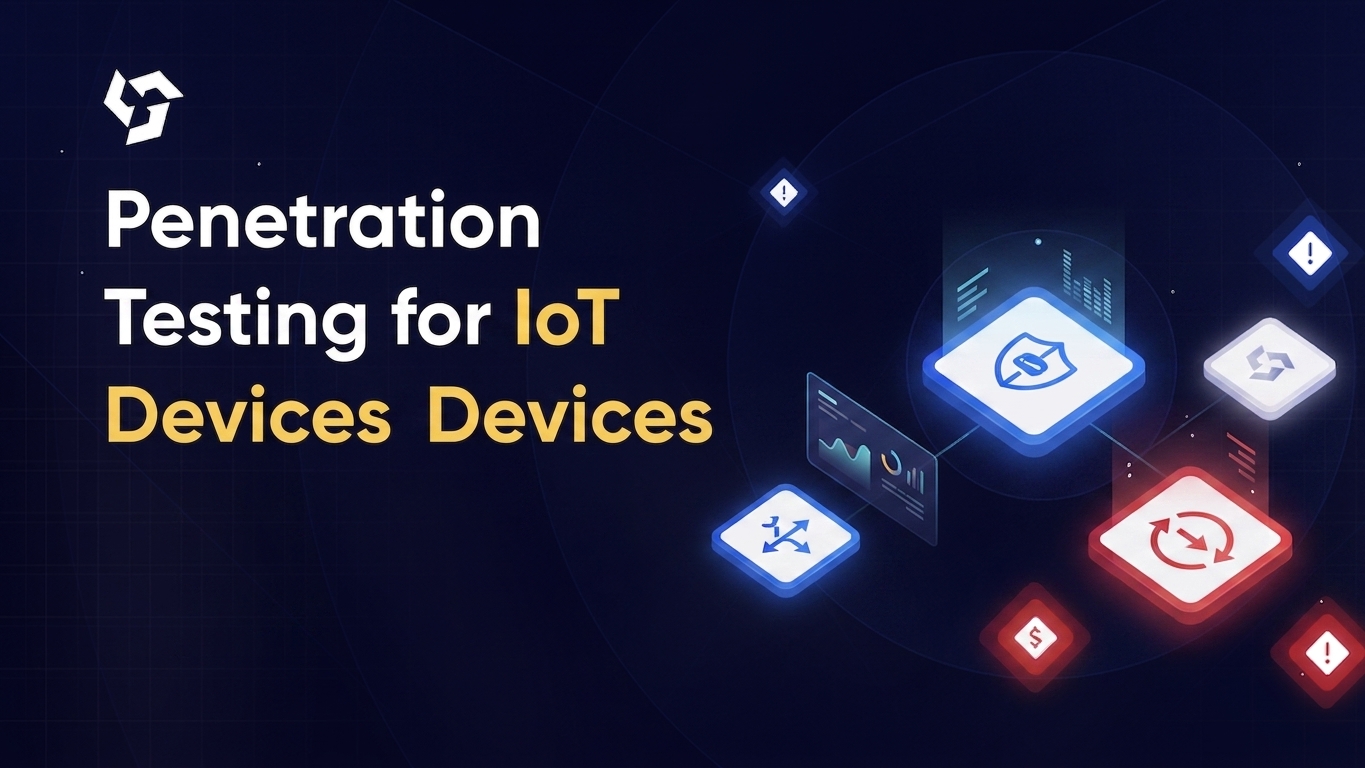
IoT devices now sit inside every layer of the logistics stack: GPS trackers, electronic logging devices (ELDs), cold-chain sensors, RFID tags, telematics gateways, and warehouse robotics controllers. Each one is a network endpoint with firmware, a radio interface, and a cloud backend — and each one is a potential entry point into fleet management systems, cargo data, and customer PII.
TL;DR
- Penetration testing for IoT logistics devices must cover firmware, RF protocols, backend APIs, and device identity — not just the app layer.
- AppSecure Security scopes IoT logistics assessments around firmware extraction, wireless protocol testing, and cloud API abuse, with manual exploitation over automated scanning.
- ELD-integrated fleets fall under FMCSA technical requirements (49 CFR Part 395 Subpart B) — scanner-only reports do not satisfy audit evidence expectations.
- Skip vendors who quote a single flat rate without naming firmware, RF, and API as separate testing tracks — that signals scanner-based coverage.
- Cellular IoT modules (LTE-M, NB-IoT) and BLE beacons require RF-capable testers, not standard web app pentesters relabeled for IoT work.
Why This Matters
A compromised IoT logistics device is rarely an isolated incident. Fleet trackers, ELDs, and cold-chain sensors feed data directly into transportation management systems (TMS), billing platforms, and customer-facing tracking portals. A single hardcoded credential on a telematics gateway can expose an entire fleet's location data, driver PII, and cargo manifests.
Regulatory exposure compounds the business risk. ELD manufacturers operate under FMCSA technical specifications. Cold-chain providers handling pharmaceutical or food shipments answer to FDA and USDA traceability rules. Any logistics IoT stack that touches payment card data for cash-on-delivery or freight billing falls under PCI DSS Requirement 11.3, which mandates annual internal and external penetration testing plus retesting after significant changes.
Automated vulnerability scanners cannot test firmware logic, RF protocol implementation, or the business logic that ties a device ID to a shipment record. That gap is exactly where logistics-specific breaches originate — cloned device identities, spoofed GPS coordinates, and API endpoints that trust device-reported data without server-side validation. Penetration testing services built for connected hardware close that gap; generic web app testing does not.
Who This Is For
This guide is for security and engineering leaders responsible for connected fleet and warehouse hardware: CISOs and CTOs at 3PL and 4PL providers, engineering leads at ELD and telematics manufacturers, product security owners at cold-chain sensor vendors, and compliance managers at freight brokers integrating IoT data into TMS platforms. If your organization ships or operates GPS trackers, telematics gateways, RFID readers, cold-chain sensors, or warehouse automation controllers, the criteria below apply directly to your next testing engagement.
What to Look For in Penetration Testing for IoT Logistics Devices
Firmware and Hardware-Level Testing Capability
Firmware holds hardcoded credentials, private keys, and debug interfaces that scanners never see. A tester needs to extract firmware — via UART, JTAG, SPI flash dumps, or OTA update interception — and reverse-engineer the binary for embedded secrets and logic flaws.
This matters because firmware vulnerabilities persist across an entire device fleet simultaneously. A single hardcoded API key found in one tracker's firmware image is present in every unit shipped with that firmware version, turning a device-level finding into a fleet-wide exposure.
Wireless and Radio Protocol Coverage
Logistics IoT devices communicate over BLE, LoRaWAN, Zigbee, and cellular IoT protocols (LTE-M, NB-IoT, 2G/3G fallback). Each protocol has distinct authentication, pairing, and encryption weaknesses that require RF-capable tooling — software-defined radios, protocol analyzers, and BLE sniffing hardware.
A provider that only tests the mobile app and cloud dashboard has not tested the device's actual attack surface. RF testing uncovers replay attacks, downgrade attacks to unencrypted 2G fallback, and BLE pairing bypass — issues that never appear in a web-focused engagement scope.
Cloud Backend and API Security Testing
Every IoT device reports to a backend — usually via MQTT, CoAP, or REST APIs. The backend is the highest-value target because it aggregates data across the entire fleet. Testing must cover broken object-level authorization (BOLA), device-to-tenant isolation, and whether the API trusts device-reported telemetry without server-side validation.
A fleet tracker that reports its own GPS coordinates without signature verification lets an attacker spoof location data for an entire shipment — a direct cargo-theft enabler. This is business logic testing, not a scanner check.
Device Identity, Provisioning, and Certificate Management Testing
Device provisioning determines how a physical unit gets an identity — typically X.509 certificates, pre-shared keys, or API tokens issued at manufacturing or first boot. Weak provisioning lets an attacker clone a device identity and inject falsified telemetry as a trusted unit.
Testers need to assess certificate lifecycle management: rotation, revocation on device decommission, and whether a single compromised device certificate grants broader fleet access. This is a supply-chain risk multiplier when devices are provisioned in bulk by a third-party manufacturer.
Fleet-Scale and Supply Chain Attack Path Testing
Logistics fleets deploy thousands of identical devices. A finding scoped to "one tracker" is meaningless — the real question is whether that finding scales to the entire deployed fleet and whether the manufacturing supply chain introduces additional exposure (contract manufacturers with firmware access, third-party component firmware, OTA update servers).
Attack path testing should model what happens after initial device compromise: lateral movement into the TMS, access to driver PII, or persistence through the OTA update mechanism.
Regulatory and Compliance Alignment
ELD manufacturers must align testing scope to FMCSA's ELD technical specifications under 49 CFR Part 395 Subpart B. Cold-chain and payment-adjacent logistics IoT stacks may fall under PCI DSS, ISO 27001, or SOC 2 depending on data handled. A provider unfamiliar with these frameworks will produce a report that satisfies neither engineering nor audit requirements.
What to Look For — Checklist
- Firmware extraction and reverse engineering capability
- RF protocol coverage (BLE, LoRaWAN, Zigbee, cellular)
- Backend API and BOLA testing across device-to-tenant boundaries
- Device provisioning and certificate lifecycle assessment
- Fleet-scale attack path modeling, not single-device findings
- Compliance mapping to FMCSA, PCI DSS, ISO 27001, or SOC 2 as applicable
Testing Scopes to Prioritize
Firmware Extraction and Reverse Engineering — the foundation
Firmware analysis surfaces hardcoded credentials, insecure bootloaders, and OTA signature-verification gaps. A single unsigned OTA update mechanism lets an attacker push malicious firmware to every device in the fleet that checks in for an update.
Verdict: Mandatory. Skip this and the assessment tests only the surface layer of the device.
RF and Wireless Protocol Testing — the blind spot
Most pentest vendors quote IoT work without RF-specific tooling. Cellular downgrade attacks (forcing a device to fall back to unencrypted 2G), BLE pairing bypass, and LoRaWAN join-request replay all require radio-capable testers.
Verdict: Mandatory for any device with a wireless interface — which is nearly all logistics IoT hardware.
Backend API and Cloud Dashboard Testing — the highest-value target
The backend aggregates every device's data. BOLA testing, tenant isolation checks, and telemetry-trust validation belong here. This overlaps significantly with API security testing practices used in telecom network penetration testing, where signaling and backend trust boundaries carry similar risk profiles.
Verdict: Mandatory.
Device Identity and Provisioning Testing — the identity layer
Certificate cloning, weak pre-shared keys, and unrevoked credentials on decommissioned units are common findings. This scope catches issues that let one compromised device impersonate another across the fleet.
Verdict: Recommended for any deployment provisioning more than a few hundred units, Mandatory for fleets over 1,000 units where identity compromise scales fastest.
Physical Tamper and Hardware Debug Port Testing — the assumed-safe layer
Exposed UART or JTAG headers on a tracker mounted in an unattended vehicle are a physical access risk. Testing whether debug interfaces are disabled in production firmware, not just documented as "should be disabled," catches configuration drift between engineering builds and shipped units.
Verdict: Recommended for devices with physical access exposure (vehicle-mounted, warehouse floor); Optional for fully enclosed, tamper-sealed sensor units with no field access.
What to Avoid
- A single flat-rate quote covering "IoT security testing" with no named tracks. If firmware, RF, and API testing aren't listed as distinct scopes with distinct methodology, the engagement is scanner-based, not manual.
- A provider that tests the mobile companion app but not the device itself. Mobile app testing matters — see how AppSecure Security approaches mobile app penetration testing for fintech apps as a reference methodology — but it is not a substitute for firmware and RF testing on the physical device.
- A report with CVSS scores and no exploitation narrative. A finding like "hardcoded API key in firmware" needs proof of exploitation — what an attacker can actually do with it across the fleet — not just a severity number.
If a device's firmware can't be pulled and analyzed offline, the pentest scope is incomplete.
Verdict Comparison Table
Firmware extraction & reverse engineering
- Business Risk If Skipped: Hardcoded credentials, insecure OTA
- Fleet-Scale Impact: High — affects every unit on that firmware version
- Verdict: Mandatory
RF/wireless protocol testing
- Business Risk If Skipped: Replay, downgrade, pairing bypass
- Fleet-Scale Impact: High — affects all units using that protocol
- Verdict: Mandatory
Backend API & BOLA testing
- Business Risk If Skipped: Cross-tenant data exposure, spoofed telemetry
- Fleet-Scale Impact: High — single API flaw exposes entire fleet
- Verdict: Mandatory
Device identity & provisioning
- Business Risk If Skipped: Device cloning, credential reuse
- Fleet-Scale Impact: Medium to High — scales with fleet size
- Verdict: Recommended/Mandatory over 1,000 units
Physical tamper & debug port testing
- Business Risk If Skipped: Local device compromise via exposed headers
- Fleet-Scale Impact: Low to Medium — limited to physically accessible units
- Verdict: Recommended for field-exposed devices
Compliance Mapping for IoT Logistics Testing
FMCSA ELD Technical Specifications (49 CFR Part 395 Subpart B)
- What It Requires: Tamper-resistance and data integrity for ELDs
- Testing Implication: Firmware tamper testing, data integrity validation on logged hours-of-service data
PCI DSS Requirement 11.3
- What It Requires: Annual internal and external penetration testing
- Testing Implication: Applies when IoT devices process or transmit cardholder data (COD terminals, freight billing)
ISO 27001 Annex A.8.16
- What It Requires: Monitoring and detection of anomalous activity
- Testing Implication: Backend logging and detection testing across device fleets
SOC 2 (Security/Availability criteria)
- What It Requires: Evidence of periodic security testing
- Testing Implication: Documented pentest reports with remediation evidence for auditors
Scope an IoT logistics pentest
Firmware, RF, and API testing tracks scoped to your fleet.
FAQ
What is penetration testing for IoT logistics devices?
It is manual security testing of connected logistics hardware — GPS trackers, ELDs, cold-chain sensors, telematics gateways — covering firmware, wireless protocols, backend APIs, and device identity. It goes beyond automated scanning to test exploitable attack paths across the device and its cloud backend.
Do ELDs require penetration testing under FMCSA rules?
FMCSA technical specifications under 49 CFR Part 395 Subpart B require tamper-resistance and data integrity for electronic logging devices. Manufacturers use penetration testing to demonstrate and validate that tamper-resistance in practice, not just in design documentation.
How is IoT device testing different from web app penetration testing?
IoT testing adds firmware reverse engineering, hardware debug port analysis, and RF protocol testing on top of standard API and backend testing. A web app pentest alone misses firmware-level and radio-level vulnerabilities entirely.
What wireless protocols need testing on logistics IoT devices?
BLE, LoRaWAN, Zigbee, and cellular IoT protocols including LTE-M and NB-IoT all require protocol-specific testing. Each has distinct pairing, authentication, and encryption weaknesses that generic network testing does not cover.
Is PCI DSS relevant to IoT logistics devices?
Yes, when devices process or transmit cardholder data, such as cash-on-delivery terminals or integrated freight billing systems. PCI DSS Requirement 11.3 then mandates annual internal and external penetration testing plus retesting after significant changes.
How often should IoT logistics devices be pentested?
Annually at minimum, and after any firmware update, new hardware revision, or backend API change. Fleets deploying new device batches should retest provisioning and identity management specifically, since manufacturing changes introduce new supply chain risk.
Can automated scanners replace manual IoT penetration testing?
No. Scanners cannot extract or reverse-engineer firmware, cannot test RF protocol implementations, and cannot validate business logic like device-to-shipment trust relationships. Manual testing finds the exploitable paths that scanners report as informational at best.
What does a fleet-scale IoT vulnerability look like?
A hardcoded credential or unsigned OTA update found in one device's firmware typically exists across every unit running that firmware version. A single finding can therefore represent an exposure across an entire deployed fleet, not one device.
Does cold-chain IoT monitoring need different testing than fleet trackers?
The core testing scopes overlap — firmware, RF, API, identity — but cold-chain sensors carry additional data integrity requirements tied to FDA and USDA traceability rules for pharmaceutical and food shipments. Testing should validate that sensor data cannot be spoofed or replayed to mask temperature excursions.
One Last Thing
The most overlooked finding in IoT logistics assessments is not the device itself — it's the OTA update mechanism. An unsigned or weakly-validated firmware update channel turns a single compromised update server into a fleet-wide compromise vector, and it rarely shows up unless the update flow is tested end-to-end during the engagement, not just documented as "HTTPS-encrypted."
Related Guides
.avif)
Founder & CEO @ Appsecure Security


.png)












.webp)
_%20Examples%2C%20Impact%20%26%20How%20to%20Fix%20Them.webp)
_.webp)




%20Tools%20vs%20Penetration%20Testing.webp)


.webp)

